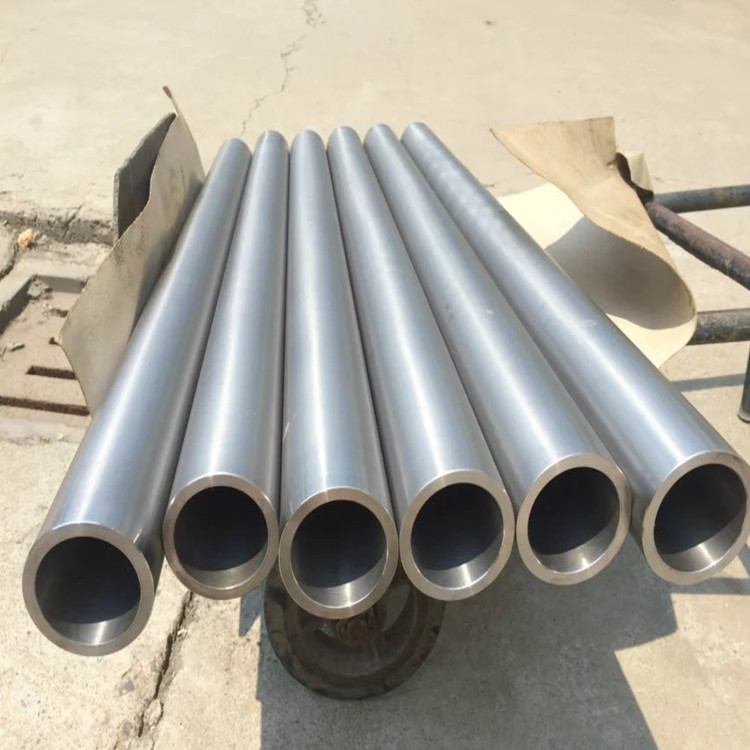
Inconel 600 is a nickel-chromium-iron alloy registered as UNS N06600. When it is drawn or rolled into tube form, the same heat of material is asked to do three things at once: hold its strength while hot, survive both oxidising and reducing media, and still bend, flare and weld after thousands of thermal cycles. No single metal delivers all three by accident. What makes Inconel 600 tube work is the balance between its chemistry, its cold-work level and the way it is finally annealed.
Below is what sits behind that balance, and where it stops being the right answer.
What Inconel 600 tube Is Made Of
Nickel does most of the work. At roughly 72%, it keeps the matrix austenitic, which means the tube stays tough instead of turning brittle at low temperature and does not undergo a ductile-to-brittle transition the way ferritic steels do. Chromium, at 14–17%, forms the surface oxide that stops further attack. Iron fills out the rest and adds ductility without hurting corrosion performance.
| Element |
Content |
What it does inside the tube |
| Nickel (Ni) |
72.0% min |
Holds the austenitic structure, resists chloride stress cracking, keeps toughness at cryogenic temperatures |
| Chromium (Cr) |
14.0–17.0% |
Builds the Cr2O3 scale that resists oxidation and high-temperature scaling |
| Iron (Fe) |
6.0–10.0% |
Adds ductility and keeps the alloy workable at a lower cost than pure nickel |
| Carbon (C) |
0.15% max |
Contributes creep strength; too much promotes carbide precipitation at grain boundaries |
| Manganese (Mn) |
1.0% max |
Deoxidation during melting, helps hot workability |
| Silicon (Si) |
0.5% max |
Deoxidation; excessive levels hurt weldability |
| Sulfur (S) |
0.015% max |
Kept low because sulfides become crack initiation points |
| Phosphorus (P) |
0.015% max |
Kept low for the same reason as sulfur |
| Copper (Cu) |
0.5% max |
Residual element; controlled to avoid altering corrosion behaviour |
The low sulfur and phosphorus ceilings matter more than they look. A tube with 0.020% sulfur instead of 0.010% can pass every tensile test and still crack during expansion into a tubesheet, because the sulfides act as stress raisers exactly where the wall is thinned.
How Inconel 600 tube Resists Corrosion
Four different mechanisms are at work, and buyers usually only need one or two of them for a given service.
Oxidation and scaling
Above roughly 700 °C, chromium migrates to the surface and forms a dense oxide that slows further oxygen diffusion. The scale adheres well under steady temperature, which is why furnace internals and radiant tubes last far longer in Inconel 600 than in 304 or 321 stainless.
Chloride stress corrosion cracking
This is the reason the alloy appears in so many marine and petrochemical specifications. Austenitic stainless steels crack in chloride environments when three conditions line up: chloride, tensile stress and temperature above about 60 °C. With 72% nickel, Inconel 600 tolerates far higher chloride levels and temperatures before that combination becomes dangerous.
High-temperature water and steam
In pressurised water reactor circuits the tube sees deaerated high-purity water at 300–350 °C. The alloy resists general corrosion in that environment and was, for decades, the standard steam generator tube material.
Acids and alkalis
Performance in acids depends heavily on whether the medium is oxidising or reducing. Inconel 600 handles nitric acid and many organic acids well, and is resistant to caustic solutions where stainless steels suffer caustic cracking. In strongly reducing acids such as hydrochloric or sulfuric, a molybdenum-bearing alloy is a better fit.
One limitation worth knowing before specifying: sulfur-bearing reducing atmospheres attack nickel-rich alloys. Where the process gas contains H2S, service temperature is usually capped well below the oxidation limit.
Inconel 600 tube Mechanical Properties
| Property |
Typical value at room temperature |
| Tensile strength |
550–690 MPa (80–100 ksi) |
| Yield strength (0.2% offset) |
240–415 MPa (35–60 ksi) |
| Elongation in 50 mm |
30–45% |
| Hardness |
88 HRB max, annealed condition |
| Modulus of elasticity |
approx. 207 GPa at 20 °C |
| Density |
8.47 g/cm³ |
These are annealed values. Cold drawing raises yield strength sharply, which is useful when the tube must resist internal pressure, but it also drops elongation and leaves residual stress that can feed stress-corrosion cracking later. That is why most specifications call for a final anneal and a hardness ceiling rather than a minimum.
At elevated temperature, creep becomes the controlling property. The alloy holds useful stress-rupture strength to about 700 °C, which is why it appears in superheater supports, retort tubes and reformer outlet lines.
Where Inconel 600 tube Reaches Its Temperature Limit
| Service condition |
Practical ceiling |
Reason for the limit |
| Continuous exposure in air |
approx. 1095 °C |
Protective chromium oxide stays intact |
| Intermittent exposure in air |
approx. 980 °C |
Repeated cooling causes scale spalling |
| Steam and high-temperature water |
approx. 650 °C |
Strength and corrosion allowance in pressure parts |
| Reducing sulfur-bearing gas |
approx. 540 °C |
Nickel sulfidation rather than oxidation |
| Flowing aerated seawater |
Pitting-limited |
Chloride attack under moving, oxygen-rich flow |
Which Industries Use Inconel 600 tube
Chemical and petrochemical processing
Tubes carry acids, alkalis and mixed corrosive streams where stainless steels pit or crack. Heat exchangers and evaporators benefit from the combination of pressure strength and corrosion resistance at temperature, and reactor internals rely on the alloy where both high temperature and aggressive media appear in the same vessel.
Nuclear power
Steam generator tubing has been the single largest application for decades. The tube must survive high-purity water at 300–350 °C on one side and secondary-side chemistry on the other, under irradiation, for the design life of the plant. Fuel element cladding and internal structural components use the same material for similar reasons.
Aerospace and gas turbines
Combustion chamber liners, transition ducts and exhaust components use Inconel 600 tube where the wall must tolerate repeated thermal cycling without cracking. Oxidation resistance matters more than peak strength in these positions.
Heat treatment furnaces
Radiant tubes, muffle tubes, fans and roller assemblies run continuously at 850–1000 °C. The alloy resists both scaling and the carburising atmospheres common in case-hardening furnaces.
Power generation
Boiler tubing and heat exchange equipment in thermal plants rely on the alloy where steam-side oxidation and fire-side corrosion meet. Superheater and reheater supports use it because those parts run hotter than the tubes they hold.
Marine and offshore
Seawater cooling circuits, deck equipment and offshore extraction hardware benefit from chloride resistance. On a heat exchanger, an Inconel 600 tube is frequently supplied as a bended integral finned tube when the surface area on the air or gas side has to be increased without adding a separate fin bond.
Pharmaceutical and food processing
Evaporators, heaters and reaction vessels need a surface that will not contaminate the product and will survive clean-in-place chemicals. Inconel 600 gives a passive, stable surface under repeated hot caustic and acid cleaning.
Oil and gas
Refinery cracking furnaces, transfer lines and high-pressure corrosive service use the alloy where carbon steel would scale away and stainless would crack. Downstream heat exchangers handling sour or chloride-bearing streams are a common application.
Which Standards Inconel 600 tube Follows
| Standard |
Scope |
| ASTM B163 |
Seamless nickel alloy condenser and heat exchanger tubes |
| ASTM B167 |
Seamless nickel-chromium-iron alloy pipe and tube |
| ASTM B168 |
Nickel-chromium-iron alloy plate, sheet and strip |
| ASTM B829 |
General requirements for nickel and nickel alloy pipe and tube |
| ASME SB163 / SB167 / SB168 / SB829 |
Boiler and pressure vessel code equivalents |
| EN 10216-5 |
Seamless steel tubes for pressure purposes, stainless and nickel alloys |
| ISO 6207 |
Seamless nickel and nickel alloy tubes |
Which Grades Match Inconel 600 tube
| Designation system |
Equivalent |
| UNS (United States) |
N06600 |
| Werkstoffnummer (Germany) |
2.4816 |
| British Standard |
NA 14 |
| Chinese GB/T 15007 |
NCr15Fe |
| AFNOR (France) |
NC15Fe |
How Inconel 600 tube Is Produced
Two routes reach the same specification. Seamless tube is pierced and pilgered or cold drawn from a hollow billet, which removes any longitudinal weld from the pressure boundary and is the usual choice for heat exchangers and steam generators. Welded tube is formed from strip and continuously welded, then cold drawn to final size; the weld is normalised by the drawing and annealing sequence but the seam still exists, so welded product is normally limited to lower-pressure duties.
Heat treatment follows forming. Annealing between 1010 and 1050 °C and rapid cooling puts carbides back into solution and restores ductility. Slow cooling through the 500–870 °C band is avoided because it precipitates chromium carbides at grain boundaries, which lowers corrosion resistance along those boundaries.
Customisation commonly covers outside diameter, wall thickness, length, straightness, surface finish and end preparation. Tubes destined for expansion into a tubesheet are usually supplied with a controlled hardness range, and tubes for bending are ordered with a minimum elongation so the outside wall of the bend does not thin below the design allowance.
Inconel 600 tube Against Other Nickel Alloys
| Grade |
Nickel |
Chromium |
Other |
Where it wins |
| Inconel 600 |
72% |
15.5% |
Fe balance |
Chloride stress cracking, caustic service, high-temperature water |
| Inconel 601 |
60.5% |
23% |
1.4% Al |
Higher oxidation resistance at 1100–1200 °C |
| Inconel 625 |
61% |
21.5% |
9% Mo, 3.6% Nb |
Flowing seawater, reducing acids, pitting |
| Incoloy 800H |
32% |
21% |
Fe balance, Ti/Al |
Creep strength above 700 °C at lower cost |
The choice usually turns on one question: is the aggressive agent chloride, or is it a reducing acid? Chloride points to Inconel 600 or 625; reducing acid points to 625. If the problem is simply higher oxidation temperature, 601 gives more chromium for less money than 625.
What Goes Wrong During Fabrication
Welding
The alloy is more sluggish than carbon steel and conducts heat poorly, so heat concentrates at the joint. Low heat input, stringer beads, interpass temperature below 150 °C and ERNiCr-3 filler keep the weld sound. Preheating is unnecessary and post-weld heat treatment is normally not required unless the service is in the sensitising temperature band.
Machining
Inconel 600 work-hardens under the tool, so a light finishing pass over a previously work-hardened surface will wear the insert rather than cut. Heavy feed, low speed, rigid tooling and no dwelling in the cut are the usual rules.
Pickling and passivation
After welding, oxide colour on the heat-affected zone should be removed mechanically or with a nickel-alloy pickling paste. Leaving a chromium-depleted, oxide-covered zone in place creates a starting point for corrosion in service.
Bending and expansion
Bend radius, wall thinning and ovality all need to be checked against the specification. Tube rolling into a tubesheet needs a hardness-controlled tube; over-rolling work-hardens the wall and can crack it.
Questions About Inconel 600 tube
Is Inconel 600 tube the same as Incoloy 600 tube?
Yes. The material is a nickel-chromium-iron alloy registered as UNS N06600. Inconel 600 is the correct trade name; Incoloy 600 appears often in search results but is not the designation used by the alloys producer, so drawings and purchase orders should always state Inconel 600 or UNS N06600.
How hot can Inconel 600 tube run in service?
In air, a continuous oxide film stays intact up to roughly 1095 °C. Intermittent cycling lowers the practical ceiling to about 980 °C because the scale spalls when the tube cools and reheats. Pressure-retaining parts sit far below those figures, since the applicable design code governs the allowable stress rather than oxidation alone.
Why does Inconel 600 tube need annealing after cold working?
Drawing and bending raise dislocation density, which lifts yield strength but cuts elongation and raises residual stress. An anneal around 1010 to 1050 °C followed by rapid cooling dissolves carbides back into solution, restores ductility and keeps the tube suitable for further forming or for flaring and rolling into a tubesheet.
Which filler metal is used to weld Inconel 600 tube?
Gas tungsten arc welding with ERNiCr-3 filler is the usual choice for tube-to-tubesheet and butt joints. The joint should be made in the annealed condition, with low heat input, interpass temperature kept under 150 °C and no preheat, because the alloy work-hardens quickly and is prone to hot cracking when restrained.
Does Inconel 600 tube resist seawater?
It tolerates chloride-bearing water better than 304 or 316 stainless and is common in marine and offshore work, but moving, aerated seawater can still pit it. For continuously flowing seawater circuits, a molybdenum-bearing alloy such as 625 or a copper-nickel grade usually gives a longer service life.