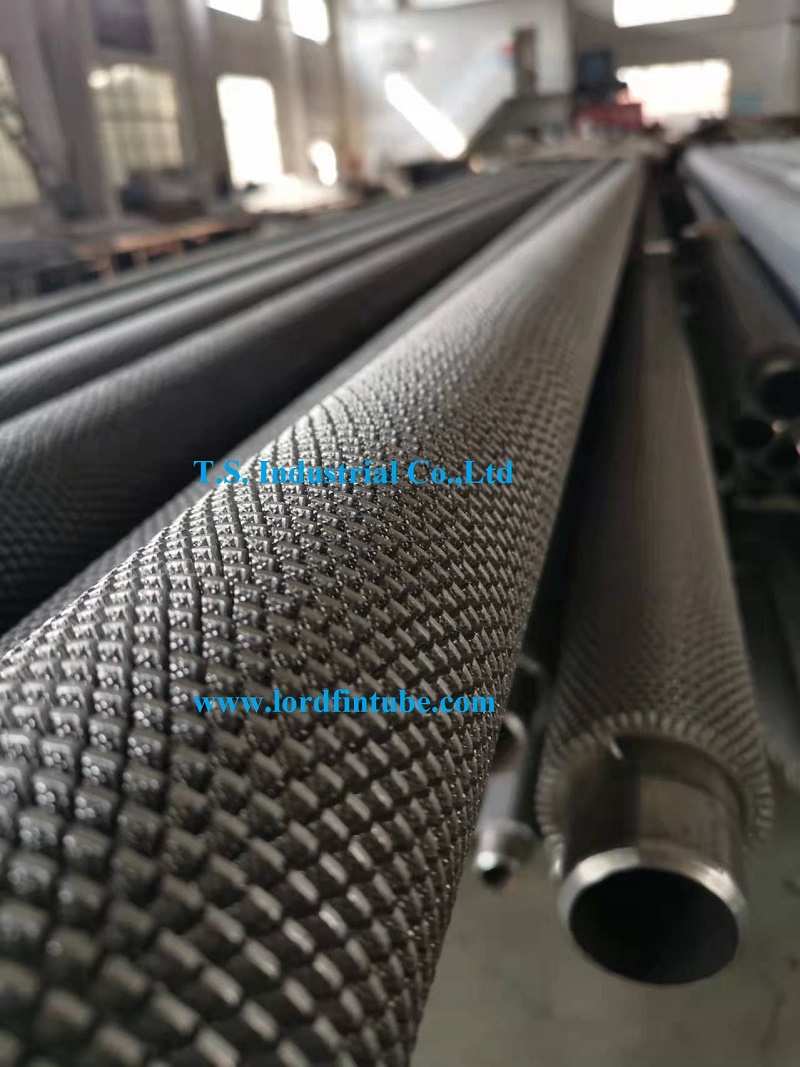

High-frequency welded spiral finned tube
High-frequency welded spiral finned tubes are precision-manufactured products produced using advanced fin tube production lines from South Korea. These tubes are designed to meet national or foreign standards and can also be manufactured according to non-standard specifications to fulfill customer requirements for mass production.
What is High-frequency welded spiral finned tube
A High-frequency welded spiral finned tube is a heat-exchange component where continuous spiral fins are permanently bonded to a base tube using high-frequency resistance welding. This metallurgical bond ensures virtually zero thermal contact resistance, which directly translates into higher heat transfer rates compared to mechanically bonded alternatives. The welding process fuses the fin strip and the tube surface at the molecular level, creating a joint that withstands thermal cycling, mechanical vibration, and pressure fluctuations without degradation. Engineers select this tube type when they need compact heat exchangers that deliver maximum surface area within limited spatial envelopes, particularly in forced-convection and natural-convection systems where every square meter of heat-transfer surface counts.
Which parameters define the performance of a High-frequency welded spiral finned tube? The fin height, fin pitch, tube diameter, and wall thickness collectively determine the thermal-hydraulic behaviour. A taller fin increases the extended surface area but may reduce the fin efficiency if the material conductivity or thickness is insufficient. A tighter pitch packs more fins per unit length, boosting the total area while increasing the airflow pressure drop. The helix angle influences the swirl and turbulence of the gas stream, which can enhance the convective heat transfer coefficient on the fin side. These interdependent variables allow designers to tailor the tube for specific operating conditions, whether the goal is to recover waste heat from flue gases, cool process fluids, or preheat combustion air in industrial furnaces.
How to produce high-frequency welded spiral finned tube
Producing high-frequency welded spiral finned tubes involves a meticulously engineered process aimed at ensuring a durable and effective bond between the fins and the tube.
► 1. High-Frequency Resistance Welding: This advanced welding technique is central to the production process, guaranteeing a robust connection between the spiral fins and the tube. Carefully calibrated, it optimizes heat dissipation, particularly beneficial in civil building heating systems reliant on natural convection mechanisms, thereby encouraging widespread adoption.
► 2. Advantages: High-frequency resistance welded spiral finned tubes offer a plethora of benefits, including exceptional pressure resistance, minimal leakage, efficient heat dissipation, a compact structure, and a design that conserves materials. These attributes make them the preferred choice for enhancing heat transfer in industrial boilers, power station boilers, medium heat pipes, and fuel gas boiler applications.
► 3. Welding Technique Efficacy: The high-frequency resistance welding technique capitalizes on the elevated temperatures generated by the high-frequency effect, prompting material fusion under external pressure. This results in superior metal contact surfaces, minimal thermal resistance, reduced heat loss, an increased fin thermalization coefficient, expanded heat transfer area, and heightened heat transfer efficiency. Their total heat transfer coefficient surpasses that of bare pipes by 4-8 times, with a welding success rate exceeding 98%.
► 4. Versatile Applications: High-frequency resistance welded spiral finned tubes find wide-ranging applications across industries such as petroleum, chemical, boiler manufacturing, metallurgy, textile, drying, cooling, and various industrial furnaces. They are utilized in heat exchangers, heat recovery devices, air coolers, heaters, economizers, and civil heating equipment, serving as indispensable components for facilitating superior heat transfer.
By integrating scientific precision, material optimization, and advanced welding techniques, high-frequency resistance welded spiral finned tubes emerge as essential assets across a spectrum of industrial and civil heating applications.
Manufacturing parameters of High-frequency welded spiral finned tube
► 1. Tube Material Selection: The base tube material is typically chosen based on the specific application requirements, considering factors such as temperature, pressure, corrosion resistance, and mechanical properties.
► 2. Tube Diameter and Thickness: Determined based on the heat transfer requirements and the size limitations of the application.
► 3. Finned Strip Material: The material of the finned strip is chosen based on factors such as compatibility with the base tube material, heat transfer efficiency, and corrosion resistance.
► 4. Finned Strip Thickness: Dictated by the desired fin height and strength requirements.
► 5. Finned Strip Width: Determined based on the desired fin density and surface area for heat transfer.
► 6. Pitch (Distance between Fins): The pitch is crucial for determining the number of fins per unit length, impacting heat transfer efficiency and pressure drop.
► 7. Helix Angle: The angle at which the fins are wound around the base tube affects the flow characteristics and heat transfer performance.
► 8. Welding Parameters: Parameters such as welding current, voltage, and speed are critical for ensuring proper fusion between the finned strip and the base tube, as well as maintaining the structural integrity of the finned tube.
► 9. Heat Treatment: Depending on the materials used and the desired properties, heat treatment processes such as annealing or stress relieving may be employed to improve the mechanical or metallurgical properties of the finished product.
Product Material: Carbon steel, stainless steel, alloy steel
Pipe Diameter: 25.4-219.08mm
Pipe Thickness: 2.0-10mm
Pipe Length: 3000-23000mm
Fin Thickness: 0.8-2.5mm
Fin Width: 10-25.4mm
Technical reference table for High-frequency welded spiral finned tube
Which combination of dimensions delivers the optimal balance between heat transfer area and pressure drop? The table below summarizes typical configurations used in industrial heat-recovery and process-heating systems. Values are indicative; final selections depend on the specific gas velocity, inlet temperature, fouling tendency, and allowable pressure loss for each project.
| Tube OD (mm) | Wall (mm) | Fin Height (mm) | Fin Pitch (mm) | Fin Thick (mm) | Area (m²/m) | Typical Application |
|---|---|---|---|---|---|---|
| 25.4 | 2.5 | 10 | 6 | 1.0 | 0.72 | Air heaters, small boilers |
| 38.0 | 3.0 | 12 | 8 | 1.2 | 1.05 | Waste heat recovery units |
| 51.0 | 3.5 | 14 | 10 | 1.5 | 1.48 | Power station economizers |
| 63.5 | 4.0 | 16 | 12 | 1.8 | 1.92 | Industrial furnaces, dryers |
| 76.0 | 4.5 | 18 | 14 | 2.0 | 2.35 | Petrochemical heaters |
| 89.0 | 5.0 | 20 | 16 | 2.2 | 2.81 | Gas turbine exhaust coolers |
How does the fin pitch influence the overall heat transfer coefficient? Reducing the pitch from 14 mm to 8 mm increases the fin density and the extended surface area per meter, but it also raises the gas-side pressure drop and may accelerate fouling in dusty streams. Engineers often use computational fluid dynamics to evaluate the trade-off between thermal performance and operating cost. For clean gas applications, tighter pitches are preferred; for flue gases with particulates, wider pitches with self-cleaning characteristics are more practical. The table above provides a starting point for preliminary sizing, and the final configuration is usually validated through full-scale testing or empirical correlations based on similar installations.
Applications of High-frequency welded spiral finned tube
Which industries rely on High-frequency welded spiral finned tubes for their thermal management needs? The list includes but is not limited to:
- Petroleum refining: Crude oil heaters, fractionator reboilers, and product coolers where high-temperature resistance and corrosion protection are critical.
- Chemical processing: Reactor cooling systems, condenser bundles, and vaporizers that handle aggressive media and require leak-proof fin-to-tube joints.
- Boiler manufacturing: Superheater elements, evaporator panels, and air preheaters in utility and industrial boilers, where the finned tubes boost thermal efficiency and reduce fuel consumption.
- Metallurgical plants: Annealing furnace recuperators, soaking pit heat exchangers, and sinter-cooler waste-heat boilers that operate under extreme thermal shocks.
- Textile and drying: Hot-air generators, stenter frame heating systems, and rotary dryers that demand uniform heat distribution and rapid response to load changes.
- Power generation: Heat recovery steam generators (HRSG), air-cooled condensers, and flue-gas desulphurization heaters where reliability and long service life are non-negotiable.
- Civil heating: District heating networks, large-scale radiator systems, and snow-melting installations that utilize natural-convection or forced-air distribution.
In each of these settings, the High-frequency welded spiral finned tube delivers a combination of high heat flux, mechanical robustness, and resistance to thermal fatigue. The welded joint eliminates the risk of fin loosening over time, which is a common failure mode in mechanically wound or embedded fin designs. This reliability makes it the preferred choice for critical applications where unscheduled downtime carries a high penalty.
Why High-frequency welded spiral finned tube
Why do procurement engineers and plant operators consistently specify High-frequency welded spiral finned tubes over other finned-tube types? The answer lies in four interconnected advantages that directly impact the bottom line: thermal performance, durability, design flexibility, and total cost of ownership.
► Thermal performance: The metallurgical bond achieved through high-frequency welding ensures that heat flows from the tube wall into the fin with minimal resistance. In contrast, mechanically bonded fins (such as tension-wrapped or embedded types) have an interfacial air gap or oxide layer that degrades over time. Field measurements show that a High-frequency welded spiral finned tube maintains more than 95% of its initial heat-transfer coefficient after 10 years of service, whereas mechanically bonded alternatives can lose 15–25% due to thermal cycling and vibration.
► Durability: The welded fin attachment withstands severe thermal transients, mechanical shocks, and erosive environments. High-frequency welding does not introduce filler materials that could corrode preferentially, and the heat-affected zone is narrow, preserving the base tubes mechanical properties. This translates into longer inspection intervals and fewer tube replacements over the plants lifetime.
► Design flexibility: Manufacturers can produce High-frequency welded spiral finned tubes in a wide range of diameters, wall thicknesses, fin geometries, and material grades. This flexibility allows engineers to optimize the heat exchanger for specific process conditions without being constrained by limited standard offerings. Non-standard specifications are readily accommodated, enabling custom solutions for retrofits or new builds.
► Cost of ownership: Although the initial cost of a High-frequency welded spiral finned tube may be slightly higher than that of a mechanically bonded tube, the total cost of ownership is often lower. Reduced fouling, stable heat transfer, and extended service life mean fewer cleaning cycles, less maintenance labor, and higher plant availability. In addition, the improved thermal efficiency reduces fuel or electricity consumption, providing a rapid payback on the incremental investment.
When selecting a finned tube for a new heat-exchanger project or a retrofit, engineers should compare the life-cycle cost rather than the upfront price. The High-frequency welded spiral finned tube consistently demonstrates a favourable cost-benefit ratio in applications where reliability and performance are paramount.