


ASME SA268 UNS S44660 (super ferritic S44600) Tube
Published: 14 August 2015
ASME SA 268 UNS44660 super ferritic stainless steel tube
Chloride-bearing cooling water forces a choice on almost every condenser project: an austenitic stainless steel that is cheap but carries pitting risk, or titanium that resists attack but costs more and brings its own fabrication headaches. ASME SA268 UNS S44660 sits between those two extremes, and at a growing number of stations it has stopped being a compromise and become the first pick.
What follows explains what the alloy actually is, why it holds up in chloride-rich water, which duties suit it, and how it behaves once it reaches the fabrication shop.
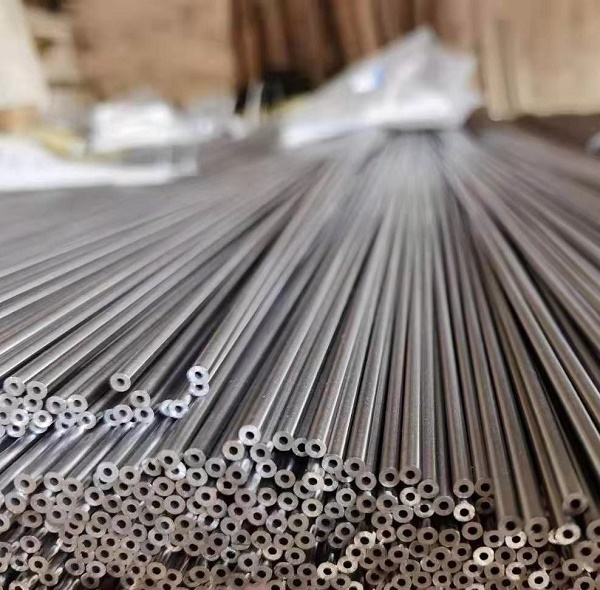
SA 268 UNS44660 super ferritic stainless steel tube
ASME SA268 UNS S44660
S44660 is the Unified Numbering System designation for a super ferritic stainless steel: a body-centred cubic structure carrying 25–27% chromium, 2.5–3.5% molybdenum, and stabilised with titanium and niobium. The ferritic matrix is what makes it immune to chloride stress corrosion cracking, while the chromium and molybdenum pairing is what lifts its resistance to pitting and crevice attack. Titanium and niobium lock up carbon and nitrogen so that welding does not strip corrosion resistance out of the heat affected zone.
The "super ferritic" prefix separates it from simpler ferritic grades such as TP405 and TP409. Those alloys rely mostly on chromium for protection and perform acceptably in mild fresh water, yet they struggle once chloride levels climb or temperature rises. The real dividing line is molybdenum. Roughly 3% of it changes how the surface behaves in seawater and brackish water, and that single addition explains why condensers built with ASME SA 268 UNS44660 tubes outlast comparable units running on basic ferritic material.
ASME SA268 UNS S44660 Chemistry and Mechanical Properties
Composition control drives everything else. The ranges below reflect what is normally written into a purchase specification for this grade.
| Element | Range | What it does in the alloy |
|---|---|---|
| C | 0.030 max | Kept low so toughness and weldability survive |
| Mn | 1.00 max | Residual from melting practice |
| Si | 1.00 max | Deoxidation during steelmaking |
| P | 0.040 max | Restricted for toughness |
| S | 0.030 max | Restricted to limit inclusion attack sites |
| Cr | 25.0 – 27.0 | Builds the passive film and anchors pitting resistance |
| Mo | 2.5 – 3.5 | Raises pitting and crevice corrosion resistance in chlorides |
| Ni | 1.0 – 3.5 | Improves toughness without turning the structure austenitic |
| Ti | 0.5 – 1.0 | Stabilises carbon and nitrogen |
| Nb | 0.25 – 0.50 | Stabilises carbon and refines grain size |
| N | 0.040 max | Capped to protect toughness |
| Cu | 0.50 max | Residual element |
Annealed tube delivers the following mechanical and physical values.
| Property | Metric | Imperial |
|---|---|---|
| Yield strength, 0.2% offset | 380 MPa min | 55 ksi min |
| Tensile strength | 550 MPa min | 80 ksi min |
| Elongation in 50 mm | 20% min | 20% min |
| Hardness | 25 HRC max | 25 HRC max |
| Modulus of elasticity | 200 GPa | 29 × 106 psi |
| Coefficient of linear expansion | 10.5 × 10⁻⁶/K | 5.8 × 10⁻⁶/°F |
| Thermal conductivity | 17 – 20 W/m·K | 118 – 139 BTU·in/hr·ft²·°F |
| Density | 7.7 g/cm³ | 0.278 lb/in³ |
ASME SA268 UNS S44660 Chloride Corrosion Behaviour
A widely used yardstick for molybdenum-bearing stainless steels is the pitting resistance equivalent number, calculated as PREN = %Cr + 3.3 × %Mo + 16 × %N. For S44660, roughly 26% chromium combined with about 3% molybdenum lands near 36. TP316L calculates out around 25. That gap shows up directly as a higher pitting potential, meaning S44660 tolerates hotter and more concentrated chloride water before breakdown begins.
Stress corrosion cracking behaves differently. Chloride SCC is fundamentally an austenitic failure mode — 300-series steels under tensile stress in a chloride environment crack transgranularly. A ferritic matrix does not crack that way, so S44660 is effectively immune to chloride stress corrosion cracking. For a tube bundle sitting in seawater or high-chloride cooling water, that single characteristic matters more than any strength figure.
Marine fouling creates a second, less obvious problem. Deposits from shellfish and algae generate crevices where flow stalls and chloride concentrates. A molybdenum-bearing super ferritic handles those stagnant pockets, whereas 316L in the same spot will often show crevice attack within a few operating cycles.
ASME SA268 UNS S44660 Against TP316L and Titanium Gr.2
Placing the three materials side by side makes the trade-offs visible.
| Attribute | UNS S44660 | TP316L | Titanium Gr.2 |
|---|---|---|---|
| PREN | ≈ 36 | ≈ 25 | Not applicable |
| Chloride SCC | Immune | Susceptible | Immune |
| Pitting resistance | High | Moderate | High |
| Modulus of elasticity | 200 GPa | 195 GPa | 103 GPa |
| Density | 7.7 g/cm³ | 8.0 g/cm³ | 4.5 g/cm³ |
| Thermal expansion | 10.5 × 10⁻⁶/K | 16.0 × 10⁻⁶/K | 8.6 × 10⁻⁶/K |
| Welding to other stainless steels | Straightforward | Straightforward | Requires shielding discipline |
| Hydrogen embrittlement | Not a concern | Not a concern | Recognised risk |
| Purchasing cost pattern | Moderate, stable | Low | High, volatile |
The stiffness row deserves attention. S44660 is nearly twice as stiff as titanium, so a bundle deflects less at the same support spacing and can safely span further between tube supports. On condensers that have fought vibration problems, that difference feeds straight back into the mechanical design.
Expansion behaviour matters too. At roughly 10.5 × 10⁻⁶/K, S44660 tracks carbon steel closely, while austenitic grades run about 40% higher. Rolling super ferritic tubes into a carbon steel tube sheet therefore produces far less differential stress than the same joint made with 316L.
On thermal conductivity, S44660 lands in the 17–20 W/m·K band, slightly ahead of TP316L, while titanium is higher still. In a real heat transfer calculation the tube wall accounts for a small share of total resistance, so pitting life rather than conductivity usually decides the total cost of ownership.
ASME SA268 UNS S44660 Welding and Fabrication
A shop already comfortable with 316L or duplex will not find S44660 unfamiliar, but heat input has to be watched.
TIG and plasma welding are the usual choices for tube-to-tube and tube-to-tubesheet joints. Resistance welding and laser welding work well for longitudinal seam tube production. Filler metal is normally a matching super ferritic composition such as ER44660, and in a few aggressive duties a nickel-base filler is substituted.
Preheating is neither needed nor helpful. Interpass temperature should stay below 150 °C. The real hazard appears after solution annealing: prolonged exposure between 400 °C and 500 °C triggers 475 °C embrittlement, and sigma phase forming in the 600–900 °C range degrades both toughness and corrosion resistance. Practically, that means keeping service temperature clear of the first window and avoiding post-weld heat treatment inside the second.
Cold forming goes smoothly, though springback runs higher than with 304 because the yield strength is greater, so bend radii need more allowance. Expanding and flaring are routine operations, and super ferritic tubes behave much like austenitic ones when rolled into a tube sheet.
ASME SA268 UNS S44660 Service Applications
- Power station condensers cooled by seawater or brackish water
- Feedwater heaters exposed to elevated chloride levels
- Brine heaters in multi-effect distillation and reverse osmosis desalination plants
- Refinery and chemical plant exchangers handling chloride-bearing streams
- Flue gas desulphurisation and flue gas heat recovery units
- Process piping, valves and fittings where stress corrosion cracking is the design driver
ASME SA268 UNS S44660 Questions
Can ASME SA268 UNS S44660 replace titanium tubing?
For most condensers running on chloride-bearing cooling water, yes. Service temperatures below roughly 150 °C with chloride levels up to about 19,000 ppm are the band where super ferritic tubes have accumulated long operating records. Titanium keeps an edge where hydrogen can be generated on the process side, but that situation is uncommon in power plant condensers.
What is the difference between UNS S44660 and UNS S44600?
They are two separate alloys. UNS S44660 is a molybdenum-bearing super ferritic grade with about 26% chromium, 3% molybdenum and titanium plus niobium stabilisation. UNS S44600 corresponds to type 446, which carries 23–27% chromium but no deliberate molybdenum addition. Removing that molybdenum drops pitting resistance to a lower band, which is why chloride-rich condensers specify S44660 rather than S44600.
Which sizes are normally available for ASME SA268 UNS S44660 tubes?
Both seamless and welded tubes are supplied. Outside diameters generally run from 12.7 mm to 38.1 mm, wall thickness from 0.7 mm to 2.11 mm, and straight lengths up to about 30 m depending on diameter and transport limits. Retubing projects are usually made to the existing tube sheet hole pattern so no drilling changes are required.
At what temperature does ASME SA268 UNS S44660 become brittle?
475 °C embrittlement develops after prolonged exposure between 400 °C and 500 °C, so continuous service should stay below that window. During fabrication, holding interpass temperature under 150 °C and avoiding post-weld heat treatment in the 600–900 °C range keeps sigma phase from forming and preserves both toughness and corrosion resistance.