


What is the Air-Cooled Aftercooler?
Air-Cooled Aftercooler
Compressed air is often called the "fourth utility" in industrial facilities, yet the air leaving a compressor is far from ready for use. It emerges hot—typically between 160°F and 212°F (70°C to 100°C)—and saturated with water vapor. Without proper treatment, this heat and moisture will corrode piping, damage pneumatic tools, and destroy downstream equipment like dryers and filters.
This is where the Air-Cooled Aftercooler comes in. It is the dedicated heat exchanger engineered to solve these problems immediately at the source.
What Is an Air-Cooled Aftercooler?
An air-cooled aftercooler is a heat exchanger installed directly after the air compressor. Its primary function is to cool the hot, saturated compressed air exiting the compressor, causing water vapor to condense into liquid so it can be removed from the system.
Unlike water-cooled alternatives that require a separate cooling water supply, air-cooled aftercoolers use ambient air as the cooling medium. A motor-driven fan forces cool air over a network of finned tubes through which the hot compressed air flows, dissipating heat and condensing moisture. The condensed liquid is then captured by a moisture separator and expelled through an automatic drain.
A typical air-cooled aftercooler will cool compressed air to approximately 10°C to 15°C (18°F to 27°F) above the ambient air temperature.
How Does an Air-Cooled Aftercooler Work?
The operation of an air-cooled aftercooler follows a straightforward yet highly effective process:
- Hot compressed air enters – Air leaving the compressor, still carrying heat from the compression process and saturated with water vapor, flows into the aftercoolers heat exchanger tubes. The compressed air travels through the inside of the tubes, while cooling air passes over the external surface of the tubes.
- Heat transfer occurs – An electric fan pushes cool ambient air across the finned tubes. The fins—typically made of aluminum or copper—dramatically increase the surface area available for heat exchange, maximizing thermal transfer. Heat moves from the hot compressed air inside the tubes to the cooler air flowing over the external finned surface.
- Condensation happens – As the compressed air cools, its ability to hold water vapor decreases. Water vapor condenses into liquid droplets, along with any oil vapor that may be present.
- Moisture is separated and drained – The condensed liquid is removed by a built-in separator—often a cyclonic or centrifugal design that spins the air, flinging droplets to the walls. The liquid then drains out through an automatic or manual drain valve.
- Cooled, drier air exits – The resulting compressed air is significantly cooler and has had up to 80% of its water vapor removed, ready for further treatment or immediate use.
The Heart of the System: The Heat Exchanger Core
At the center of every air-cooled aftercooler is the heat exchanger core—the component that does the actual work of transferring heat from the compressed air to the cooling air.
The core typically consists of a tube bundle—an assembly of multiple finned tubes secured by tube sheets at each end, with header boxes (inlet and outlet manifolds) attached to distribute the compressed air through the tubes. The finned tubes are the fundamental heat transfer elements, and their design directly determines the cooling efficiency, pressure drop, and overall performance of the aftercooler.
Finned tubes used in air-cooled aftercoolers can be classified into several types based on fin location, fin geometry, and manufacturing method. The three most common and important types are described below.
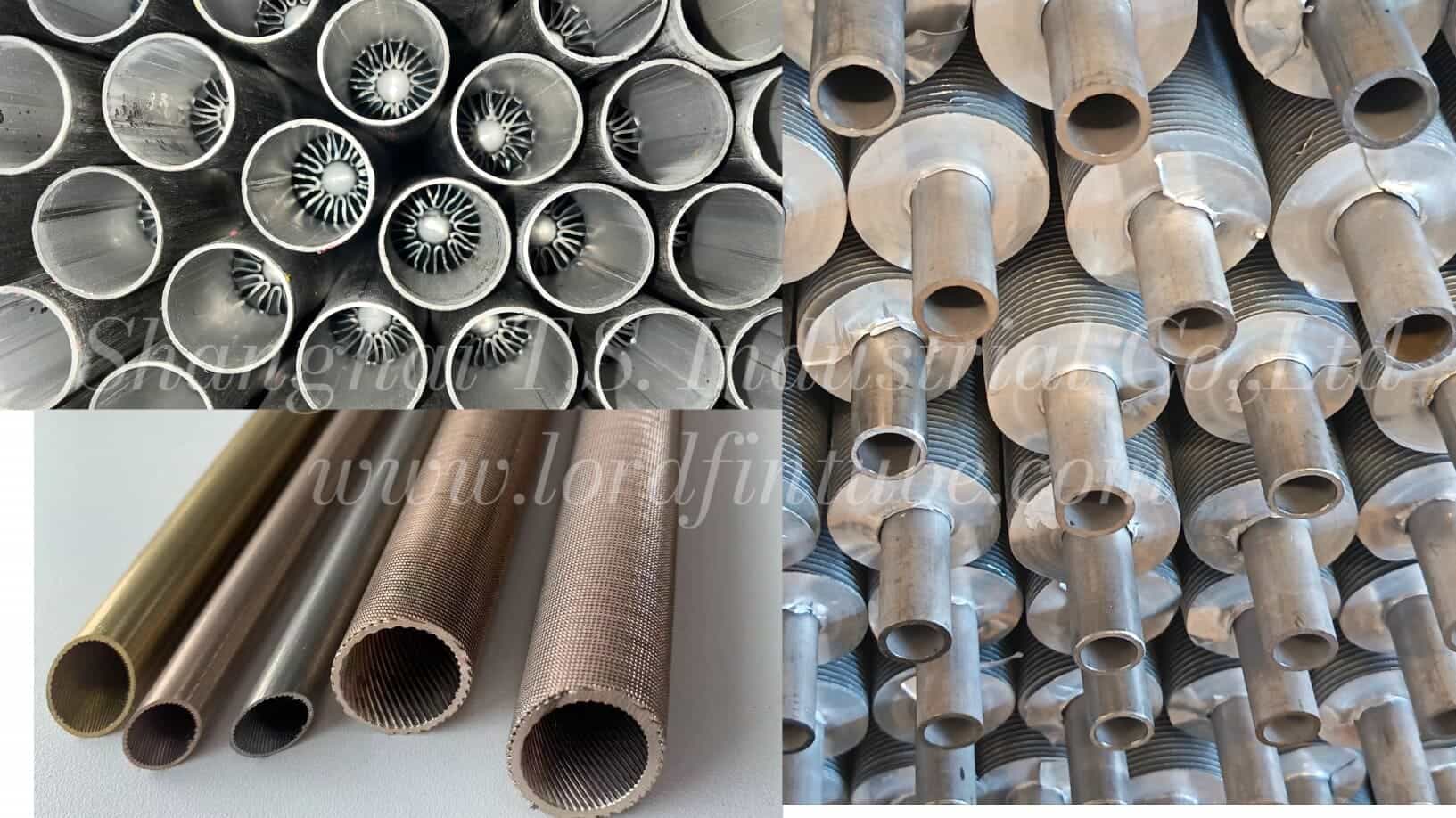
1. inner finned tubes
How They Work: Inner finned tubes feature a complex internal geometry—fins or ribs are formed on the inside surface of the tube. These internal fins increase the surface area in contact with the compressed air flowing through the tube, enhancing the heat transfer on the internal (air-side) of the tube.
Key Advantages:
- Significantly increases the internal heat transfer surface area—internal finning ratios can reach 4 to 6, and the internal heat transfer coefficient can be 3 to 4 times greater than that of a bare tube
- Particularly effective for gas-to-gas or gas-to-liquid heat exchange where the gas-side heat transfer coefficient is the limiting factor
- Allows for a more compact core design with higher heat transfer per unit volume
Typical Applications: Inner finned tubes are widely used in air compressor intercoolers and aftercoolers from major manufacturers such as Ingersoll Rand and Atlas Copco. They are also commonly found in air coolers and condensers where high-efficiency gas-side heat transfer is required.
Material Considerations: Copper is a common material for inner finned tubes due to its excellent thermal conductivity, though stainless steel and other alloys are also available depending on the operating environment and corrosion requirements.
Learn more about inner finned tubes.
2. aluminum finned tubes
How They Work: Aluminum finned tubes are the most prevalent type of finned tube used in air-cooled heat exchangers. An aluminum fin strip is mechanically bonded to a base tube (which may be made of carbon steel, stainless steel, copper, or other materials). The aluminum fins can be applied through various methods:
- L/LL/KL Type (Wrap-On): An L-shaped aluminum strip is wound tightly around the base tube, with the foot of the "L" locking into a pre-formed groove. This is economical for moderate-temperature applications up to approximately 150°C (300°F).
- G-Type (Embedded): A helical groove is cut into the base tube, and an aluminum fin strip is embedded under tension. This provides superior mechanical strength and can withstand temperatures up to 400°C (750°F).
- Extruded (Integral) Type: A bimetallic tube is used—an inner core surrounded by an outer aluminum sleeve, which is mechanically extruded into fins. This offers exceptional corrosion protection as the base tube is completely sealed from the atmosphere.
Key Advantages:
- Dramatically increases the external heat transfer surface area—integral finned tubes can increase the heat transfer area by 3 to 3.5 times compared to a plain tube
- Lightweight design reduces the overall weight of the heat exchanger
- Excellent corrosion resistance, especially with extruded fin designs where the aluminum fully encapsulates the base tube
- Cost-effective and widely available in various fin densities
Typical Applications: Aluminum finned tubes are the standard choice for air-cooled aftercoolers, air coolers, air heaters, and charge air chillers. They are extensively used in compressor cooling systems, refinery air coolers, and power generation applications.
Material Considerations: Aluminum fins are available in various series—1000 series for standard air cooling, and 5000/6000 series for higher strength and corrosion resistance in demanding environments.
Explore aluminum finned tubes.
3. low fin tubes
How They Work: Low fin tubes are produced by mechanically rolling or forming fins on the external surface of a plain tube. The fins are relatively low in height compared to standard finned tubes, with closely spaced fins that create a high fin density.
Key Advantages:
- Provides a larger external surface area while consuming the same amount of metal material as a bare tube
- High fin efficiency due to the relatively short fin height, meaning more of the fin surface actively contributes to heat transfer
- Lower air-side pressure drop compared to taller, more densely packed fin designs
- Cost-effective for applications where moderate enhancement is sufficient
Typical Applications: Low fin tubes are commonly used in condensers and evaporators of heat exchangers in air conditioning, refrigeration, and process heating systems. They are also found in oil coolers, dryers, and heaters in the chemical industry. In the context of air-cooled aftercoolers, low fin tubes are often employed when the required cooling duty is moderate and the emphasis is on balancing cost with performance.
Material Considerations: Low fin tubes can be manufactured from carbon steel, stainless steel, copper, or other alloys, with the material selection depending on the operating temperature, pressure, and corrosion environment.
View low fin tubes.
Selecting the Right Tube Type for Your Aftercooler
| Tube Type | Fin Location | Best For | Key Benefit |
|---|---|---|---|
| inner finned tubes | Inside the tube | Gas-side heat transfer limitation | Maximizes internal surface area; 3–4× higher internal heat transfer coefficient |
| aluminum finned tubes | Outside the tube | Standard air-cooling applications | Maximizes external surface area; lightweight; excellent corrosion resistance |
| low fin tubes | Outside the tube | Moderate-duty cooling | High fin efficiency; lower pressure drop; cost-effective |
In many air-cooled aftercooler designs, aluminum finned tubes are the default choice due to their excellent balance of cost, performance, and durability. However, for high-performance applications where the gas-side heat transfer is the bottleneck, inner finned tubes may be specified to enhance the internal heat transfer coefficient. For moderate-duty applications where cost sensitivity is paramount, low fin tubes offer a practical and economical solution.
Air-Cooled vs. Water-Cooled Aftercoolers: A Comparison
| Feature | Air-Cooled Aftercooler | water-cooled aftercoolers |
|---|---|---|
| Cooling Medium | Ambient air | Cooling water |
| Typical Outlet Temperature | 10–15°C above ambient | Lower and more stable, independent of ambient |
| Energy Cost | Fan electricity only | Water supply, pumping, and treatment |
| Installation | Simple; no water piping required | Requires water supply and return lines |
| Maintenance | Clean fins and check fan operation | Check for scale buildup, leaks, water flow |
| Best For | Moderate compressor sizes, water-scarce locations, ambient temps below 35°C (95°F) | Large systems, hot climates, precise temperature control |
| Maximum Pressure | Up to 250 psi | Up to 435 psi |
Key Benefits of Air-Cooled Aftercoolers
1. No Cooling Water Required
The most significant advantage is independence from cooling water systems. There is no risk of water supply interruption, freezing, or scaling. This makes air-cooled aftercoolers ideal for remote locations, arid climates, or facilities without existing cooling water infrastructure.
2. Lower Operating Costs
Cooling air is free. The only ongoing energy cost is the electricity required to run the cooling fan motor. There are no water bills, pumping costs, or water treatment expenses.
3. Simple Installation and Maintenance
Air-cooled aftercoolers have a relatively simple design. Installation does not require complex water piping. Routine maintenance primarily involves keeping the cooling fins and fan free of dust and debris.
4. Effective Moisture Removal
By cooling compressed air to within 10–15°C of ambient temperature, air-cooled aftercoolers remove 70% to 80% of the water vapor present. This significantly reduces the moisture load on downstream dryers, extending their life and reducing energy consumption.
5. Protects Downstream Equipment
Cooler, drier air means less corrosion in piping, longer life for valves and cylinders, and reduced wear on pneumatic tools. It also prevents the formation of rust and scale that can clog or damage equipment.
Selecting the Right Air-Cooled Aftercooler
Proper sizing is critical for optimal performance. Here are the key factors to consider:
- Compressor Horsepower and Flow Rate – The aftercooler must be sized to handle the full flow (SCFM or m³/h) of the compressor. Most manufacturers provide selection charts based on compressor horsepower.
- Inlet Temperature – The temperature of the compressed air entering the aftercooler must be known. Typical discharge temperatures range from 160°F to 212°F (70°C to 100°C).
- Approach Temperature – The approach temperature is the difference between the cooled air outlet temperature and the ambient air temperature. A lower approach indicates a more efficient (and typically larger) heat exchanger. Common approach temperatures are 5°F, 10°F, 15°F, or 20°F.
Formula: Outlet Temperature = Ambient Temperature + Approach Temperature. For example, with an ambient temperature of 85°F and a 15°F approach, the compressed air will exit at approximately 100°F. - Ambient Conditions – Always plan for the hottest day with 100% relative humidity. Air-cooled aftercoolers become less effective as ambient temperature rises, so sizing must account for worst-case conditions.
- Operating Pressure – Air-cooled aftercoolers are typically suitable for pressures up to 250 psi. Higher-pressure applications may require water-cooled alternatives.
Maintenance Best Practices
While air-cooled aftercoolers are relatively low-maintenance, regular attention ensures long-term reliability:
- Clean the cooling fins regularly – Dust, dirt, and debris accumulate on the fins, reducing heat transfer efficiency. Compressed air or a soft brush can be used to clean them.
- Check fan operation – Ensure the fan motor is running properly and that fan blades are free from obstructions.
- Inspect the core – Over time, the heat exchanger core can become clogged with oil deposits or dirt. If pressure drop becomes excessive, the core may need cleaning or replacement.
- Verify drain function – Ensure the automatic or manual drain is removing condensate properly.
- Look for air leaks – Check fittings and connections for leakage.
Why Quality Heat Exchanger Components Matter
The performance and longevity of an air-cooled aftercooler depend almost entirely on the quality of its heat exchanger core—specifically, the finned tube bundle that forms the heart of the cooling system.
Inferior materials or poor manufacturing can lead to:
- Reduced cooling efficiency
- Higher energy consumption
- Frequent breakdowns and downtime
- Premature failure and costly replacements
High-quality finned tube bundles—with proper fin design, optimal tube materials, and robust construction—ensure:
- Maximum heat transfer for lower outlet temperatures
- Corrosion resistance for long service life
- Reliable operation under demanding industrial conditions
- Easy replacement when service is eventually needed