


Lord Fin Tube-Bended integral finned tube
Bended Integral Finned Tube Overview
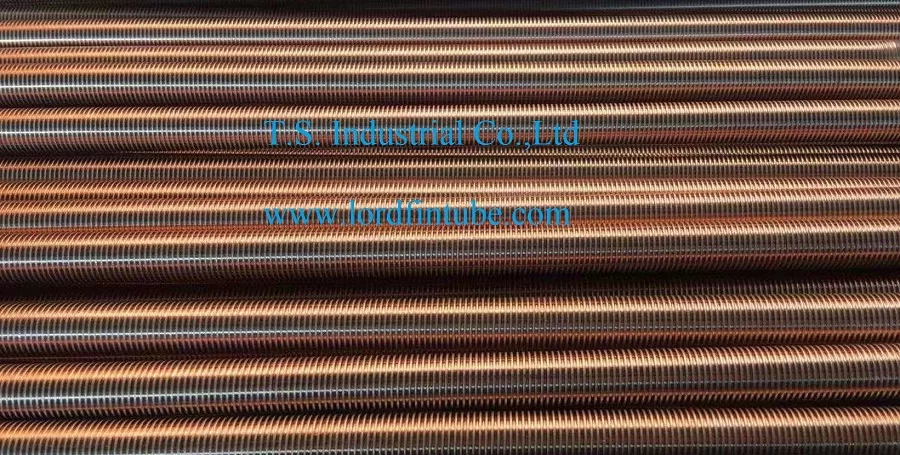
Bended integral finned tubes represent a specialized category of heat transfer components engineered for demanding industrial environments. These components integrate extruded fins directly onto the tube surface before precision bending, creating a unified structure that maintains thermal efficiency even after complex forming operations.
The manufacturing sequence begins with seamless or welded base tubes, typically carbon or alloy steel. Fins are extruded from the tube wall material using specialized equipment, ensuring metallurgical continuity between fin and tube. Following fin formation, tubes undergo controlled bending operations to achieve required configurations—U-bends, serpentine coils, or custom geometries—while preserving fin integrity.
Performance Characteristics
Surface area expansion ratios typically range from 3.6 to 4.35 times the bare tube exterior, with heat transfer enhancements of 1.6-2.0x compared to plain tubes. The integral construction eliminates thermal contact resistance inherent in attached fin designs, particularly valuable in high-temperature or corrosive service conditions.
Bended Integral Finned Tube Materials
Material selection for bended integral finned tubes depends on service conditions, thermal requirements, and environmental factors. The extrusion process for integral fins works with ductile materials capable of plastic deformation without cracking.
ASTM A179, A192, A210 for general service up to 450°C. Offer cost-effective solutions for non-corrosive applications with excellent thermal conductivity.
Chromium-molybdenum alloys (1.25Cr-0.5Mo, 2.25Cr-1Mo) for elevated temperature service with improved oxidation resistance and creep strength.
304/304L, 316/316L for corrosive environments. Require specialized tooling and process adjustments due to work hardening characteristics.
Selected nickel alloys and duplex stainless steels for severe service conditions, subject to material-specific feasibility evaluation.
Post-fin fabrication quality verification includes eddy current examination for material integrity. Supplementary testing—hydrostatic pressure tests, dimensional verification, and surface inspection—ensures compliance with project specifications. Custom material configurations undergo technical review to confirm manufacturing feasibility and performance expectations.
Bended Integral Finned Tube Manufacturing Process
The production of bended integral finned tubes follows a controlled sequence that maintains material properties while achieving precise geometrical requirements.
| Process Stage | Key Operations | Quality Controls |
|---|---|---|
| Base Tube Preparation | Material certification, dimensional verification, surface cleaning | Chemical analysis, wall thickness mapping, visual inspection |
| Fin Extrusion | Cold or warm extrusion using rotating tools, lubricant application | Fin height consistency, root thickness measurement, visual defect screening |
| Bending Operation | CNC mandrel bending, rotary draw bending, heat-assisted forming for tight radii | Radius verification, ovality checks, fin integrity assessment post-bending |
| Heat Treatment | Stress relief annealing, normalizing, or tempering based on material and application | Hardness testing, microstructural evaluation, dimensional stability verification |
| Final Processing | Straightening, cutting to length, end preparation, surface treatment | Final dimensional audit, NDE (dye penetrant, eddy current), pressure testing |
Bending considerations include minimum centerline radii based on tube OD and wall thickness. Standard practice maintains 2.5-3.0 x OD minimum bend radii for finned sections, with tighter radii achievable through process modifications. Bent regions may retain fins or feature plain sections based on application requirements and tooling constraints.
Heat treatment protocols address work hardening from fin extrusion and bending operations. Stress relief at 600-650°C for carbon steels restores ductility without significant microstructure alteration. Critical applications may require full normalizing or tempering cycles to achieve specified mechanical properties.
Bended Integral Finned Tube Applications
Bended integral finned tubes serve diverse industrial sectors where efficient heat transfer in constrained spaces or complex layouts provides operational advantages.
Crude preheat trains, product coolers, and reflux condensers utilize bent finned tubes to accommodate shell-and-tube exchanger layouts with multiple tube passes. The enhanced surface area reduces exchanger footprint while maintaining thermal duty.
Ethylene cracking furnace convection sections, aromatics plant heat recovery systems, and polymerization reactor cooling employ bent configurations to maximize tube count within fired heater boxes and compact heat recovery units.
Combined cycle plant heat recovery steam generators (HRSGs), feedwater heaters, and turbine oil coolers benefit from bent integral finned tubes ability to create efficient multi-pass arrangements in limited spaces.
Turbofan and centrifugal chiller evaporators/condensers utilize tight-radius bends to create compact coil arrangements with enhanced heat transfer for refrigerant phase change processes.
Beyond these primary applications, bended integral finned tubes find use in:
- Compressed air aftercoolers and intercoolers
- Lube oil cooling systems for large rotating equipment
- Process gas heaters and coolers in chemical plants
- Waste heat recovery units across manufacturing sectors
- Geothermal and solar thermal power components
Bended Integral Finned Tube Technical Specifications
Standard dimensional parameters for integral finned tubes provide baseline specifications for procurement and design activities. Custom configurations outside these ranges require technical consultation regarding manufacturing feasibility.
| Material Size Diameter/Thickness (avg) |
Number of Fins (Fins per 25.4mm) |
Fin Outside Diameter | Root Diameter | Bottom of Fin Minimum Thickness |
Outer Surface Area Average (m²/m) |
Ratio of Surface Area Outer/Inner |
Product Number |
|---|---|---|---|---|---|---|---|
| 15.88/1.91 | 19 | ≤15.98 | 12.70 | 1.27 | 12.34×10⁻² | 3.99 | |
| 15.88/2.11 | 1.47 | 4.18 | |||||
| 19.05/1.65 | ≤19.15 | 15.88 | 1.12 | 15.12×10⁻² | 3.60 | ||
| 19.05/1.91 | 1.27 | 3.69 | |||||
| 19.05/2.11 | 1.47 | 3.84 | |||||
| 19.05/2.28 | 1.65 | 3.94 | |||||
| 19.05/2.54 | 1.88 | 4.13 | |||||
| 19.05/2.77 | 2.13 | 4.35 | |||||
| 25.40/2.54 | ≤25.55 | 22.23 | 1.88 | 20.67×10⁻² | 3.65 | ||
| 25.40/2.77 | 2.13 | 3.83 | |||||
| 25.40/3.05 | 2.46 | 3.98 |
General Manufacturing Tolerances:
- Fin length tolerance: +10mm/-0mm or ±5mm as specified
- Minimum middle land length: 25±5mm
- Minimum end land length: 25±5mm
- Maximum imperfect fin length at tube ends: ≤120mm cumulative
- Maximum finned length: 19.5 meters (longer lengths subject to technical review)
Bended integral finned tube configurations maintain fin integrity through bending operations, with bent regions available as finned or plain sections based on application requirements. Post-bending heat treatment ensures dimensional stability and mechanical property retention.
Design Considerations for Optimal Performance
Successful implementation of bended integral finned tubes requires attention to several engineering factors. Fluid characteristics—including fouling propensity, particulate content, and corrosivity—influence fin geometry selection. Thermal-hydraulic calculations should account for bent section flow resistance and potential heat transfer coefficient variations. Mechanical design must consider differential thermal expansion between finned and plain sections, particularly in high-temperature cycling service. Installation practices should preserve fin integrity during handling and tube bundle assembly operations.
Bended Integral Finned Tube Selection Criteria
Procurement specifications for bended integral finned tubes should address both performance requirements and manufacturing constraints to ensure satisfactory project outcomes.
| Parameter | Standard Range | Critical Considerations |
|---|---|---|
| Bend Radius | 2.5-4.0 × Tube OD | Tighter radii increase material thinning; may require specialized tooling or heating |
| Fin Height | 0.8-1.6mm | Height-to-thickness ratio affects fin efficiency and mechanical stability |
| Fin Density | 16-28 fins per 25.4mm | Higher densities reduce fouling clearance; optimize for specific service conditions |
| Surface Finish | As-extruded to 3.2μm Ra | Finish affects fouling characteristics and cleanability |
| Bend Location | Minimum 100mm from tube ends | Proximity to tube sheets affects expansion allowance and sealing integrity |
For specialized applications involving extreme temperatures, corrosive media, or cyclic thermal stress, material testing coupons from bent sections provide verification of retained properties. Non-destructive examination techniques—including advanced eddy current arrays and phased array ultrasonics—offer comprehensive quality assessment without compromising component integrity.
Technical Resource: Lord Fin Tube – Heat Transfer Component Specialists