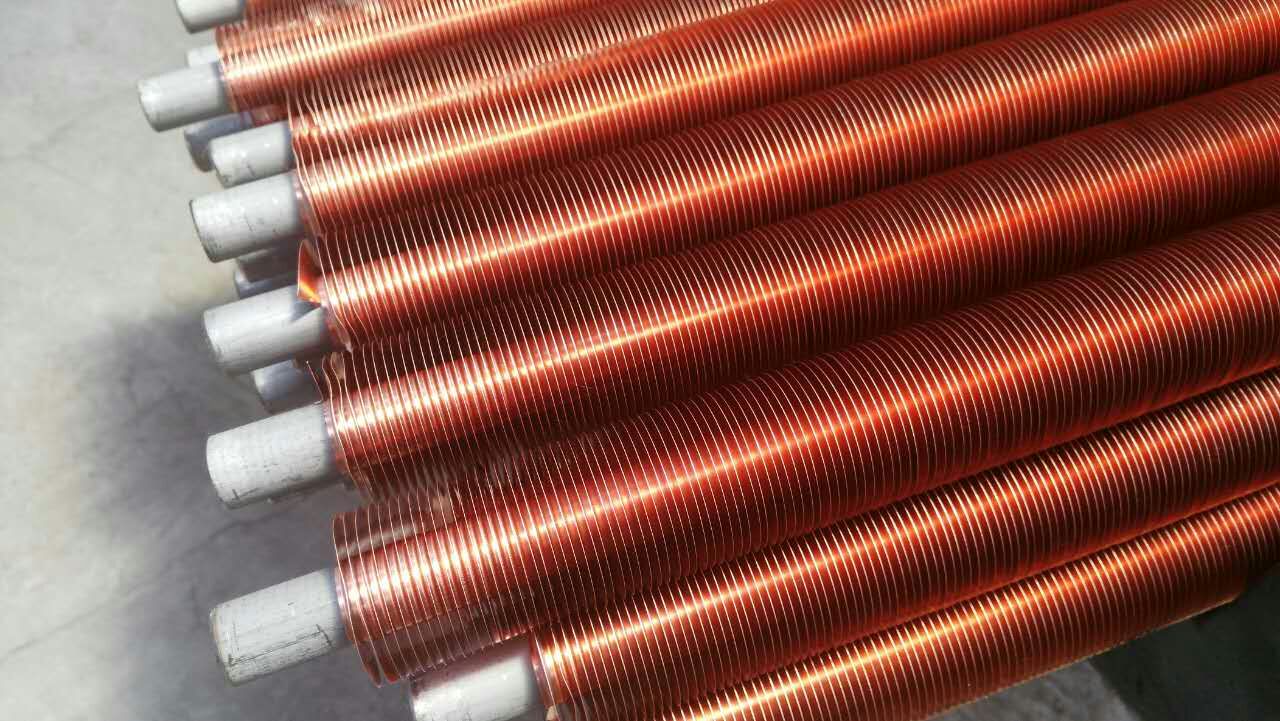

Brazing Finned Tubes Technology
Nickel-based brazing finned tube technology represents a significant breakthrough in power plant efficiency, particularly for deep retrofitting of low-pressure economizers. This innovation enhances heat exchange efficiency and reduces coal consumption through advanced design and material applications.
Market Context: Over the past two years, with coal prices exceeding ¥1,000 per ton, major power plants across China have actively sought energy-saving solutions, making nickel-based brazing finned tube technology highly sought-after due to its substantial economic benefits.
Current Applications: This technology has been successfully implemented in over a dozen power plants nationwide, with demand growing significantly in 2023.
What Makes Nickel-Based Brazing Different?
Unlike conventional mechanical bonding or welding methods, nickel-based brazing creates a true metallurgical bond at the molecular level. The process involves heating the assembly to temperatures between 980°C and 1,050°C in a controlled vacuum environment, allowing the nickel-based filler metal to flow uniformly across the fin-to-tube interface. This diffusion bonding eliminates any microscopic air gaps that would otherwise impede heat transfer. The resulting joint exhibits thermal conductivity approaching that of the base materials themselves, which directly translates to higher overall heat transfer coefficients and lower flue gas outlet temperatures.
Which power plants benefit most? Units operating with high-sulfur coals or those facing stringent emission regulations find particular advantage, as the nickel-based alloy layer provides exceptional resistance to both low-temperature sulfuric acid dew-point corrosion and high-temperature oxidation. The technology also performs reliably under variable load conditions, maintaining stable thermal performance across a wide range of operating parameters.
Brazing Finned Tubes Economic Benefits
Energy Savings
- Installed at the tail end of boiler flues
- Reduces flue gas temperature from 130°C to 90-100°C
- Achieves 30-40°C temperature drop
- Saves 3-5g of standard coal per kWh
Economic Returns
- Example: 200MW power plant in Shandong (5,500 operating hours/year)
- Annual coal savings exceeding 4,000 tons
- Annual cost savings over ¥4 million
- Equipment investment recovered in just 1.5 years
Environmental Benefits
- 200MW unit reduces CO₂ emissions by 16,000 tons/year
- Equivalent to planting 900,000 trees
- Recovers 8-12 tons/hour of condensate water
- Complies with national energy conservation policies
How Does the ROI Compare Across Different Unit Sizes?
| Unit Capacity | Annual Coal Savings (tons) | Annual Cost Savings (¥ million) | Payback Period |
|---|---|---|---|
| 100 MW | 2,100 – 2,800 | 2.1 – 2.8 | 1.8 years |
| 200 MW | 4,200 – 5,600 | 4.2 – 5.6 | 1.5 years |
| 300 MW | 6,300 – 8,400 | 6.3 – 8.4 | 1.3 years |
| 600 MW | 12,600 – 16,800 | 12.6 – 16.8 | 1.0 – 1.2 years |
These figures assume coal prices at ¥1,000/ton and 5,500 operating hours per year. Actual savings vary with local coal quality, unit load factors, and specific flue gas conditions. The economic case strengthens further when carbon credits or emission reduction incentives are factored into the calculation.
Brazing Finned Tubes Technical Specifications
Core Technical Advantages
Nickel-based brazing finned tube technology employs advanced vacuum brazing processes to create a metallurgical bonding layer between fins and base tubes, achieving near-zero thermal resistance for optimal heat transfer.
Technical Breakthrough: Through nickel-based brazing and diffusion layer technology, near-zero contact thermal resistance is achieved between fins and tubes, ensuring stable heat transfer, erosion resistance, and corrosion resistance.
Design Advantages: The finned tube heating surface significantly expands the economizers surface area, enabling compact and flexible layouts within the limited space of power plant flues, without requiring extensive infrastructure modifications.
Production Status
| Manufacturer | Production Capacity | Notes |
|---|---|---|
| Jiaozuo Guo Energy | 6 sets/year (300MW & 200MW units) | Output value ~¥900 million |
| Jiaozuo Zhongzhou | Expected 4 sets/year | Stable production |
| Tianjin Huaneng | Capacity unknown | Limited data available |
Supply Gap: Current production capacity falls significantly short of domestic power plant demands, with a supply gap exceeding 50%.
Finned Tube Technology Comparison
| Technical Parameter | Nickel-Based Brazing Finned Tubes | Conventional High-Frequency Welded Finned Tubes |
|---|---|---|
| Contact Thermal Resistance | ≈0 m²·K/W | 0.2~0.4 m²·K/W |
| Fly Ash Erosion Resistance | >15 Years | 5~8 Years |
| Low-Temperature Corrosion Resistance | Stable at pH 1~14 | Applicable at pH >5.5 |
| Heat Transfer Coefficient | 35~45 W/(m²·K) | 20~28 W/(m²·K) |
Material Composition & Durability Factors
Why does nickel-based brazing outperform other joining methods in corrosive environments? The answer lies in the filler metal composition. Typical nickel-based brazing alloys contain 70–85% nickel, with chromium (10–15%), silicon (3–5%), and trace amounts of boron and iron. This formulation provides:
- Oxidation resistance up to 950°C in continuous service
- Sulfidation resistance critical for high-sulfur coal applications
- Chloride stress corrosion cracking resistance in coastal or high-humidity environments
The base tube material is typically carbon steel (SA-210 or SA-213) or low-alloy steel, while fins are produced from high-grade carbon steel strips with controlled thickness (0.8–1.2 mm) and density (2–4 fins per inch). The entire assembly undergoes a post-braze heat treatment that relieves residual stresses and further homogenizes the diffusion layer, extending service life beyond 15 years in most operating conditions.
Brazing Finned Tubes Application Cases
Case 1: 300MW Unit in Henan Province
Installed in Q4 2022, this retrofit achieved a flue gas temperature reduction from 132°C to 96°C. Over 12 months of operation, the unit recorded a 4.2 g/kWh reduction in standard coal consumption, translating to 7,200 tons of coal saved annually. The system has operated with zero maintenance interventions and shows no measurable degradation in thermal performance.
Case 2: 600MW Unit in Guangdong Province
This coastal plant faced severe chloride-induced corrosion with previous finned tube designs. After switching to nickel-based brazing finned tubes, the unit has operated for 18 months with no signs of pitting or stress corrosion cracking. The heat transfer coefficient remains within 2% of initial values, and the plant reports annual savings of ¥14.5 million in coal costs.
Case 3: 200MW Unit in Shandong Province
Retrofitted as part of a comprehensive energy-efficiency upgrade, this unit now operates with a flue gas temperature of 91°C, well below the regulatory threshold of 100°C. The plant recovered its investment in 14 months and has since received provincial recognition for emission reduction excellence.
Key Takeaway: Across all cases, the brazing finned tubes have demonstrated consistent performance, with payback periods ranging from 12 to 18 months and projected service lives exceeding 15 years.
Brazing Finned Tubes Manufacturing Process
Tube & Fin Preparation
Base tubes are precision-ground to remove surface oxides and achieve dimensional tolerances within ±0.05 mm. Fins are stamped from cold-rolled steel strips with controlled edge quality to ensure uniform brazing contact.
Filler Metal Application
A precisely measured paste or preform of nickel-based brazing alloy is applied to the fin-to-tube interface. The amount is calculated to achieve optimal fillet formation without excess flow that could block fin passages.
Vacuum Brazing
Assemblies are loaded into vacuum furnaces and heated under controlled atmosphere (10-3 to 10-5 mbar) to temperatures of 1,000°C ±10°C. The brazing cycle includes soak times of 5–15 minutes to ensure complete diffusion and joint consolidation.
Post-Braze Heat Treatment
A controlled cooling and tempering cycle follows the brazing phase, relieving thermal stresses and stabilizing the microstructure of both the diffusion layer and the base materials. This step is critical for achieving long-term creep resistance and fatigue strength.
Inspection & Testing
Every tube undergoes non-destructive testing including dye penetrant inspection, eddy current testing, and helium leak detection. Destructive testing on sample tubes confirms braze penetration depth, shear strength, and microstructural integrity.
Quality Assurance: The manufacturing process is certified to ISO 9001:2015 and ASME Boiler and Pressure Vessel Code standards. Each production batch includes full traceability from raw material certificates to final test reports.
Brazing Finned Tubes Market Outlook
Market Demand
- Product lifespan exceeds 10 years
- Driven by mandatory energy efficiency policies
- By 2025, flue gas temperature ≤100°C required for 300MW+ units
- Subsidy of ¥120-150 per ton of standard coal saved
Retrofit Potential
- 300MW units available for retrofit: 287
- 600MW units available for retrofit: 154
- Potential market value: ¥8.1 billion
- Huaneng Group plans to retrofit 42 units in 2024
Technical Collaborations
- Tsinghua University Thermal Engineering Institute
- Shandong University Energy College
- China Huaneng Clean Energy Technology
- Alexander Walter Environmental Engineering
- Jiangsu/Hangzhou Design Institutes
What Does the Five-Year Outlook Hold for Brazing Finned Tubes?
Industry analysts project that the market for nickel-based brazing finned tubes will grow at a compound annual rate of 18–22% through 2029. Key drivers include:
- Stricter emission standards under Chinas "Dual Carbon" goals, pushing flue gas temperature limits even lower
- Rising coal prices making efficiency improvements increasingly cost-effective
- Growing awareness of the technologys reliability and long-term performance among plant operators
- Expansion of the technology to other industrial sectors, including chemical processing and waste-to-energy plants
Supply constraints remain a near-term challenge, but several manufacturers are investing in new production lines. By 2026, industry capacity is expected to increase by 60–70%, narrowing the current supply gap and potentially reducing lead times from 6–8 months to 3–4 months.
Brazing Finned Tubes Installation & Maintenance
Installation Best Practices
- Ensure flue gas flow distribution is uniform across the tube bundle to prevent localized overheating or erosion
- Use proper support structures that allow for thermal expansion without imposing stress on the brazed joints
- Install soot-blowing systems at appropriate intervals to maintain fin surface cleanliness
- Verify that all connections are sealed to prevent flue gas bypass that would reduce heat transfer effectiveness
Maintenance & Longevity
- Routine visual inspections every 6 months to detect any fin damage or erosion patterns
- Annual thermal performance testing to track any decline in heat transfer coefficient
- Periodic cleaning schedules tailored to the fuel type and flue gas composition
- With proper maintenance, service life routinely exceeds 12–15 years, with some installations reporting 18+ years of reliable operation
Pro Tip: Many plant operators find that integrating brazing finned tubes with a digital monitoring system allows for real-time tracking of thermal performance and early detection of potential issues, further extending equipment life and optimizing maintenance schedules.