


Lord Fin Tube--Extruded Finned Tubes SB-444 S06625
What Are Extruded Finned Tubes SB-444 S06625?
Boiler and heat exchanger design work spanning more than fifteen years sits behind the notes on this page. What follows explains how Extruded Finned Tubes SB-444 S06625 behave in service, where they fit, and which numbers a specifier needs before an order is placed.
Finned tubes sit at the core of industrial heat transfer equipment. They increase the outer surface available to a gas or liquid stream and, in doing so, pull more duty out of the same tube length. Extruded finned tubes hold a distinct place in that family because the fins are not welded on and not tension-wrapped — they are formed under pressure from a thick aluminium sleeve that is squeezed into the base tube surface.
SB-444 S06625 refers to a nickel-chromium-molybdenum alloy (UNS N06625) covered by the ASME SB-444 specification. It is known for corrosion resistance, high-temperature strength, and fabrication behaviour that suits severe service. Pair that base tube with the extrusion finning process and the result is a heat transfer element built for conditions where carbon steel and standard stainless grades fail early.
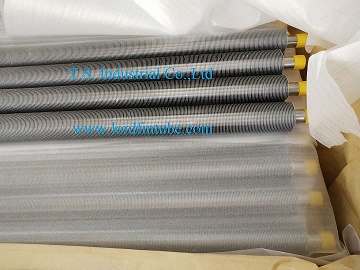
Extruded Finned Tubes SB-444 S06625
A point that often causes confusion: in an extruded finned tube, the fins and the base tube are two different materials. The base tube carries the pressure and the corrosion duty, while the aluminium sleeve — usually grade 1060 or 6063 — becomes the fin. The table below shows how the two components divide the work.
| Component | Material | Role in Service |
|---|---|---|
| Base tube | UNS N06625 nickel alloy, per ASME SB-444 | Carries internal pressure, resists process-side corrosion, handles thermal cycling |
| Fin sleeve | Aluminium 1060 or 6063 | Provides extended surface, transfers heat from the gas side |
| Fin-to-tube bond | Mechanically extruded, metal-to-metal | Removes the air gap that would otherwise act as an insulator |
| Tube ends | Bare N06625, fins stripped back | Allows welding or rolling into the tubesheet |
Extruded Finned Tubes SB-444 S06625 Dimensions and Tolerances
Standard Dimensional Specifications
| Parameter | Specification | Tolerance | Measurement Standard |
|---|---|---|---|
| Base Tube Outer Diameter | 25.4 mm | ±0.1 mm | ASME SB-444 |
| Base Tube Thickness | 2.11 mm | ±10% | ASME SB-444 |
| Fin Height | 11 mm | ±0.3 mm | ASTM B829 |
| Fin Thickness | 0.4 mm | ±0.05 mm | ASTM B829 |
| Fin Pitch | 2.54 mm | ±0.1 mm | ASTM B829 |
| Fin Density | 394 fins/meter | ±5% | ASTM B829 |
Surface Area Produced by the Standard Geometry
| Item | Value per Metre of Tube |
|---|---|
| Bare tube outside surface | 0.080 m² |
| Fin surface | ≈0.99 m² |
| Combined outside surface | ≈1.07 m² |
| Surface ratio against bare tube | ≈13.4 : 1 |
| Fin tip diameter | 47.4 mm |
| Fin count per metre | 394 |
These figures matter at the bidding stage. A designer who knows the outside surface per metre can size the bundle before the drawing is issued, and a buyer can compare quotations from different suppliers on the same basis instead of relying on the fin height alone.
Extruded Finned Tubes SB-444 S06625 Chemical Composition
Material Composition — SB-444 S06625 (UNS N06625)
| Element | Percentage (%) | Function |
|---|---|---|
| Nickel (Ni) | ≥58.0 | Base element providing corrosion resistance |
| Chromium (Cr) | 20.0–23.0 | Oxidation resistance |
| Molybdenum (Mo) | 8.0–10.0 | Pitting and crevice corrosion resistance |
| Niobium (Nb) | 3.15–4.15 | Stabilization against sensitization |
| Iron (Fe) | ≤5.0 | Balance element |
| Carbon (C) | ≤0.10 | Control of carbide formation |
Mechanical Behaviour at Room and Elevated Temperature
| Property | At 20 °C | At 650 °C |
|---|---|---|
| Tensile strength | ≈827 MPa | ≈620 MPa |
| 0.2% yield strength | ≈414 MPa | ≈380 MPa |
| Elongation in 50 mm | ≈30% | — |
| Hardness | ≤220 HB | — |
| Melting range | 1290–1350 °C | |
What makes the niobium addition worth noting? It ties up carbon during elevated-temperature exposure, so grain-boundary chromium carbides are less likely to form. In practice this means the tube keeps its ductility after years in a flue gas duct, which reduces the chance of brittle cracking during a shutdown wash or a mechanical clean.
Why Extruded Finned Tubes SB-444 S06625 Resist Corrosion and Heat
Chloride Environments
SB-444 S06625 extruded finned tubes resist pitting, crevice corrosion, and stress corrosion cracking in chloride-bearing media, which is why they appear in marine and offshore duty where 316L would pit within a few seasons.
Elevated Temperature
The alloy holds structural integrity and oxidation resistance up to 980 °C (1800 °F), so it suits high-temperature heat recovery where flue gas enters the bundle hot and leaves cool enough to condense acid.
Heat Flow Through the Bond
The extrusion process presses the aluminium sleeve into the base tube wall until the two metals touch over their full length. No brazing filler, no wrapped tension, no air gap. Contact resistance drops to a level that wrapped fins cannot reach, and the same duty can be met with a shorter bundle.
Acid Condensation Zones
Where flue gas drops below its dew point, sulphuric and hydrochloric acid form on the fin surface. The aluminium fin tolerates the low-temperature end while the N06625 base tube handles the aggressive condensate that runs down onto it.
Thermal Cycling
Repeated startup and shutdown cycles stress the fin-to-tube joint. Because the bond is formed by deformation rather than filler metal, there is no brittle intermetallic layer to crack after a few hundred cycles.
Fouling and Cleaning
Extruded fins are continuous and smooth. Ash and soot release more easily than they do from welded spiral fins, and a high-pressure water wash does not peel the fin away from the tube.
Extruded Finned Tubes SB-444 S06625 Compared With Other Alloys
| Property | SB-444 S06625 | Stainless Steel 304 | Stainless Steel 316 | Carbon Steel |
|---|---|---|---|---|
| Max Service Temperature (°C) | 980 | 815 | 870 | 540 |
| Corrosion Resistance | Excellent | Good | Very Good | Poor |
| Tensile Strength (MPa) | 827 | 515 | 515 | 415 |
| Thermal Conductivity (W/m·K) | 9.8 | 16.2 | 16.3 | 45.0 |
| Relative Cost Factor | 4.2 | 1.0 | 1.5 | 0.6 |
| Service Life in Corrosive Duty (Years) | 15–25 | 3–8 | 5–12 | 1–3 |
The conductivity number in that table sometimes raises a question. N06625 conducts heat less readily than carbon steel, so why use it? Because the wall is thin and the fin does most of the surface work. What the base tube must do is survive. A carbon steel tube with better conductivity but a three-year life costs more across a decade than an alloy tube that is simply left in place.
| Service Condition | Reasonable Material Choice |
|---|---|
| Clean flue gas, low sulphur, moderate temperature | Carbon steel or 304 |
| Moderate chloride, occasional condensation | 316L |
| Marine air, chloride-rich condensate, cycling duty | SB-444 S06625 |
| Acid dew point attack at the cold end | SB-444 S06625 |
| Temperature above 870 °C with oxidising gas | SB-444 S06625 |
Where Extruded Finned Tubes SB-444 S06625 Are Used
Power Generation
Heat recovery steam generators, economisers, and air preheaters where flue gas condensation corrosion decides how long the bundle lasts.
Chemical Processing
Heat exchangers in sulphuric acid plants, chlorine handling, and other aggressive process streams where the tube side cannot be allowed to fail.
Oil & Gas
Fired heaters, waste heat recovery units, and offshore platform exchangers exposed to salt-laden air and wet gas.
Waste Incineration
Waste-to-energy boilers where acidic flue gas and high temperature combine into one of the harshest environments a heat exchanger will ever see.
Marine and Shipboard
Exhaust gas economisers and auxiliary boilers where chloride attack from sea air shortens the life of ordinary stainless bundles.
Metallurgical Furnaces
Recuperators and cooling sections handling hot, dirty gas streams with entrained particulates.
How Extruded Finned Tubes SB-444 S06625 Are Made
The extrusion process for SB-444 S06625 finned tubes starts with a plain N06625 base tube and an aluminium sleeve slipped over it. A set of rotating dies then presses the sleeve down while three forming tools lift the displaced metal outward, fin by fin, along the whole length. Nothing is added between the two metals, and nothing is melted.
- Zero thermal contact resistance between fin and tube
- Mechanical strength that wrapped or welded fins do not match
- No filler metal, so no leak path and no dissimilar-metal weld
- Consistent fin geometry from one end of the tube to the other
- Fins stripped back at both ends so the tube can be rolled or welded into the tubesheet
Every batch of SB-444 S06625 extruded finned tubes goes through hydrostatic testing, dimensional verification, and material certification against ASME and ASTM requirements before it leaves the shop.
| Production Step | What Happens | What It Controls |
|---|---|---|
| Sleeve fitting | Aluminium sleeve slid over the N06625 tube | Starting wall thickness of the fin |
| Extrusion | Rotating dies compress the sleeve; forming tools raise the fins | Fin height, pitch, and bond quality |
| End stripping | Fins removed at both ends to the required bare length | Tube-to-tubesheet joint quality |
| Pressure test | Hydrostatic test at specified pressure | Base tube integrity |
| Inspection | Dimension check and material verification | Conformance to order and standard |
How to Maintain Extruded Finned Tubes SB-444 S06625
| Maintenance Activity | Frequency | Method | Expected Outcome |
|---|---|---|---|
| Visual Inspection | Quarterly | Borescope or visual examination | Early detection of fouling or corrosion |
| Fin Cleaning | As needed, based on pressure drop | High-pressure water or chemical cleaning | Restored heat transfer efficiency |
| NDT Testing | Annually | Ultrasonic thickness testing | Wall thickness monitoring |
| Performance Analysis | Semi-annually | Thermal performance calculation | Efficiency trend analysis |
| Fin Bond Check | Every major shutdown | Tap test or visual check for fin separation | Confirms the extruded bond is intact |
Which cleaning method suits a given bundle? It depends on what is on the fins. Dry ash responds to soot blowing and dry brushing. Sulphate scale needs a mild alkaline wash. If the deposit is acidic condensate residue, a neutral wash followed by a clean water rinse prevents the residue from re-attacking the aluminium surface. Steam lancing at very high pressure should be avoided on thin fins, since 0.4 mm aluminium distorts easily when the nozzle is held too close.
Extruded Finned Tubes SB-444 S06625 Frequently Asked Questions
How does an extruded fin differ from a wrapped or welded fin?
A wrapped fin is wound under tension around the tube and relies on that tension to stay in place. A welded fin is attached by a continuous or spot weld. An extruded fin is formed from an aluminium sleeve that is pressed into the base tube until the two metals touch along the entire length. The practical difference is contact resistance: extruded fins transfer heat through a metal-to-metal bond, while wrapped fins always leave a small air gap that acts as an insulator.
What is the maximum working temperature for these tubes?
The N06625 base tube itself handles continuous service up to about 980 °C in oxidising atmospheres. The limiting factor is usually the aluminium fin, which softens well below that. Most designs keep the fin metal below roughly 300 °C to preserve fin strength and bond integrity, and the base tube is selected for the hotter, more corrosive duty.
Can fin height, pitch, and tube length be customised?
Yes. Fin height, fin pitch, base tube diameter, wall thickness, and overall length are all set per order. A tighter pitch gives more surface per metre but fouls faster in dirty gas; a wider pitch trades surface for cleanability. The bare end length at each tube end is also made to the drawing so the tube fits the tubesheet without rework on site.
Which documents come with a delivery?
A typical shipment includes the mill certificate for the base tube showing heat number and chemical analysis, a dimensional inspection report, the hydrostatic test record, and a packing list. Third-party inspection and non-destructive examination reports can be arranged when the project specification calls for them.
How should the tubes be stored before installation?
Keep them indoors, on timber or plastic dunnage, clear of the floor. Aluminium fins pick up surface marks easily, and standing water between fins leads to white oxide staining. If outdoor storage cannot be avoided, cover the bundles so rain runs off rather than sitting in the fin channels.
Is repair possible if a fin section is damaged?
Minor fin deformation can usually be straightened without affecting performance. A damaged section can be cut back if the bare length required for the tubesheet joint is still available. Because the bond is formed by deformation rather than welding, there is no filler metal to re-flow, so field repair is limited to mechanical methods.
Extruded Finned Tubes SB-444 S06625 Ordering and Delivery
| Order Item | What to Specify | Typical Range |
|---|---|---|
| Base tube material | UNS N06625 per ASME SB-444 | Fixed grade |
| Base tube size | Outside diameter and wall thickness | 19.05–51 mm OD |
| Fin height | Measured from base tube surface | 6–16 mm |
| Fin pitch | Fins per metre or fin spacing | 2.0–5.0 mm pitch |
| Tube length | Overall length including bare ends | Up to 25 m in one piece |
| Bare end length | Stripped length at each end | Per tubesheet drawing |
| Fin material | Aluminium grade | 1060 or 6063 |
| Packing | Steel frame, wooden case, or sea-worthy bundle | Per shipping route |
| Inspection | Third-party witness or document review | Optional |
Lead time depends mainly on base tube availability. N06625 is not a stock item at every mill, so early confirmation of the tube size shortens the whole schedule. Buyers who lock in the fin geometry together with the tube size at the enquiry stage usually avoid a second round of drawings later.
Extruded Finned Tubes SB-444 S06625 in Service
Extruded Finned Tubes SB-444 S06625 sit at the top of the range for heat transfer duty in harsh conditions. The S06625 alloy brings corrosion resistance, high-temperature capability, and a stable microstructure, while the extrusion process delivers a fin bond that keeps thermal performance steady over years of cycling. The purchase price is higher than carbon steel or standard stainless, and that is a real consideration at the budget stage. Against it stands a service life measured in decades rather than seasons, fewer shutdowns for bundle replacement, and less downtime lost to unplanned repairs.
For engineers specifying into corrosive or high-temperature service, and for buyers who have already paid once for a bundle that failed early, these tubes are a long-term answer rather than a short-term saving.