


Carbon Steel Fin Tubes vs Stainless Fin Tubes vs Aluminum Fin Tubes
The efficiency and longevity of any industrial heat transfer system rely heavily on the materials used in its construction. Fin tubes, the core components of air coolers, economizers, and various heat exchangers, must be carefully matched to their operating environments. Selecting the incorrect material can lead to rapid degradation, system failure, and costly downtime. As a specialized manufacturer, Lord Fin Tube (www.lordfintube.com) provides customized fin tube solutions engineered to withstand specific environmental challenges.
This breakdown examines the primary characteristics and ideal operating conditions for three of the most widely used fin tube materials: carbon steel, stainless steel, and aluminum. Understanding what each material offers — and where each falls short — is the first step toward optimizing heat exchanger performance and lifecycle cost.
Which material delivers the right balance of thermal conductivity, corrosion resistance, and mechanical strength for your specific application? How do operating temperature, fluid composition, and atmospheric conditions influence the choice between carbon steel, stainless, and aluminum fin tubes? The following sections provide clear, actionable answers.
Carbon Steel Fin Tubes in Power Generation and Heat Recovery
Carbon steel is a fundamental material in heavy industry, valued for its exceptional structural strength, favorable thermal conductivity, and cost-effectiveness. What makes carbon steel fin tubes the preferred choice for power plants and industrial boilers? The material delivers reliable performance under high internal pressures and elevated temperatures, provided the medium remains non-corrosive.
Ideal Operating Environments: Carbon steel fin tubes perform exceptionally well in environments characterized by high temperatures and high internal pressures, provided the medium is non-corrosive. They are the standard choice for utility boilers, power plant economizers, and heavy industrial heat recovery systems. Carbon steel can easily handle the severe mechanical stress exerted by high-pressure steam or water.
Limitations and Considerations: The primary vulnerability of carbon steel is oxidation. It is not suitable for environments exposed to high moisture, acids, or aggressive chemicals. When utilized in environments where external atmospheric corrosion is a minor risk but internal pressure demands are high, carbon steel base tubes are often paired with aluminum fins to create a bimetallic tube, offering the strength of steel with the atmospheric protection and heat dissipation of aluminum.
How does carbon steel compare in terms of thermal efficiency? With a thermal conductivity of approximately 50 W/m·K, carbon steel provides efficient heat transfer while maintaining structural integrity at temperatures up to 540°C. This makes it an economical workhorse for applications where corrosion risk is low but mechanical demands are high. For procurement teams and engineers evaluating long-term operating costs, carbon steel fin tubes often present the most cost-effective solution for non-corrosive high-temperature zones.
Stainless Fin Tubes in Chemical and Marine Environments
When industrial processes involve harsh chemicals, extreme temperatures, or strict hygiene standards, Stainless Fin Tubes are the mandatory choice. The addition of chromium in the steel alloy forms a passive oxide layer that prevents surface corrosion, delivering unmatched durability in the most aggressive settings.
Ideal Operating Environments: Stainless steel fin tubes are engineered for highly corrosive and demanding settings. This includes chemical and petrochemical processing plants, offshore marine environments subjected to saltwater spray, and facilities handling acidic or alkaline fluids. Furthermore, grades such as 304 and 316L are essential in the food and beverage industry and pharmaceutical manufacturing, where sanitary conditions and resistance to aggressive cleaning agents are strictly required. Stainless steel maintains its mechanical integrity at both cryogenic temperatures and extreme heat, making it highly versatile.
Performance Characteristics: While the thermal conductivity of stainless steel is lower than that of carbon steel or aluminum, its unmatched operational lifespan in harsh environments completely offsets this factor. Through advanced welding techniques like High-Frequency Solid Resistance Welding (HFW), the bond between the stainless steel tube and fin is forged perfectly, ensuring uninterrupted heat transfer despite the base materials lower conductivity rating.
Why choose stainless over other materials when thermal conductivity is a concern? The answer lies in lifecycle economics. In chemical plants, marine vessels, and food processing facilities, the cost of premature failure far outweighs the initial material premium. Stainless fin tubes withstand temperatures up to 870°C and resist pitting, crevice corrosion, and stress corrosion cracking — factors that render carbon steel and aluminum unsuitable for such environments. For procurement managers, the long-term reliability of stainless fin tubes translates to reduced maintenance intervals and fewer unplanned shutdowns.
Aluminum Fin Tubes in Air-Cooled Heat Exchangers
Aluminum is renowned for its low density and outstanding thermal conductivity, making it an indispensable material for extended surface heat transfer. In most industrial applications, aluminum is used for the fins rather than the base tube, often extruded over a stronger core material or applied via L-foot or G-fin tension methods.
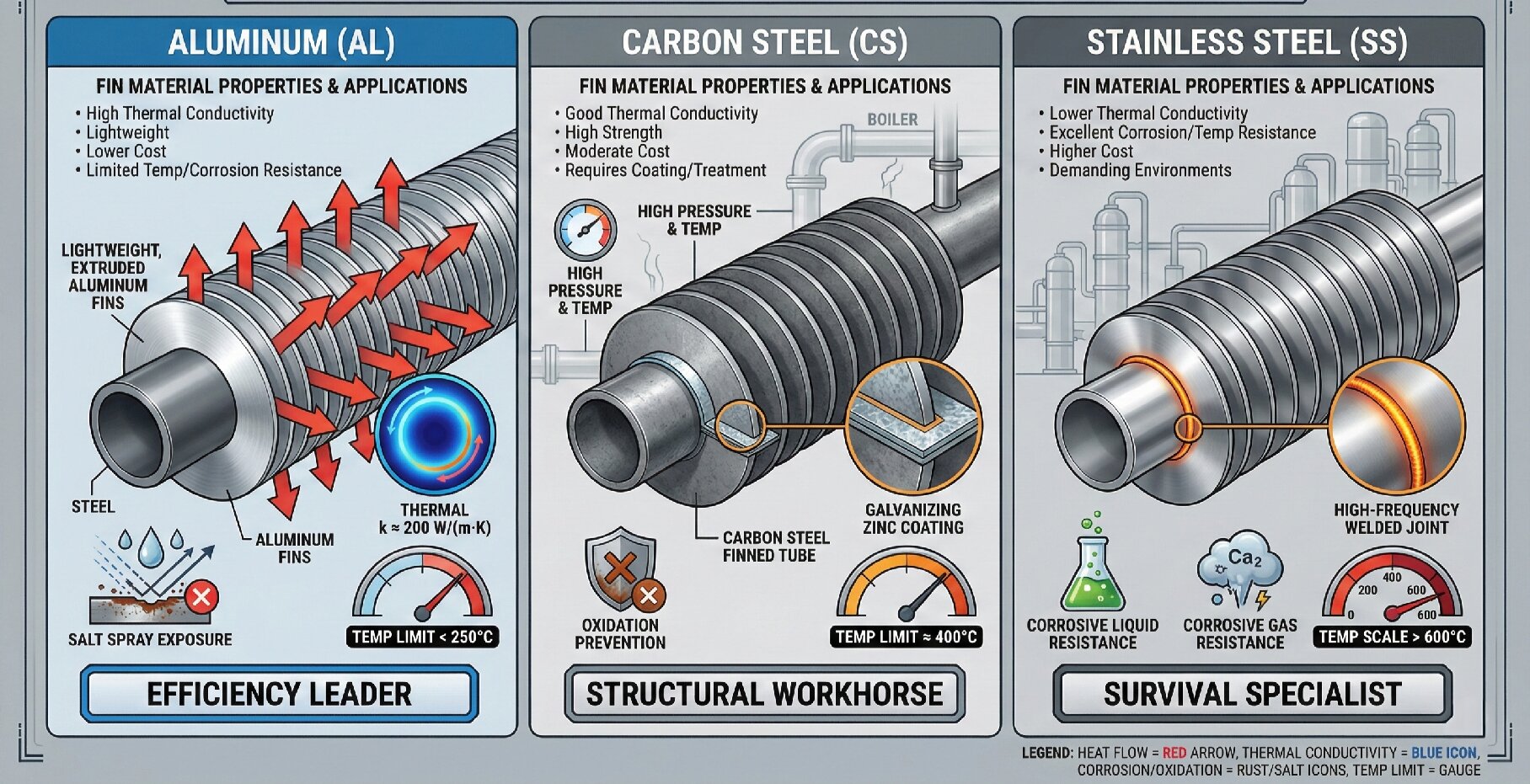
Ideal Operating Environments: Aluminum fins are the optimal choice for air-cooled heat exchangers, HVAC systems, and low-to-medium temperature heat recovery units. They thrive in environments where the primary cooling medium is ambient air. Aluminum naturally forms a protective oxide layer when exposed to the atmosphere, granting it excellent resistance to standard weather conditions and atmospheric moisture.
Manufacturing Advantages: Extruded aluminum fin tubes provide seamless protection for the underlying base tube. The extrusion process forms a thick, continuous layer of aluminum that completely encases the core tube, protecting it from external corrosive elements while delivering maximum surface area for rapid heat dissipation.
Which fin tube material offers the highest thermal conductivity? Aluminum leads with approximately 235 W/m·K — nearly five times that of stainless steel and more than four times that of carbon steel. This exceptional heat transfer capability, combined with a density of just 2.7 g/cm³, makes aluminum fins the preferred choice for applications where weight reduction and rapid thermal response are critical. How does aluminum perform in corrosive settings? While its natural oxide layer provides good atmospheric corrosion resistance, aluminum is vulnerable to strong acids and alkalis, limiting its use in chemical processing environments.
Comparative Material Properties: Carbon Steel, Stainless, and Aluminum Fin Tubes
To make an informed selection, engineers and procurement specialists need a clear side-by-side comparison of the key performance indicators for each material. The table below summarizes the critical properties that influence fin tube performance across different operating conditions.
| Property | Carbon Steel Fin Tubes | Stainless Fin Tubes | Aluminum Fin Tubes |
|---|---|---|---|
| Thermal Conductivity (W/m·K) | ~50 | ~16 | ~235 |
| Corrosion Resistance | Low (oxidation prone) | Highest (excellent against acids, saltwater) | Moderate (good in atmospheric conditions) |
| Max Operating Temperature (°C) | ~540 | ~870 | ~400 |
| Density (g/cm³) | 7.85 | 7.90 | 2.70 |
| Relative Cost | Low | High | Moderate |
| Primary Applications | Boilers, economizers, power plants, heat recovery | Chemical plants, marine, food processing, pharmaceuticals | HVAC, air-cooled exchangers, refrigeration, low-temp recovery |
| Fabrication Methods | HFW welding, tension winding, bimetallic extrusion | HFW welding, laser welding, extrusion | Extrusion, L-foot, G-fin tension wrapping |
This comparative data highlights the trade-offs each material presents. Carbon steel offers the best cost-to-strength ratio for non-corrosive high-temperature service. Stainless steel delivers the highest durability and corrosion resistance at a premium cost. Aluminum provides the best thermal conductivity and light weight for air-cooled and low-temperature applications. Which material aligns with your projects specific demands? The answer depends on the operating environment, expected service life, and budget constraints.
Custom Manufacturing Capabilities at Lord Fin Tube
No two industrial plants operate under identical conditions. Achieving peak thermal efficiency requires fin tubes manufactured to exact project specifications. Lord Fin Tube operates advanced production lines capable of manufacturing extruded, high-frequency welded, and tension-wound fin tubes across all material grades.
The Customization Process
By aligning material properties with environmental demands, facility operators can significantly extend the lifecycle of their heat exchange equipment. For comprehensive material data sheets, customized production capabilities, and technical support, engineering teams and procurement managers are encouraged to consult the resources available at www.lordfintube.com.