


Guide to All Flange Types: Structure, Seal Face
I. Basic Overview of Flanges
A flange, also known as a flange disc, is a core detachable connection component for pipelines, pressure vessels and equipment. It achieves sealing by tightening bolts and gaskets, facilitating equipment maintenance and disassembly. Flanges are classified into various standard types based on overall structure, welding method and sealing contact surface. Different flanges are applicable to vastly different pressure, temperature and medium conditions, and the sealing face is the critical part determining leakage performance.
II. Main Flange Types Classified by Overall Structure
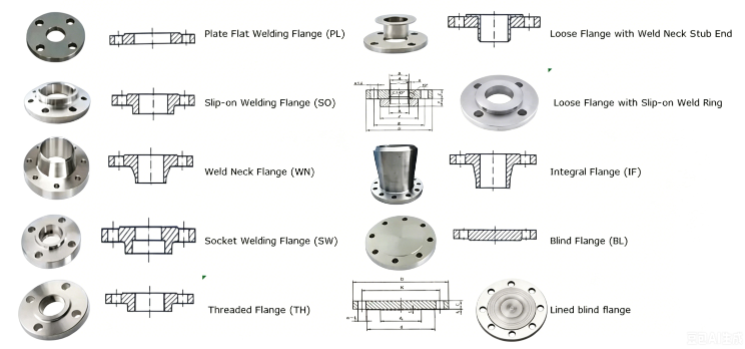
1. Plate Flat Welding Flange (PL)
Structural: flat disc, pipe inserted and welded only outside. Low cost.
Pros/Cons: easy, cheap; poor rigidity, low weld strength.
Application: PN ≤ 16 bar, water/air/sewage. Sealing: FF, RF.
2. Slip-on Welding Flange (SO)
Structural: short conical neck, welded inside & outside. Better rigidity than PL.
Pros/Cons: moderate rigidity, easy inspection; deformable at high T/P.
Application: PN16~PN40, oil products, cooling water. Sealing: RF, M/FM, T/G, FF.
3. Weld Neck Flange (WN)
Structural: long tapered neck, butt-welded full penetration. Uniform stress.
Pros/Cons: best strength, fatigue resistance; expensive.
Application: high T/P steam, oil/gas, corrosive media. Sealing: RF, M/FM, T/G, FF, RJ.
4. Socket Welding Flange (SW)
Structural: stepped socket, small-bore pipe inserted and welded outside.
Application: PN ≤ 10.0 MPa, DN ≤ 40. Boiler systems. Not for strong corrosive media. Sealing: RF, FF, MFM, TG, RJ.
5. Threaded Flange (TH)
Structural: internal threads, no welding. Avoids thermal influence.
Application: flammable/explosive pipelines, galvanized lines. T range: -45°C ~ 260°C. Sealing: RF, FF, MFM, TG.
6. Loose Flange (LJ / LF)
Structural: stub end + loose disc, rotates for bolt alignment. Two subtypes: weld neck stub end & slip-on weld ring.
Pros: cost saving (different materials), easy alignment. Cons: low pressure capacity, weak weld.
Application: PN10~PN40, stainless steel/alloy pipelines.
7. Integral Flange (IF) – integrally forged with valve/body, highest rigidity. Usually RF; for hazardous conditions MFM/TG optional.
8. Blind Flange (BL) – solid flange, used to block pipe ends, manholes. Supports FF, RF, MFM, TG, RJ. blind flange with anti‑corrosion lining for corrosive media.
III. Detailed Explanation of Flange Sealing Faces
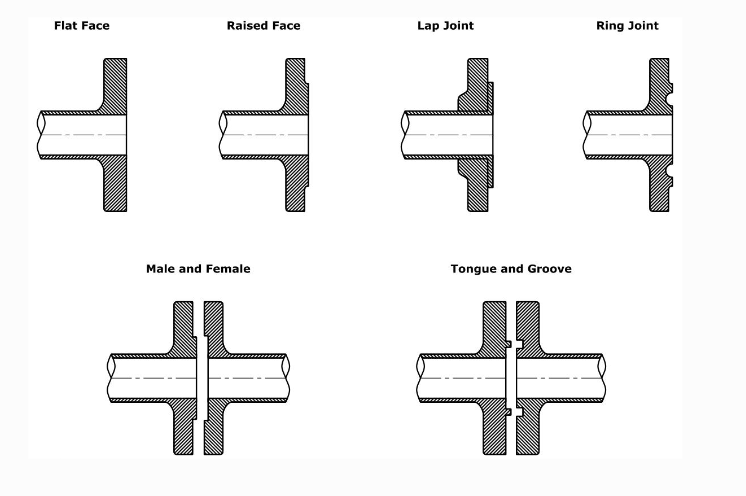
Sealing faces cooperate with gaskets to achieve sealing. Higher pressure and more hazardous media demand higher machining precision. The commonly used types:
| Sealing Face | Grade | Typical Gasket | Suitability for High‑risk Media |
|---|---|---|---|
| RF Raised Face | Ordinary | Spiral wound, rubber | Not recommended for highly toxic |
| MFM Male & Female | Good | Composite gasket | Conventional chemical liquids |
| TG Tongue & Groove | Excellent | PTFE, flexible graphite | Toxic / volatile media |
| RJ Ring Joint | Top‑tier metal hard seal | Metal octagonal ring | Ultra‑high T/P oil & gas |
| FF Flat Face | Poor | Full‑size rubber sheet | Low‑pressure cast iron pipelines |
Ring Joint Face (RJ) – trapezoidal ring grooves, metal ring gaskets (octagonal/oval). Metal‑to‑metal hard sealing. High‑temp, ultra‑high pressure, oil/gas. Class600+.
Octagonal Ring Seal (special for RJ) – pure metal sealing for extremely harsh conditions.
IV. Simplified Flange Selection Comparison Table
| Flange Type | Core Advantages | Pressure Class | Recommended Media |
|---|---|---|---|
| PL | Low cost, easy machining | PN6/10/16 | Clean water, air |
| SO | Moderate rigidity | PN16/25/40 | General chemical media, cooling water |
| WN | Resist high T/P & fatigue | PN16~PN160 | Steam, oil & gas, corrosive |
| SW | Convenient alignment for small high‑pressure pipes | PN16~PN40, DN≤50 | Instrument, hydraulic small‑bore |
| TH | Welding‑free, no hot work | PN16~PN40 | Flammable/explosive pipelines |
| LJ | Easy bolt alignment, saves stainless steel | PN10~PN40 | Stainless steel, alloy pipelines |
| BL | Pipeline end plug with pressure capacity | All classes | Blocking pipeline terminals |
V. Conclusion
Two core dimensions determine flange selection: the flange body structure is defined by pressure, temperature and welding requirements, while the sealing contact surface is selected according to medium toxicity and permeability.
For low‑pressure normal‑temperature water/air: plate flat welding flanges with RF. For high‑temperature high‑pressure oil/gas: weld neck flanges with RJ. For toxic media: tongue & groove TG is mandatory. For expensive stainless steel pipelines: loose flanges cut costs. For welding‑forbidden sites: threaded flanges.
Reasonable matching of flange form and sealing face reduces leakage risks and ensures long‑term stable operation.
Explore more: flange types · blind flange