

Rectangle HH Finned Tube for Boiler Economizer
Walk into any coal-fired or biomass power plant, and the economizer section is where you will find rows of rectangular HH finned tubes doing the heavy lifting. These are not your standard circular spiral fins. The geometry is specific: two rectangular steel plates welded symmetrically onto the base tube, forming an “H” shape. When two base tubes share a set of fins, it becomes a double H finned tube. This design directly addresses the thermal and mechanical demands of high-ash flue gas environments, which is why you see them specified so often in waste incinerator economizer retrofits and large utility boilers.
The fundamental challenge in any boiler economizer is the gas-side thermal resistance. On a bare tube, the film coefficient accounts for roughly 70–80% of the total thermal resistance. To extract the same heat, you would need six times the number of bare tubes. The rectangular fin profile multiplies the outside surface area by a factor of three to five, which significantly reduces the physical footprint of the bank. But the real engineering decision comes down to fouling and erosion—especially when dealing with high-ash flue gas.
Why the HH Profile Excels in High-Ash and Waste-to-Energy Services
Spiral finned tubes have a continuous helical path. In a clean-gas application, they perform admirably. However, once ash loading increases, those spirals become collection points. Soot and fly ash accumulate at the fin root, bridging the gaps and adding thermal resistance. The cleaning cycles become shorter, and the effective heat transfer coefficient drops off quickly.
The rectangular HH finned tube takes a different approach. The straight, parallel channels between the fin plates allow the flue gas to sweep through without creating stagnant recirculation zones. Field data from coal-fired units show that HH designs can reduce fouling-related efficiency losses by up to 40% compared to spiral fins in similar service. This is not just about cleaning frequency—it is about maintaining stable exit gas temperatures over the course of a run. For a waste incinerator economizer, where the fuel composition varies and particulate loading is aggressive, this stability translates directly to reduced soot-blowing steam consumption and more predictable back-end corrosion rates.
Wear is another critical factor. The erosive wear rate on tube surfaces scales with the 3.33 power of gas velocity. A reduction in flue gas velocity from 9 m/s to 7 m/s cuts the wear rate by roughly 43%. Because the rectangular fin arrangement provides a larger free-flow area for the same heat duty, the design velocities can be kept lower than those required for a comparable spiral bundle. The fins themselves act as a sacrificial barrier, deflecting the larger ash particles away from the tube wall.
Technical Dimensional Parameters
When you sit down with a supplier’s datasheet, the dimensional matrix matters. Here is a practical breakdown of what each spec controls in the context of a boiler economizer installation.
| Parameter | Typical Range (Metric) | Typical Range (Imperial) | What It Controls in Practice |
|---|---|---|---|
| Base Tube OD | 25–73 mm | 1/2"–2-1/2" NPS | Pressure containment, water/steam flow area, and structural span |
| Tube Wall Thickness | 3.0–6.0 mm | 0.118"–0.236" | Pressure rating and corrosion/erosion allowance for long-term service |
| Tube Length | ≤18,500 mm | ≤60.7 ft | Economizer layout and shipping logistics |
| Fin Thickness | 1.5–4.0 mm | 0.060"–0.157" | Thermal conduction path and resistance to mechanical damage during soot blowing |
| Fin Height | 25–45 mm | 0.98"–1.77" | Extended surface area vs. gas-side pressure drop trade-off |
| Fin Length (plate width) | 50–250 mm | 1.97"–9.8" | Tube spacing and overall bundle compactness |
| Fin Pitch | 20–117 fins/m | 1–3 fins/inch | Direct impact on convective coefficient and accessibility for cleaning lance penetration |
For a typical high-ash flue gas application, you will often see a fin pitch on the tighter end of the range to maximize surface area, but this must be balanced against the increased pressure drop across the economizer. The induced draft fan curve usually dictates where that sweet spot lies.
Material Pairing for Corrosive and Erosive Environments
Material selection is where the operating conditions of the waste incinerator economizer or coal-fired unit dictate the bill of materials. The base tube carries the boiler pressure and must comply with ASME Section I or EN 12952. The fins are non-pressure parts, but their material impacts weld integrity and thermal cycling life.
Base Tube Grades
| Material Grade | Typical Application | Key Consideration |
|---|---|---|
| Carbon Steel (A106 Gr.B, A179, A192) | Standard economizer, moderate temps | Cost-effective, but limited to flue gas inlet temps below 400°C |
| Alloy Steel (T/P11, T/P22, T/P91) | High-pressure sections, elevated temp | Creep resistance for supercritical units |
| Stainless Steel (TP304, TP316, TP321) | Corrosive flue gas, high sulfur or chloride | Necessary when acid dew point is frequently breached |
| ND Steel (09CrCuSb) | Acid dew-point corrosion protection | Specifically developed for sulfuric acid resistance, common in low-temperature economizer sections |
For the fins, carbon steel (Q235B) is the default choice for standard duty. However, if the waste incinerator economizer sees fluctuating flue gas temperatures that dip below the acid dew point, specifying stainless steel (409 or 304) for the fins adds a layer of oxidation resistance. In our shop, we frequently see customers opt for ND steel on both the tube and the fin when burning high-sulfur pet coke—this is a premium upgrade, but it extends the replacement interval significantly.
HH vs. Spiral Fins: The Engineering Trade-Off
Here is the decision matrix that procurement and engineering teams usually work through.
| Characteristic | Spiral Finned Tube | HH Finned Tube |
|---|---|---|
| Fin Geometry | Continuous helical wrap | Rectangular plates (single H or double H) |
| Gas Flow Pattern | Swirling, turbulent | Straight parallel channels |
| Clean Gas Efficiency | Higher surface coefficient | Moderate, but stable |
| Fouling in High-Ash Flue Gas | Ash bridges at the root | Self-scouring effect through the straight gaps |
| Pressure Drop for Same Duty | Higher (due to tighter flow area) | Lower (larger free-flow section) |
| Wear Rate | Higher due to elevated velocity | Lower—reducing velocity by 2 m/s cuts wear by ~43% |
| Sootblower Penetration | Limited to the helical path | Full line-of-sight cleaning through channels |
| Preferred Application | Gas-fired units, low-ash fuels | Coal, biomass, waste-to-energy, high-ash flue gas |
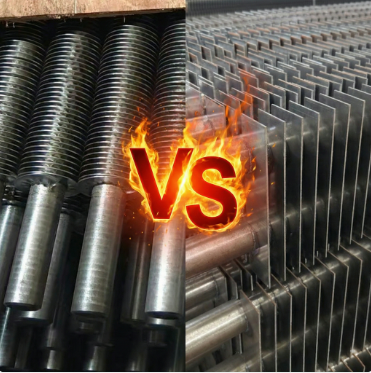
If your boiler burns pulverized coal or refuse-derived fuel, the HH geometry is the standard industrial solution. It might not give you the absolute peak efficiency in the first 100 hours of operation, but it will maintain a much flatter performance curve over a 12-month campaign between outages.
Manufacturing Perspective: What You Are Paying For
From a supplier’s standpoint, the manufacturing process determines the quality of the weld joint and the consistency of the fin pitch. In our production line, the steel plates are stamped to the specified fin dimensions and loaded into an automatic feeder. The tubes are positioned simultaneously, and a high-frequency resistance welding setup fuses the fins to the tube wall. The weld fusion rate is consistently above 95% if the electrode pressure and current are correctly calibrated.
What you want to inspect when you visit the shop: burr formation at the weld root, fin alignment along the tube axis, and any gaps between the fin plate and the tube surface. A gap as small as 0.1 mm creates a thermal contact resistance that reduces the effective heat transfer area by more than the math would suggest. Reputable suppliers use flash welding with automatic pressure control, which minimizes human error.
For the double H configuration, the welding sequence alternates between the two tubes to prevent distortion. The cooling rate after welding is also crucial—if the fins cool too quickly, the residual stress can cause the fin plates to warp slightly, which affects the channel gap. We typically run a slow-cooling conveyor to maintain dimensional stability.
Installation and Operational Tuning
Flue gas velocity: Stick to 5–8 m/s. Below 5 m/s, you risk ash dropout and settling on the lower tube rows. Above 8 m/s, the erosion rate accelerates disproportionately. If your current economizer is running at 9 m/s, consider re-tubing with a slightly larger free-flow section to bring that velocity down.
Gas-side pressure drop: Expect a 15–30% increase over a bare tube bank. This is the price you pay for the extended surface. Verify the induced draft fan capacity before finalizing the tube bundle arrangement.
Soot-blowing strategy: The straight channels mean that steam soot blowers or acoustic cleaners are highly effective. We recommend a baseline frequency of once per shift for high-ash flue gas, with adjustments based on the differential pressure across the economizer.
Acid dew-point management: For high-sulfur fuels, keep the economizer outlet gas temperature above 105°C to prevent sulfuric acid condensation. If you are running a waste incinerator economizer with high moisture content, you may need to accept a lower temperature and upgrade the last row to ND steel or TP316.
RFQ Checklist: Practical Points for Buyers
When you issue a request for quotation for rectangular HH finned tubes, include these specifics to get comparable bids from different suppliers. Missing these items is the main reason quotes come back non-comparable.
Base Tube Data
- Outside diameter and wall thickness (with tolerance)
- Material grade and applicable standard (ASTM/EN/GB)
- Total tube length and straightness requirement
Fin Geometry
- Type: Single H or Double H
- Fin thickness, height, and pitch (fins/m or fins/in)
- Fin material (and coating, if any)
Welding Quality
- Specified welding method (HF resistance preferred)
- Minimum weld fusion rate (e.g., ≥95%)
- Visual and NDT inspection standards
Commercial & Logistics
- Number of tubes and bundle arrangement
- Delivery lead time and packaging for export
- Material test certificates (EN 10204 3.1/3.2)
Cost of Ownership vs. Unit Price
Procurement in the power sector tends to focus on the price per meter of tube. That is a mistake. The total cost of ownership includes the fouling penalty, the wear rate, and the frequency of soot-blowing. A cheaper spiral tube might save you 15% on the initial order, but if you have to increase soot-blowing steam flow by 20% and replace the bundle a year earlier, the economics flip.
The rectangular HH finned tube, particularly the double H variant, offers a longer service interval in high-ash flue gas applications. For a waste incinerator economizer, where maintenance access is often constrained and outage windows are fixed, the reliability of the HH geometry justifies the upfront cost.
For more specific sizing or to discuss your flue gas composition, contact our engineering team. The Boiler Economizer tube selection is mission-critical, and we are happy to run the thermal calculations alongside your existing ID fan curve.