


Lord Fin Tube--Laser welded stainless steel tube
Laser Welded Stainless Steel Tube in Heat Exchanger Applications
As a heat exchanger specialist with over 15 years of industry experience, Ive witnessed the transformative impact of laser welded stainless steel tube technology on thermal efficiency, reliability, and manufacturing economics. This advanced manufacturing method represents a significant evolution beyond traditional welding techniques.
Why Laser Welding Revolutionizes Heat Exchanger Performance
Superior Thermal Efficiency
Laser welded tubes maintain perfect circularity with minimal ovality (±0.1mm), ensuring optimal fluid dynamics and heat transfer coefficients 15-20% higher than conventional welded tubes.
Enhanced Corrosion Resistance
The autogenous weld zone exhibits corrosion resistance matching the base material, critical for aggressive media in chemical processing and marine applications.
Pressure Integrity
Weld strength efficiency reaches 95-98% of base material, allowing design pressures up to 200 MPa in critical applications.
Technical Comparison: Laser Welded vs. Traditional Methods
| Parameter | Laser Welded Tube | HF Welded Tube | TIG Welded Tube | Seamless Tube |
|---|---|---|---|---|
| Heat Affected Zone (HAZ) | 0.2-0.5 mm | 2-4 mm | 3-6 mm | N/A |
| Weld Width | 0.1-0.3 mm | 2-3 mm | 4-8 mm | N/A |
| Energy Consumption (kWh/m) | 0.8-1.2 | 2.5-3.5 | 1.8-2.5 | 15-25* |
| Production Speed (m/min) | 20-60 | 15-40 | 5-15 | 2-8 |
| Corrosion Resistance in Weld | 95-100% | 80-85% | 85-90% | 100% |
*Manufacturing process energy for seamless tubes
Performance Data: Real-World Heat Exchanger Applications
Material Specifications for Heat Exchanger Service
| Steel tube material | 304, 316L, 2205, 2507, 825, 625 |
| Steel tube O.D. | 1/16" - 1" |
| Steel tube wall thickness | 0.5mm - 3mm |
| Steel tube length | 100-12000m |
| Working pressure | 50-200 MPa |
| Surface roughness (Ra) | 0.4-0.8 μm (electropolished options available) |
| Ovality tolerance | ±0.1mm or 0.5% of OD (whichever is smaller) |
Laser Welded Stainless Steel Tube Applications in Heat Exchange Systems
Industry-Specific Applications
- Shell and tube heat exchangers for chemical processing
- Plate heat exchanger connecting pipes
- U-tube bundles for high-temperature service
- Finned tube applications for enhanced surface area
- Double-wall safety heat exchangers
- Compact heat exchangers for space-constrained installations
- Marine and offshore heat exchange systems
- Nuclear power plant secondary circuits
Manufacturing Excellence: The Laser Welding Advantage
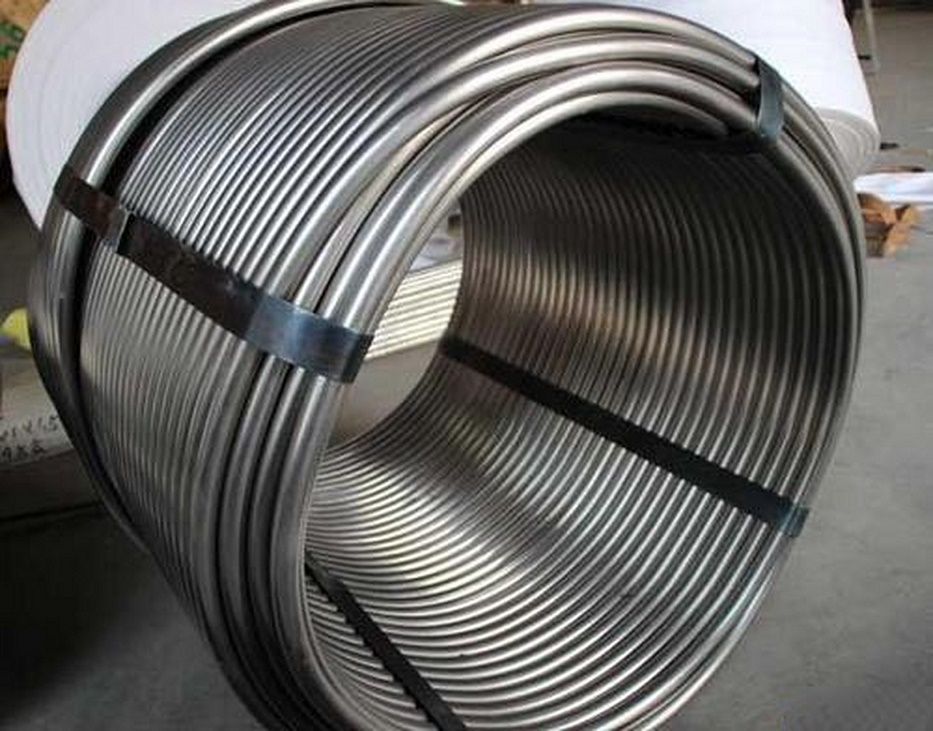
Laser welding overcomes traditional limitations of high-frequency welding, including groove corrosion susceptibility and internal burr formation. The process achieves:
- 60-70% reduction in energy consumption compared to HF welding
- Elimination of internal burrs that disrupt fluid flow
- Minimal heat input preserving material metallurgy
- Superior corrosion performance in the weld zone
Economic Advantages for Heat Exchanger Manufacturers
The transition to stainless steel tube manufactured via laser welding delivers substantial economic benefits:
| Material Utilization | 92-95% (vs. 75-85% for seamless) |
| Production Speed | 3-5x faster than TIG welding |
| Scrap Rate | <2% (industry average 5-8%) |
| Quality Assurance | 100% automated inspection capability |
| Lifecycle Cost | 15-25% reduction over 10-year service |
Laser Welded Tubes in Next-Generation Heat Exchangers
As heat exchanger designs evolve toward compact, high-efficiency configurations, laser welded tubes enable:
- Thinner wall designs (down to 0.3mm) for weight reduction
- Integration with additive manufacturing for complex geometries
- Multi-material welding for specialized service conditions
- Digital twin integration for predictive maintenance
Expert Insight: The precision and consistency of laser welded stainless steel tube technology has redefined performance benchmarks in heat exchanger design. For engineers specifying tubing for critical thermal applications, laser welded options now deliver the reliability of seamless tubes with enhanced dimensional control and significant cost advantages.