


Lord Fin Tube--Seamless steel extruded finned tube
Seamless Steel Extruded Finned Tubes
Technical specifications, manufacturing processes, and procurement considerations for industrial heat transfer applications
Seamless Steel Extruded Finned Tube Manufacturing Process
The production of seamless steel extruded finned tubes involves a specialized mechanical process where fins are formed from the base tube material itself. Unlike welded or embedded fins, extruded fins are created by forcing the tube material through a die that shapes the fin structure. This results in a monolithic construction with no separate bond between fin and tube.
Industrial finned tube applications demand precision engineering, particularly for seamless variants where material integrity is paramount. The extrusion process begins with seamless carbon or alloy steel tubes that meet specific pressure and temperature requirements. Through controlled pressure and rotational movement, the tube material is reshaped to create continuous helical or longitudinal fins with precise dimensional characteristics.
Seamless Steel Extruded Finned Tube Material Specifications
Material selection for seamless extruded finned tubes depends on operating conditions, corrosion requirements, and thermal performance needs. Common base materials include ASTM A192, A213, and A335 specifications, each suitable for different temperature and pressure ranges.
| Material Standard | Temperature Range | Pressure Rating | Common Applications | Fin Height Range |
|---|---|---|---|---|
| ASTM A192 | Up to 450°C | High Pressure | Boiler Systems | 6-25 mm |
| ASTM A213 T11/T22 | Up to 550°C | Medium-High Pressure | Heat Exchangers | 8-20 mm |
| ASTM A335 P11/P22 | Up to 600°C | High Pressure | Superheaters | 10-30 mm |
| ASTM A179 | Up to 400°C | Medium Pressure | Condensers | 6-15 mm |
Standard specifications for seamless steel extruded finned tubes in various applications
Seamless Steel Extruded Finned Tube Thermal Performance
Heat transfer efficiency in seamless extruded finned tubes is determined by multiple geometric and material factors. The integral fin construction eliminates thermal resistance at the fin-tube interface, providing superior heat conduction compared to attached-fin designs.
Fin Efficiency Calculation
Fin efficiency for extruded designs typically exceeds 85% due to the continuous material transition from tube to fin. Efficiency depends on fin height, thickness, material conductivity, and surrounding fluid properties.
Surface Area Enhancement
Extruded fins provide 5-12 times more surface area than bare tubes, with the exact ratio determined by fin density, height, and profile geometry. This enhancement directly impacts heat transfer capacity.
Pressure Drop Considerations
While increasing fin density improves heat transfer, it also affects flow resistance. Optimal designs balance thermal performance with acceptable pressure loss across the tube bundle.
Seamless Steel Extruded Finned Tube Applications
- Heat recovery steam generators (HRSG) in power plants
- Air-cooled heat exchangers in petrochemical facilities
- Waste heat boilers for industrial processes
- Radiator systems for heavy machinery
- Thermal oil heaters in chemical processing
- Economizers for boiler efficiency improvement
- Process gas coolers in refineries
- Biomass boiler superheaters
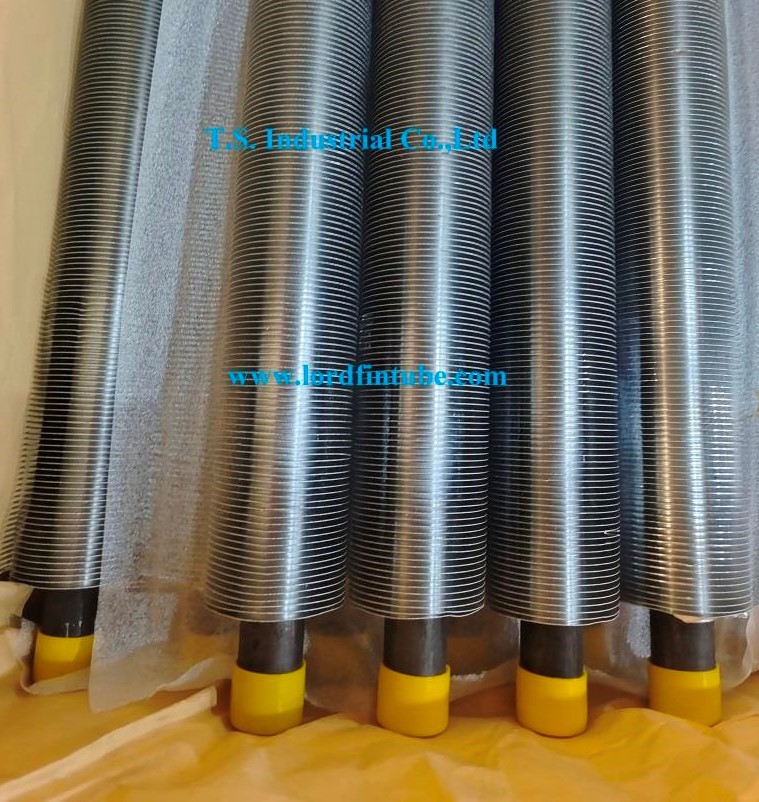
Manufacturing process and structural details of seamless steel extruded finned tubes
Seamless Steel Extruded Finned Tube Procurement Guidelines
When sourcing seamless extruded finned tubes, technical specifications must align precisely with operational requirements. The following checklist ensures comprehensive procurement evaluation:
Dimensional Verification
Confirm tube OD, wall thickness, fin height, thickness, and pitch meet design specifications. Tolerances should comply with ASTM or ASME standards.
Material Certification
Request mill test certificates for base tube material, verifying chemical composition and mechanical properties against specified standards.
Surface Inspection
Examine fin formation consistency, surface finish, and absence of manufacturing defects like cracks or uneven fin distribution.
Manufacturing Note: The extrusion process work-hardens the fin material, increasing its mechanical strength. This characteristic makes seamless extruded finned tubes particularly resistant to vibration and thermal cycling stresses in industrial environments.
Seamless Steel Extruded Finned Tube vs Alternative Technologies
| Feature | Seamless Extruded Finned Tubes | Welded Finned Tubes | Embedded Finned Tubes |
|---|---|---|---|
| Thermal Contact | Perfect (monolithic construction) | Good (welded interface) | Variable (mechanical bond) |
| Maximum Temperature | 600°C+ | 400°C | 350°C |
| Pressure Rating | Very High | High | Medium |
| Corrosion Resistance | Excellent at fin base | Potential at weld line | Potential at grooves |
| Manufacturing Cost | Higher initial investment | Moderate | Lower |
| Lifecycle Cost | Lower (reduced maintenance) | Moderate | Higher (potential retubing) |
Technical Specification Inquiry Form
| Sample Specification Request for Seamless Steel Extruded Finned Tubes | ||||
|---|---|---|---|---|
| Parameter | Unit | Value | Standard | Notes |
| Base Tube Material | - | ASTM A192 | ASME SA192 | Seamless carbon steel |
| Tube Outer Diameter | mm | 25.4 | ±0.1mm | Before finning |
| Tube Wall Thickness | mm | 2.0 | ±10% | Minimum at any point |
| Fin Height | mm | 15.9 | ±0.3mm | From root to tip |
| Fin Thickness | mm | 0.4 | ±0.05mm | At fin root |
| Fin Pitch | mm | 2.54 | ±0.1mm | Center to center |
| Fin Type | - | Helical | Continuous | Extruded integral |
| Surface Finish | - | Pickled | ASTM A380 | Clean, oil-free |
Seamless steel extruded finned tubes represent a specialized heat transfer technology where material integrity and thermal performance converge. Their manufacturing process ensures continuous metallurgical structure from tube wall through fin structure, eliminating potential failure points present in alternative fin attachment methods. This characteristic makes them particularly suitable for high-pressure, high-temperature applications where reliability is non-negotiable.
Proper specification requires careful consideration of operating parameters, fluid characteristics, and thermal cycling conditions. Material selection should account for both process conditions and potential corrosion mechanisms. The higher initial investment in seamless extruded finned tubes often yields significant lifecycle cost savings through reduced maintenance, extended service life, and consistent thermal performance.