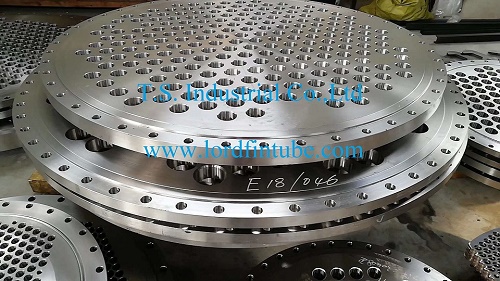

Tube sheet type and specific description
A tube sheet is a critical component in various heat exchangers and shell-and-tube vessels. Its primary purpose is to provide support and sealing for a bundle of tubes within a cylindrical or rectangular shell. There are different types of tube sheets, each designed for specific applications. Here are some common types of tube sheets along with their specific descriptions:
1. Stationary Tube Sheet:
- Description: A stationary tube sheet is fixed in place within the shell of a heat exchanger or pressure vessel. The tubes are either welded or rolled into holes in the stationary tube sheet, and they do not move relative to the tube sheet. This design is suitable for applications where differential thermal expansion between the tubes and shell is minimal.
2. Floating Tube Sheet:
- Description: A floating tube sheet is designed to allow the tube bundle to expand and contract freely with temperature changes. The tube sheet is not directly welded or attached to the shell; instead, it is free to move within certain constraints. This design is used when there are significant temperature variations, and it helps prevent damage to the tubes and tube-to-tube sheet joints.
3. U-Tube Bundle:
- Description: In a U-tube bundle heat exchanger, the tubes are bent into a U-shape, and the ends of the U-tubes are fixed or welded to a single tube sheet. This configuration is often used in applications where thermal expansion and contraction need to be accommodated, but the bundle needs to be removable for maintenance.
4. Floating Head Tube Sheet:
- Description: In some shell-and-tube heat exchangers, one end of the shell is closed by a stationary tube sheet, while the other end is closed by a floating head tube sheet. The floating head can move axially to accommodate thermal expansion and contraction of the tubes. This design is common in larger heat exchangers.
5. Fixed Tube Sheet (with Expansion Joint):
- Description: In cases where the temperature differential between the tubes and the shell is significant, and a floating tube sheet may not be practical, expansion joints can be incorporated into the design of a fixed tube sheet. These expansion joints allow some movement while maintaining a secure connection between the tubes and the tube sheet.
Tube sheet type comparison
Comparing different tube sheet designs helps engineers and procurement specialists match the right configuration to specific operational demands. Each type carries distinct mechanical behavior, maintenance accessibility, and cost implications. The table below summarizes key differentiators across the five common tube sheet types.
| Tube Sheet Type | Movement Allowance | Thermal Expansion Handling | Maintenance Access | Typical Applications |
|---|---|---|---|---|
| Stationary | None (fixed) | Minimal differential | Limited | Low-temperature exchangers, condensers |
| Floating | Free axial/radial | High differential | Moderate | High-temperature processes, reboilers |
| U-Tube Bundle | Single-end fixed | Accommodated by U-bend | Bundle removable | High-pressure gas coolers, hydraulic systems |
| Floating Head | Axial (floating head) | Large differential | Good (head removable) | Large industrial heat exchangers |
| Fixed with Expansion Joint | Limited (joint flex) | Significant differential | Restricted | Steam generators, chemical reactors |
What becomes clear from this comparison is that no single tube sheet type fits every scenario. The stationary design offers simplicity and lower initial cost, while floating and floating head configurations provide superior thermal stress relief at a higher complexity and price point. U-tube bundles strike a balance between removability and expansion accommodation, making them a popular choice for moderate-duty services.
Tube sheet type selection
Which tube sheet type should an engineer choose for a new heat exchanger project? The answer depends on a combination of thermal, mechanical, and operational parameters. How does one navigate these choices effectively? By evaluating the following core criteria:
- Temperature range: What is the maximum and minimum operating temperature? Larger temperature swings favor floating or floating head designs to prevent tube-to-sheet joint failure.
- Pressure differential: How much pressure difference exists between the tube side and the shell side? Stationary tube sheets handle high differentials well, but expansion joints may be needed for combined thermal-pressure loads.
- Maintenance frequency: How often will the bundle need cleaning or inspection? U-tube and floating head types allow bundle withdrawal, which reduces downtime.
- Space constraints: What are the physical dimensions of the installation area? Floating head designs require additional shell length for head movement.
- Budget and lifecycle cost: Which option offers the best balance between initial capital expenditure and long-term reliability? Stationary tube sheets are economical upfront, but floating designs may reduce maintenance costs over time.
What many procurement professionals overlook is the interplay between tube sheet type and tube layout. For instance, a floating tube sheet often pairs with a triangular pitch to maximize tube count, while a stationary design may use a square pitch for easier cleaning. How these variables interact directly impacts heat transfer efficiency and fouling resistance.
When evaluating suppliers, ask how they handle thermal expansion calculations for each tube sheet type. Reputable manufacturers provide detailed finite element analysis (FEA) reports that validate the design under worst-case operating conditions. Which data points should be requested? Thermal stress distribution, tube pull-out forces, and shell-side pressure drop are among the most critical.
Tube sheet type materials
What materials are suitable for different tube sheet types? The choice of material directly affects corrosion resistance, strength at elevated temperatures, and weldability. Common material families include:
- Carbon steel (SA-516, SA-266): Cost-effective for moderate temperatures and non-corrosive services. Used extensively in stationary and fixed tube sheets for water and steam applications.
- Stainless steel (304, 316, 321): Offers excellent corrosion resistance and good high-temperature strength. Floating and U-tube bundle designs frequently utilize stainless steel for chemical and petrochemical services.
- Alloy steel (Cr-Mo grades): Withstands high pressures and temperatures. Floating head tube sheets in refinery applications often specify alloy steels like 1.25Cr-0.5Mo or 2.25Cr-1Mo.
- Nickel alloys (Inconel, Monel, Hastelloy): Selected for extreme corrosion environments, such as seawater cooling or sour gas services. Floating tube sheets in offshore platforms commonly use these alloys.
- Titanium and copper alloys: Lightweight and highly corrosion-resistant, though expensive. Used in specialized aerospace and marine heat exchangers.
How does material selection interact with tube sheet type? A stationary tube sheet in carbon steel is straightforward to fabricate, but a floating tube sheet in a nickel alloy requires careful welding procedures and post-weld heat treatment to avoid stress corrosion cracking. Which material offers the best value? For many industrial applications, stainless steel 316 provides an optimal balance of performance and cost, especially when paired with a U-tube bundle configuration.
Procurement specialists should also consider material availability and lead times. Exotic alloys may extend delivery schedules, whereas carbon steel and standard stainless grades are typically stocked by major distributors. What about clad or lined tube sheets? For highly corrosive services, a carbon steel tube sheet with a corrosion-resistant cladding (e.g., Inconel overlay) can reduce costs while maintaining performance, a strategy often applied to floating head designs.
Tube sheet type applications
Which industries rely on specific tube sheet types? Understanding real-world applications helps procurement teams select the right design for their sector. Here is how different tube sheet types are deployed across major industries:
- Power generation: Stationary tube sheets are common in feedwater heaters and surface condensers, where temperature differentials remain modest. Fixed tube sheets with expansion joints appear in steam generator reheater sections.
- Oil and gas: Floating tube sheets dominate in crude oil preheaters and gas dehydration units, where wide temperature swings occur during startup and shutdown. Floating head designs are also used in large fractionation column reboilers.
- Chemical processing: U-tube bundles are frequently specified for reactor effluent coolers and distillation column condensers, offering the advantage of easy bundle removal for catalyst or fouling cleaning.
- Pharmaceutical and food: Stainless steel stationary tube sheets with polished surfaces are used in sanitary heat exchangers to prevent product contamination and facilitate cleaning-in-place (CIP).
- HVAC and refrigeration: Compact U-tube and fixed tube sheet designs are employed in chillers and evaporators, where space is limited and thermal loads are relatively constant.
How does application environment influence tube sheet type choice? For offshore platforms, floating tube sheets with corrosion-resistant alloys are preferred to withstand marine atmospheres and thermal cycling from process upsets. In contrast, onshore chemical plants may opt for fixed tube sheets with expansion joints when the thermal differential is predictable but still significant.
What about emerging applications? Renewable energy systems, such as concentrated solar power (CSP) plants, use floating head tube sheets in thermal storage heat exchangers to handle diurnal temperature variations. Similarly, hydrogen production facilities employ U-tube bundles with high-nickel alloys to resist hydrogen embrittlement while accommodating thermal expansion.
The choice of tube sheet type depends on various factors, including the specific application, temperature and pressure requirements, and the need to accommodate thermal expansion and contraction. Proper selection and design of the tube sheet are crucial to ensure the efficient and safe operation of heat exchangers and pressure vessels.