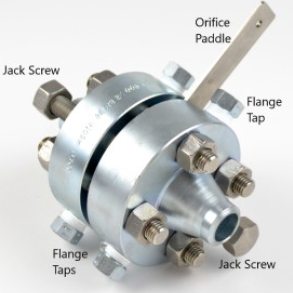

Weld Neck Orifice Flange with NPS 1/2 Socket Weld (SW) Pressure Taps
A weld neck orifice flange is a specialized clamping assembly used in differential-pressure flow measurement systems, manufactured in accordance with ASME B16.36. It consists of a matched pair of weld neck flanges that hold an orifice plate between their facing surfaces. Radially machined pressure taps in each flange body transmit the static pressure upstream and downstream of the orifice plate to a differential-pressure transmitter, which converts the pressure difference into volumetric or mass flow rate of the fluid inside the pipeline.
This article focuses on the configuration equipped with NPS 1/2 (DN15) Socket Weld (SW) pressure taps. Compared with the standard 1/2" NPT threaded taps, socket weld taps form a permanent metal-to-metal seal through fillet welding, eliminating the helical leakage path inherent in threaded connections. This design is particularly suited for flow measurement services involving high temperature, high pressure, flammable, explosive, toxic, or otherwise hazardous media.
Structural Design Features
2.1 Weld Neck Flange Body
- The flange hub is joined to the process pipe by a butt weld, producing a full-penetration joint with uniform stress distribution and excellent fatigue resistance.
- The tapered hub transition effectively reduces stress concentration at the flange-to-pipe junction, making it suitable for services with frequent pressure fluctuations.
- The flange bore matches the pipe inside diameter, ensuring a stable flow profile across the orifice plate and preserving measurement accuracy without internal diameter discontinuities.
2.2 Orifice Plate Clamping and Location
- The orifice plate is clamped between the facing surfaces of the two flanges. A handling tab (or handle) on the plate periphery facilitates alignment during installation and extraction during maintenance.
- Jack screws (extractor screws) are provided to safely separate the two flanges during inspection, preventing damage to the orifice plate and gasket surfaces.
- Facing options include Raised Face (RF) for Class 300–600 medium-pressure services and Ring Type Joint (RTJ) for Class 900 and above, where metallic ring gaskets deliver higher sealing reliability.
2.3 NPS 1/2 Socket Weld Pressure Taps
The pressure tap (meter tap) is the defining feature that distinguishes an orifice flange from a standard flange.
Tap Configuration: NPS 1/2 (DN15) nominal size • Socket Weld (SW) connection per ASME B16.11 • Two taps per flange, 180° apart radially • Flange-tap style, tap center 25.4 mm (1 inch) from the flange face
Key dimensional and positional parameters:
| Parameter | Specification |
|---|---|
| Nominal tap size | NPS 1/2 (DN15) |
| Connection type | Socket Weld (SW), conforming to ASME B16.11 forged socket-welding fittings |
| Quantity | 2 taps per flange, diametrically opposed at 180° (one in service, one standby; or used for drain/vent) |
| Tap style | Flange tap — the centerline of the tap bore is located 25.4 mm (1 inch) from the flange facing surface (orifice plate face), with tight tolerances (±0.5 mm for NPS < 4, ±0.8 mm for NPS ≥ 4) |
Advantages of Socket Weld Pressure Taps:
Material Selection
Depending on the process medium, temperature, and pressure, the flange body and pressure taps may be supplied in the following materials:
| Material | Standard / Grade | Applications |
|---|---|---|
| Carbon Steel | ASTM A105 / A105N | for water, steam, oil, and general services; most economical. |
| Low-Temperature Carbon Steel | ASTM A350 LF2 | for cryogenic services down to -46°C. |
| Stainless Steel | ASTM A182 F304/F304L, F316/F316L | for corrosive media, food and pharmaceutical industries. |
| Alloy Steel | ASTM A182 F11 (1.25Cr-0.5Mo), F22 (2.25Cr-1Mo) | for high-temperature, high-pressure hydroprocessing and refining services. |
| Duplex Steel | ASTM A182 F51/F53 (2205 / 2507) | for chloride-bearing, seawater, and other strongly corrosive environments. |
The socket (tap bore) is normally of the same material as the flange body to ensure welding compatibility.
Typical Applications
Weld Neck Orifice Flange