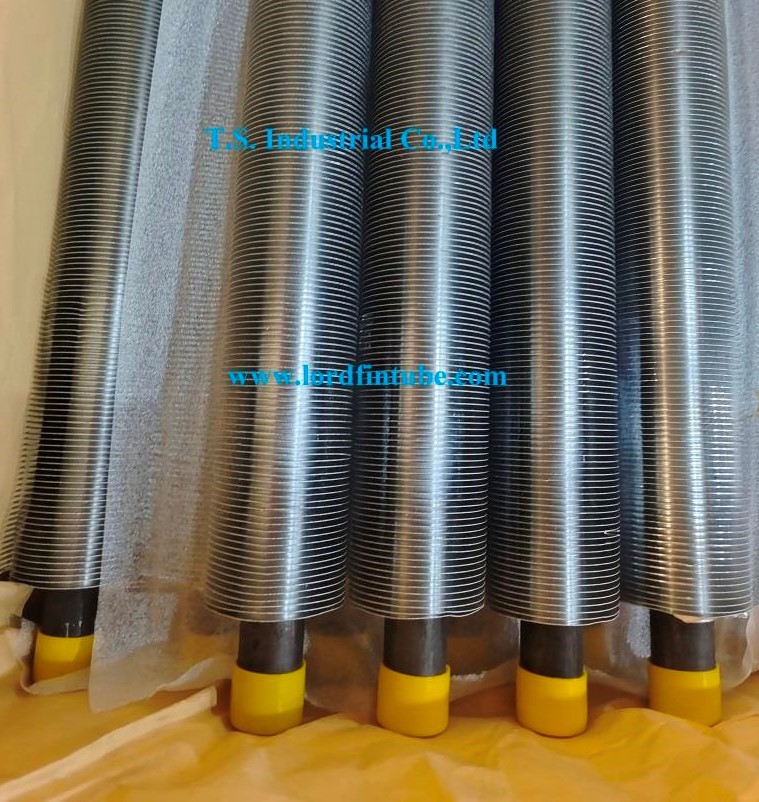

Lord Fin Tube-ASTM A210 A1 Extuded Fin Tubes
ASTM A210 A1 extruded fin tubes
ASTM A210 A1 Extuded Fin Tubes represent a mature, high-performance solution for industrial heat exchange where reliability and thermal efficiency are non-negotiable. These bimetallic finned tubes combine a seamless carbon steel base tube (per ASTM A210 Grade A-1) with an integrally formed aluminum fin, creating a durable composite that withstands elevated temperatures, internal pressures, and corrosive environments. What sets them apart from welded or wrapped fin alternatives? How does the extrusion process influence long-term heat transfer? And which operating conditions favour this specific fin-tube configuration? This page addresses those practical questions with technical depth and real-world perspective.
ASTM A210 A1 extruded fin tubes material specifications
The base tube of ASTM A210 A1 extruded fin tubes is manufactured from seamless carbon steel in accordance with ASTM A210 Grade A-1. This material is specifically chosen for its balanced mechanical strength, resistance to thermal fatigue, and suitability for moderate-to-high temperature service. The aluminum fin, typically alloy 1060 or 1100, provides excellent thermal conductivity while remaining lightweight and corrosion-resistant in atmospheric conditions.
| Elements | Carbon | Mn | P | S | Si |
| Standard Requirement | ≤ 0.27 | ≤ 0.93 | ≤ 0.0035 | ≤ 0.0035 | ≥ 0.1 |
| Property | Value | Condition |
| Tensile Strength | ≥ 415 MPa (60,000 psi) | Room temperature |
| Yield Strength (min) | ≥ 255 MPa (37,000 psi) | 0.2% offset |
| Elongation (min) | 30% (in 50 mm) | Longitudinal |
| Hardness (HBW) | 137 – 187 | Brinell |
| Maximum Operating Temperature | 425 °C (800 °F) | Continuous service |
Which properties matter most for heat exchanger designers? The combination of moderate carbon content (≤0.27%) and manganese (≤0.93%) ensures adequate hardenability without sacrificing weldability or formability. The silicon content (≥0.1%) contributes to deoxidation and improves high-temperature oxidation resistance. These compositional controls directly affect how ASTM A210 A1 extruded fin tubes perform under cyclic thermal loads and in the presence of combustion gases or process fluids.
ASTM A210 A1 extruded fin tubes manufacturing process
How are ASTM A210 A1 extruded fin tubes produced? The manufacturing sequence relies on a cold-forming extrusion technique that ensures metallurgical bonding between the steel base tube and the aluminum fin. Unlike wrapped or embedded fin designs, the extrusion process creates a continuous, void-free interface that minimises contact thermal resistance from the outset.
- Tube preparation: The seamless ASTM A210 A1 base tube is cleaned and inspected to remove surface oxides, oils, and scale. Precise outer diameter and wall thickness tolerances are verified before further processing.
- Aluminum sleeve application: An aluminum tube or sleeve, with a controlled wall thickness and internal clearance, is slipped over the prepared steel base tube. The aluminum alloy (typically 1060 or 1100) is chosen for its ductility and thermal conductivity.
- Extrusion rolling: The assembled bimetallic tube passes through a finning machine equipped with multiple rolling disks. These disks exert radial pressure, forcing the aluminum material outward into helical fin profiles while simultaneously compressing the aluminum against the steel substrate. The result is a mechanically interlocked and diffusion-bonded interface.
- Finishing and inspection: After extrusion, the finned tube undergoes dimensional checking, fin-height measurement, and visual inspection. Hydrostatic testing or eddy-current examination may be applied to verify the integrity of the base tube and the fin-to-tube bond.
Why does this process matter for end-users? The extrusion method produces fins with consistent height, pitch, and thickness, which translates to predictable heat-transfer coefficients across the entire tube length. Additionally, the cold-working action work-hardens the aluminum fin, giving it improved resistance to mechanical damage during cleaning and maintenance.
ASTM A210 A1 extruded fin tubes performance characteristics
The performance of ASTM A210 A1 extruded fin tubes hinges on several interrelated factors: the thermal conductivity of the aluminum fin, the integrity of the fin–tube interface, and the corrosion resistance of the steel substrate. Below are the key characteristics that define their operational behaviour.
- The base tube is seamless carbon steel per ASTM A210 A1, delivering good mechanical properties, temperature resistance, pressure resistance, and corrosion resistance.
- The outer fin is manufactured from aluminium, which is light in weight, low in price, easy to process, offers good atmospheric corrosion resistance, and presents a clean appearance.
- Fins exhibit high mechanical strength and can withstand high-pressure washing, steam cleaning, and mechanical descaling without permanent deformation.
- The contact thermal resistance between the fin and the base tube remains stable over time; it does not increase due to corrosion or oxidation of the base tube under normal operating conditions.
Which factor most affects long-term performance? Field data indicates that the bond integrity between the aluminum fin and the steel tube is the primary determinant of thermal efficiency over time. Because the extrusion process creates a continuous metallic interface without voids or organic adhesives, ASTM A210 A1 extruded fin tubes maintain their heat-transfer capability even after thousands of thermal cycles. This reliability makes them a preferred choice for critical service where unplanned downtime carries high costs.
ASTM A210 A1 extruded fin tubes application fields
ASTM A210 A1 extruded fin tubes are widely used in air cooling, air conditioning, power plants, petroleum, chemical and other equipment and air heat exchangers. Their versatility stems from the balance between cost, thermal performance, and mechanical robustness.
More specifically, these finned tubes appear in the following types of equipment and systems:
- Air-cooled heat exchangers (ACHE): Used in refineries, petrochemical plants, and gas processing facilities where water availability is limited.
- Condensers and evaporators: Applied in HVAC systems, refrigeration trains, and process cooling loops.
- Waste heat recovery units: Recover thermal energy from exhaust gases in power generation and industrial furnaces.
- Oil coolers and transformer cooling: Maintain optimal fluid temperatures in power transmission and hydraulic systems.
- Chemical reactor cooling: Remove exothermic heat from catalytic and polymerization reactors.
What makes ASTM A210 A1 extruded fin tubes suitable for such diverse applications? The seamless steel base tube provides pressure containment for fluids up to moderate pressures, while the aluminum fin efficiently transfers heat to or from the surrounding air or gas stream. The extruded fin geometry also allows for a high surface-area-to-volume ratio, which reduces the overall size and weight of the heat exchanger.
ASTM A210 A1 extruded fin tubes comparison with other fin types
How do ASTM A210 A1 extruded fin tubes stack up against other common fin-tube constructions? The table below compares extruded, L-foot wrapped, and helical welded fin designs across key performance and economic criteria.
| Parameter | Extruded (A210 A1 + Al) | L-Foot Wrapped | Helical Welded (Steel) |
| Fin-to-tube bond | Metallurgical / mechanical interlock | Mechanical grip only | Continuous weld |
| Contact thermal resistance | Very low, stable | Moderate, may increase with age | Low, but weld-affected zone |
| Corrosion resistance (fin side) | Excellent (aluminium) | Good (aluminium) | Moderate (carbon steel) |
| Maximum fin temperature | ~300 °C (aluminium limit) | ~250 °C | ~450 °C (steel fin) |
| Resistance to mechanical cleaning | High | Low – risk of unravelling | Moderate |
| Relative cost | Medium-high | Low-medium | Medium |
| Typical service life (years) | 15 – 25 | 8 – 15 | 12 – 20 |
Why might an engineer choose extruded over wrapped or welded fins? For applications involving frequent thermal cycling, high-velocity airflow, or abrasive particulates, the extruded fins robust bond and smooth surface provide clear advantages. The aluminium fin also offers superior atmospheric corrosion resistance compared to plain carbon steel fins, reducing maintenance frequency. While the initial capital cost is higher than wrapped alternatives, the extended service life and stable thermal performance often result in lower total cost of ownership.