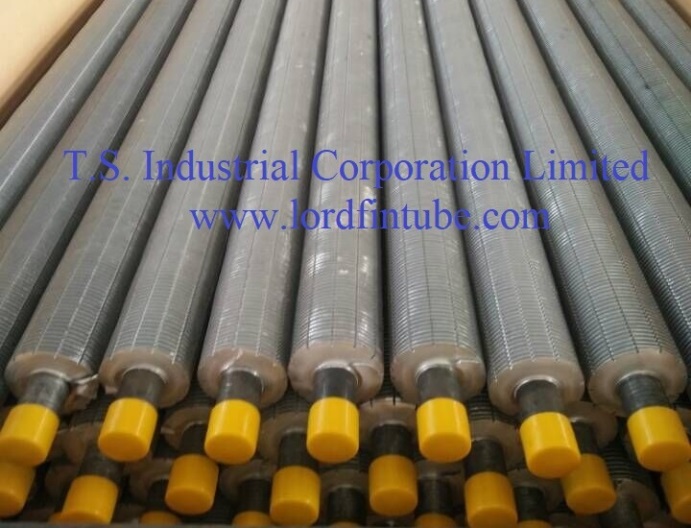

Lord Fin Tube--What is extruded fin tubing?
Extruded Fin Tubing
What is extruded fin tubing?
Aluminum extruded fin tubing, also known as “integral finned tubes,” are formed by machine extrusion of a base tube covered with aluminum tube (the base tube can be carbon steel, stainless steel, or copper) to form a tube fin, the fin base and the tube outer wall are close fitting, and this fin tubing control can produce finned tubes with high heat transfer coefficient and heat transfer performance. Extruded fin tubing can be made of iron, copper, or aluminum tube through compound rolling, which has the advantages of tight bonding, low thermal resistance, good heat transfer performance, high strength, low flow loss, strong anti-corrosion performance, not easily deformed under long-term hot and cold working conditions, and long working life.
Which industries rely most heavily on extruded fin tubing? Power generation, petrochemical processing, refrigeration, and HVAC systems all depend on these components for efficient thermal management. The integral design eliminates the contact resistance that plagues mechanically bonded fins, making extruded fin tubing a preferred choice for demanding heat exchange applications.
How extruded fin tubing works
The working principle of extruded fin tubing centers on maximizing the surface area available for heat transfer while maintaining a direct metallic bond between the fin and the base tube. During operation, heat flows from the fluid inside the base tube through the tube wall and into the integral fins, where it is dissipated to the surrounding air or process gas. Because the fins are formed from the same continuous material as the outer tube, there is no interfacial resistance to impede heat flow.
What makes this design particularly effective? The extrusion process produces fins with a consistent profile and uniform thickness, which ensures predictable thermal performance across the entire length of the tube. The close-fitting fin base also protects the inner tube from corrosive environments, extending the service life of the heat exchanger.
Which factors influence the thermal efficiency of extruded fin tubing? Fin density, fin height, tube diameter, and the thermal conductivity of the materials used all play significant roles. Higher fin densities provide more surface area but may increase air-side pressure drop, so engineers must balance these parameters based on the specific operating conditions.
Materials for extruded fin tubing
The selection of materials for extruded fin tubing directly affects performance, durability, and cost. The base tube material is chosen based on the fluid being handled, while the outer tube material is selected for its corrosion resistance and formability during the extrusion process.
| Base Tube Material | Outer Tube Material | Typical Applications | Max Working Temperature |
|---|---|---|---|
| Carbon Steel | Aluminum | Air coolers, economizers, industrial heat exchangers | 280°C |
| Stainless Steel | Aluminum | Corrosive environments, food processing, chemical plants | 300°C |
| Copper | Aluminum | Refrigeration, HVAC, condensers | 260°C |
| Aluminum | Aluminum | Lightweight applications, cryogenic systems | 250°C |
| Titanium | Aluminum | Marine environments, aggressive chemical service | 280°C |
Which material combination offers the best overall performance? Aluminum over carbon steel remains the most popular choice due to its balance of cost, thermal conductivity, and corrosion resistance. For applications involving aggressive fluids, stainless steel base tubes provide the necessary protection while the aluminum outer tube ensures efficient heat transfer.
Extruded fin tubing manufacturing process
Pipe line——compressing or rolling——strip peeling——washing——pressure test——blast blowing——packaging.
Extruded fin tubing is made up of a bimetallic tube made up of an aluminum outer tube and an inner tube made of almost any material. The fin is formed by rolling the material from the outside of the outer tube, resulting in an integrated fin with excellent heat transfer performance and longevity. The base tube is well protected against corrosion thanks to the extruded fins.
The extrusion method is used to manufacture the composite finned tube: the bimetallic composite tube is lined with a mandrel, and the composite tube is processed on the outer surface through the cavity formed by the rolling groove and the core head Out fins. This method produces a heat transfer tube that is an organic whole with its outer tube and fins, so there is no contact heat loss, and it has good performance and high heat transfer efficiency.
What are the critical parameters controlled during the extrusion process? Rolling pressure, feed rate, mandrel position, and cooling rate all influence the final fin geometry and the integrity of the bond between the inner and outer tubes. Precise control of these parameters ensures consistent fin height, thickness, and pitch across the entire production run.
| Process Parameter | Typical Range | Effect on Product Quality |
|---|---|---|
| Rolling Pressure | 50–150 MPa | Determines fin density and bond strength |
| Feed Rate | 2–8 m/min | Affects fin surface finish and dimensional accuracy |
| Mandrel Position | ±0.05 mm | Controls wall thickness uniformity |
| Cooling Rate | Controlled by water/air quench | Influences material microstructure and stress distribution |
Why choose extruded fin tubing
When comparing extruded fin tubing to other finned tube types, several distinct advantages emerge. The integral construction eliminates the thermal contact resistance that is inherent in wrapped or embedded fin designs. This means more efficient heat transfer and lower energy consumption over the life of the equipment.
How does extruded fin tubing compare to spiral-wound finned tubes? The following table highlights the key differences:
| Characteristic | Extruded Fin Tubing | Spiral-Wound Finned Tube |
|---|---|---|
| Thermal Contact Resistance | None (integral construction) | Significant (mechanical bond) |
| Corrosion Resistance | Superior (aluminum outer layer protects base tube) | Moderate (gap between fin and tube can trap moisture) |
| Maximum Operating Temperature | 280–300°C | Up to 400°C (depending on fin material) |
| Fin Attachment Strength | Very high (integral) | Moderate (mechanical or brazed) |
| Resistance to Cleaning (high-pressure water) | Withstands 4.0 MPa without fin damage | May loosen or deform under high pressure |
| Thermal Performance Stability | Stable over wide temperature range | Decreases with thermal cycling |
Which application conditions favor extruded fin tubing? Environments with thermal cycling, corrosive atmospheres, or where high-pressure cleaning is required are ideal candidates. The robust construction and stable thermal performance make extruded fin tubing a reliable choice for critical heat exchange services.
Benefits of extruded fin tubing
When compared to the ordinary wound finned tube, the contact thermal resistance remains stable over a wide temperature range, implying that the heat transfer performance of the bimetallic aluminum extruded finned tube is superior to the spiral fin tube in the limit tube wall temperature range.
Furthermore, when compared to the coiled tube, the bimetallic aluminum extruded fin tube has superior corrosion resistance and high strength; it can withstand 4.0MPa water pressure cleaning without the fins falling down, and the base of the bimetallic aluminum extruded tube. The tube can be chosen based on the corrosion of the fluid in the tube as well as the processing technology. The base tube can be made of carbon steel, copper, stainless steel, or another material.
What additional benefits do extruded fin tubing offer? The smooth, continuous fin surface reduces fouling and makes cleaning easier. The integral fin design also eliminates the risk of fin loosening due to thermal expansion or vibration, which is a common failure mode in mechanically attached fins. These characteristics translate to lower maintenance costs and higher system reliability over the equipment lifespan.
Applications of extruded fin tubing
Extruded fin tubings are the primary components of air coolers and are frequently used as heat exchangers in power plants (electric, nuclear, thermal and geothermal). System for collecting steam condensate. Industries such as petrochemicals and chemicals. Refrigeration and food processing plants. Industry (steel mills, incinerators, gas compression facilities). Petrochemical, power plant and power plant renovation, air conditioning and refrigeration, boilers, finned tube economizers, and air preheaters are just a few of the industries we work in. The maximum working temperature ranges between 280°C and 300°C.
Which specific equipment types commonly use extruded fin tubing? The list includes air-cooled heat exchangers, condenser coils, evaporator coils, waste heat recovery units, boiler economizers, and process gas coolers. In each of these applications, the high heat transfer efficiency and corrosion resistance of extruded fin tubing contribute to improved process performance and reduced energy consumption.
| Industry Sector | Typical Equipment | Operating Conditions |
|---|---|---|
| Power Generation | Air-cooled condensers, economizers | High temperature, steam/water side |
| Petrochemical | Process coolers, condensers | Corrosive fluids, high pressure |
| Refrigeration | Evaporators, condensers | Low temperature, refrigerants |
| Steel Mills | Gas cooling systems, heat recovery | High dust loading, thermal cycling |
| Food Processing | Cooling coils, air dryers | Hygienic requirements, moderate temperatures |
| HVAC | Chillers, heat pumps, air handlers | Varying loads, ambient conditions |