


Lord Fin Tube--HFW Spiral finned tube
What is HFW Spiral finned tube?
HFW Spiral finned tube is short for High-frequency welding spiral finned tube, which made against disadvantage of Strings and wound fin type fnned tube. The finned tube heat sink and improve by use of a high-frequency welding. Finned tube efficient cooling element, finned tube itself is the thickness of 0.8 -1mm strip wound on the finned tube, while using high-frequency welding process, the chip-weld on the pipe, to ensure that the combined strength of the tube with fins, the metal heat intensity reached 1.10 ~ 1.20w / kg ℃ economizer the finned tubes are widely used in boilers, air preheater production and factories, residential energy radiator production, and around the chip of choice as a heat pipe late.
How does HFW Spiral finned tube improve heat transfer efficiency?
HFW Spiral finned tube substantially expands the effective heat exchange surface area while maintaining a compact footprint. The high-frequency welding technique creates a continuous metallurgical bond between the fin strip and the base tube, which virtually eliminates contact thermal resistance. This direct bond allows heat to flow from the tube wall into the fin with minimal impedance, and from the fin surface into the surrounding air or gas stream with exceptional effectiveness. In practical terms, a HFW Spiral finned tube can deliver 5 to 10 times the heat transfer capacity of a bare tube of the same diameter, which directly translates into smaller equipment size, lower fan power consumption, and reduced overall system cost.
HFW Spiral finned tube is a highly efficient heat transfer components.
HFW Spiral finned tubes heat transfer area of the bare pipe several times or can be enhanced heat transfer and reduce flow resistance and reduce metal consumption, thereby improving the economy and operational reliability of heat transfer equipment. Currently, the finned tube has been widely used in a variety of boilers.
Why choose HFW Spiral finned tube over other finned tube types?
When comparing HFW Spiral finned tube with wrapped, embedded, or extruded fin tubes, several key differentiators emerge. The high-frequency welded fin maintains its bond integrity under severe thermal cycling and mechanical vibration, whereas wrapped fins may loosen over time and embedded fins can suffer from stress concentration at the groove roots. The HFW process also allows for tighter fin spacing and higher fin density, which directly increases the heat transfer area per unit length. Furthermore, the weld penetration is precisely controlled to avoid burn-through or excessive heat-affected zones, preserving the mechanical properties of the base tube. These advantages make HFW Spiral finned tube the preferred choice for critical applications where reliability and performance cannot be compromised.
HFW Spiral finned tube is regulary used and welcome by users because of its excellent thermal performance, strong bearing force, good corrosion resistance, long service life and beautiful outlook. In the previous radiator market, the large-scale production of heating equipment was cast iron radiator, which had a single shape, large metal consumption, low pressure, low metal thermal strength, inconvenient installation, and was gradually eliminated. The high-frequency welded fin tube radiator has become a substitute for the traditional radiator.
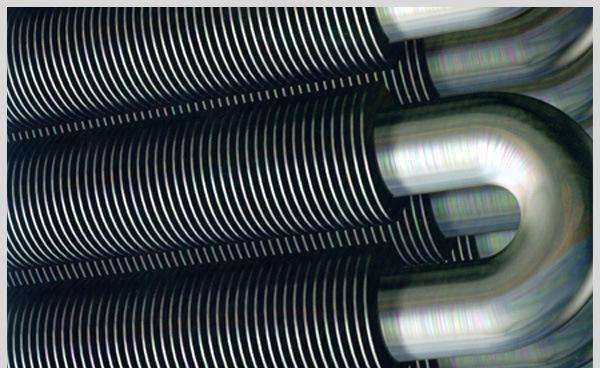
HFW Spiral finned tube
HFW Spiral finned tube manufacturing process
The production of HFW Spiral finned tube begins with selecting the appropriate base tube and fin strip materials based on the intended service conditions. The fin strip, typically 0.8 mm to 2.0 mm thick, is wound helically around the tube at a precise pitch while high-frequency electrical current is applied through contact shoes. The induced current creates localized heating at the interface between the fin and the tube, and as the strip is pressed against the tube, a solid-state weld is formed without the need for filler metal. This process is continuous and can achieve welding speeds that make it economically viable for large-scale production. The welding parameters—power, frequency, speed, and pressure—are monitored and adjusted in real time to ensure consistent weld quality across the entire length of the tube. After welding, the finned tube may undergo heat treatment or surface coating depending on the application requirements.
HFW Spiral finned tube technical specifications
| Parameter | Range / Options |
|---|---|
| Base tube material | Carbon steel (A106, A179, A192), stainless steel (304, 316, 321), alloy steel (T11, T22, T91) |
| Fin material | Carbon steel, stainless steel, copper, aluminum, or matching alloy |
| Base tube outer diameter | 25 mm – 219 mm (1 inch – 8.6 inches) |
| Fin height | 10 mm – 25 mm (0.4 inch – 1.0 inch) |
| Fin thickness | 0.8 mm – 2.0 mm (0.03 inch – 0.08 inch) |
| Fin pitch | 5 mm – 20 mm (3 – 12 fins per inch) |
| Maximum continuous operating temperature | Up to 600 °C (1112 °F) depending on material selection |
| Welding method | High-frequency resistance welding (HFW) with solid-state bond |
HFW Spiral finned tube applications in industry
HFW Spiral finned tubes are deployed across a broad spectrum of industrial sectors where thermal management is critical. In power generation, they serve as economizer tubes and air preheater elements in coal-fired and biomass boilers, recovering waste heat from flue gas to preheat combustion air or feedwater. In the petrochemical industry, these finned tubes are used in fired heaters, reformer furnaces, and heat exchangers for process streams that require precise temperature control. The HVAC sector relies on HFW Spiral finned tubes for large air-cooled heat exchangers, condenser coils, and unit heaters in commercial and institutional buildings. Additionally, waste heat recovery systems in cement plants, steel mills, and glass manufacturing facilities incorporate these finned tubes to capture otherwise lost thermal energy and improve overall plant efficiency. The versatility of HFW Spiral finned tube stems from its ability to handle both gas-to-liquid and gas-to-gas heat transfer duties with equal competence.
HFW Spiral finned tube vs conventional bare tubes
| Performance attribute | HFW Spiral finned tube | Conventional bare tube |
|---|---|---|
| Effective heat transfer area | 5 – 10 times larger per unit length | Base surface area only |
| Overall heat transfer coefficient | Substantially higher due to extended surface | Limited by bare surface area |
| Equipment footprint | Compact — fewer tubes required for same duty | Large — requires more tubes or larger shell |
| Air / gas side pressure drop | Moderate — optimized fin geometry reduces drag | Low — but at the cost of thermal performance |
| Material consumption per unit duty | Lower — less tube length and shell volume | Higher — more material for equivalent capacity |
| Operating cost (fan/ pumping power) | Lower — due to compact design and optimized flow | Higher — larger equipment requires more energy |
| Service life in corrosive or erosive environments | Longer — fin material can be selected for durability | Shorter — direct exposure of tube wall to harsh media |
HFW Spiral finned tube key features
HFW Spiral finned tube is distinguished by several core attributes that make it a preferred heat transfer solution in demanding environments. The high-frequency welded fin-to-tube bond provides exceptional mechanical strength and thermal conductivity, ensuring that the fin remains firmly attached throughout the equipments operational life. The spiral fin geometry promotes turbulent flow on the air or gas side, which further enhances heat transfer while managing fouling and particulate buildup more effectively than plain surfaces. Corrosion resistance can be tailored by selecting appropriate fin and tube materials, including stainless steel or corrosion-resistant alloys. The manufacturing process allows for tight tolerances on fin pitch and height, resulting in consistent thermal performance from tube to tube. These features collectively contribute to improved reliability, reduced maintenance intervals, and lower total cost of ownership for heat exchange equipment. Whether used in new installations or as replacements in existing systems, HFW Spiral finned tubes deliver measurable performance gains that translate into energy savings and operational stability.
Which factors affect the performance of HFW Spiral finned tube?
The thermal performance of a HFW Spiral finned tube depends on several interrelated factors. Fin geometry—including height, thickness, and pitch—determines the effective surface area and the air-side heat transfer coefficient. The thermal conductivity of both the tube and fin materials influences the overall heat transfer resistance, with higher conductivity materials yielding better performance. Operating conditions such as gas velocity, temperature differential, and fouling tendency also play significant roles. Additionally, the quality of the high-frequency weld directly impacts the bond integrity and thermal contact resistance; a well-executed weld ensures that the fin and tube act as a single thermal unit. Proper selection of these parameters, guided by performance testing and computational modeling, allows engineers to optimize HFW Spiral finned tube designs for specific applications, achieving the best balance between heat transfer, pressure drop, and material cost.
Where can HFW Spiral finned tube be used for maximum benefit?
HFW Spiral finned tube delivers maximum benefit in applications where high heat transfer rates are required in constrained spaces or where gas-side heat transfer coefficient is the limiting factor. Typical scenarios include waste heat recovery from flue gases, where the finned tube captures energy that would otherwise be lost to the atmosphere; air preheating in boilers and furnaces, which improves combustion efficiency; and cooling of process gases in petrochemical plants, where reliable thermal management is essential for product quality. The finned tube also excels in environments with corrosive or abrasive flue gases, because the fin material can be selected or coated to resist degradation. Furthermore, in retrofitting projects where existing equipment footprint cannot be expanded, HFW Spiral finned tubes offer a practical path to increase thermal capacity without modifying the overall system layout.