


The advantages of studded tubes
Studded Tubes: What Makes Them Stand Out in Heat Exchange?
The studded tubes (also called needle tube or nail head tube) is a cylindrical needle arranged in a square or hexagonal shape and welded equally on the surface of the heat exchange tube. This design transforms a plain tube into a high-performance heat transfer element that addresses several operational challenges in industrial boilers and heat exchangers. But what exactly gives studded tubes their edge over conventional solutions? Which properties make them the preferred choice for engineers dealing with fouling, high temperatures, and space constraints? How do they compare to smooth tubes or finned tubes in real-world conditions? Lets examine the core advantages through a structured lens.
| Parameter | Studded Tubes | Smooth Tubes | Finned Tubes |
|---|---|---|---|
| Heat transfer coefficient | High (turbulent flow) | Low (laminar flow) | Moderate |
| Ash accumulation tendency | Low (self-cleaning) | High | Moderate to high |
| Self-cleaning capability | Strong (vibration effect) | None | Weak |
| Fouling resistance | Excellent | Poor | Fair |
| Weight per unit heat transfer | Low | High | Moderate |
| Typical applications | Waste heat recovery, oil/gas fired boilers | Clean fluids, low-fouling services | Air cooling, clean gas streams |
Heat Transfer Efficiency
How do studded tubes achieve superior heat transfer performance? The answer lies in the turbulent flushing of flue gas across the pin ribs. Unlike smooth tubes where the boundary layer remains intact and acts as a thermal insulator, the studded geometry disrupts this layer continuously. Each cylindrical pin creates localized turbulence that enhances the convective heat transfer coefficient significantly. Field data indicates that under identical operating conditions, studded tubes can deliver 2–3 times the heat transfer rate of plain tubes. This efficiency gain translates directly into smaller surface area requirements, which is a critical advantage when retrofitting or designing compact equipment. Which industries benefit most? Petrochemical refineries, power generation plants, and chemical processing units routinely specify studded tubes for their fired heaters and waste heat recovery systems.
Self-Ash Removal Capability
Why do studded tubes resist fouling so effectively? The pin ribs of the studded tubes are cantilever structures with a compact geometry. When the flue gas stream impinges on these pins, the resulting aerodynamic force induces a micro-vibration in each rib. This vibration is not merely a mechanical curiosity — it actively dislodges ash particles that would otherwise adhere to the surface. Over time, the cumulative effect of these vibrations prevents the buildup of insulating ash layers, maintaining the thermal performance of the heat exchanger over extended operating cycles. What makes this especially valuable is that the self-cleaning action occurs continuously without any external intervention, reducing maintenance shutdowns and cleaning costs. For plants burning heavy fuels or biomass, where ash fouling is a persistent problem, this characteristic alone justifies the selection of studded tubes over conventional designs.
Anti-Fouling Performance
In comparison with other enhanced heat transfer tubes, the anti-fouling performance of the studded tubes group is greatly improved. The pin configuration not only promotes self-cleaning but also minimizes the surface area available for particle adhesion. The staggered arrangement of pins creates a tortuous path for the flue gas, causing particles to impact the pins at glancing angles rather than directly sticking. This geometric advantage, combined with the vibrational effect, ensures that the tubes remain cleaner for longer periods. How does this benefit the operator? Reduced fouling means less frequent soot-blowing, lower pressure drop across the tube bank, and more stable outlet temperatures. For applications where the flue gas contains sticky or hygroscopic ash, the studded tubes offer a level of reliability that smooth or finned tubes cannot match. The net result is a heat exchanger that delivers consistent performance with minimal degradation over its service life.
Weight and Dimensions Optimization
Under the same heat exchange rate, the weight and overall dimensions of studded tube bundles have decreased significantly compared to conventional boiler tubes. This reduction stems directly from the enhanced heat transfer coefficient — because each tube transfers more heat per unit area, fewer tubes are required to achieve a given duty. The compactness of the bundle translates into smaller pressure vessels, lighter structural supports, and reduced foundation costs. For skid-mounted units or offshore platforms where space and weight are at a premium, the studded tubes offer a practical solution without compromising thermal performance. Which design considerations come into play? The tube count, pitch, and arrangement must be optimized to balance heat transfer, pressure drop, and mechanical integrity, but the inherent efficiency of the studded design provides a favorable starting point for any thermal engineer.
Low-Temperature Waste Heat Recovery
Under very low flue gas temperature conditions, the studded tubes can still economically recover waste heat. This is a crucial advantage in modern energy conservation projects, where maximizing the utilization of low-grade heat is essential for improving overall plant efficiency. How does this work? The enhanced heat transfer coefficient of the studded tubes compensates for the reduced temperature driving force, enabling effective heat recovery even when the gas inlet temperature is below 200 °C. This capability opens up opportunities for installing economizers and recuperators in systems where conventional tubes would be economically unviable due to the large surface area required. The broad application prospects in heat exchange and energy conservation engineering are well documented, with successful installations in cement kilns, glass furnaces, and steel mills where waste heat recovery is a key performance indicator.
Manufacturing Precision and Quality Control
The studded tubes equipment uses resistance welding process technology, a method that ensures consistent metallurgical bonding between the pins and the parent tube. The entire welding process is controlled by PLC programs, providing precise regulation of welding current, time, and pressure. The motors for indexing and feeding are braking motors, which guarantee accurate positioning of each pin during the welding cycle. The man-machine interface allows operators to set the number of studs, the indexing parameters, and the compensation coefficients according to specific process requirements. This level of control ensures that each tube meets the design specifications in terms of pin density, alignment, and weld quality. For buyers, this translates into a product with predictable thermal and mechanical properties, reducing the risk of premature failure or underperformance. Which parameters are typically adjustable? Pin pitch, pin height, pin diameter, and the number of pins per row can all be programmed to suit the intended service conditions, making the manufacturing process highly flexible.
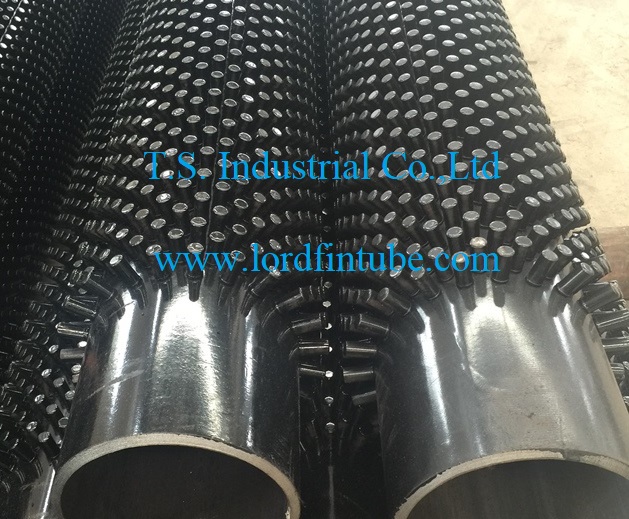
In the use of heat exchange equipment and chemical equipment, the studded tubes occupies the role of the main component. In the process of daily manufacturing and production, as well as regular maintenance and maintenance, the equipment is inseparable from the use of the studded tubes. Good prospects for use and promotion. The forecast results for market benefits and economic benefits are relatively clear.
The studded tubes equipment uses the welding process technology of resistance welding. The whole welding process is controlled by PLC programs, and the motors for indexing and feeding are all braking motors. The man-machine interface can effectively set the number of studded tubess. The parameters of indexing and the coefficient of compensation can be set in advance on the man-machine interface. It is set according to the requirements of different processes to ensure that the product is more guaranteed in terms of quality and precision.