


What Is an ASTM A178 Boiler Tube?
An ASTM A178 boiler tube is a minimum-wall-thickness, electric-resistance-welded (ERW) tube made from carbon steel or carbon-manganese steel. The specification covers tubes intended for boiler tubes, boiler flues, superheater flues, and safe ends. It is a product specification: it fixes chemistry, tensile properties, heat treatment, and inspection rules for the finished tube, not only for the strip or skelp from which the tube is formed.
The grade designation is part of the product definition. ASTM A178 defines three grades — A, C, and D — and each one carries a different chemistry, a different minimum tensile strength, and a different set of applicable tests. A purchase order that names "A178" without a grade is incomplete. Type C and D tubes are not suitable for safe-ending for forge welding, which shapes how these grades are used at the boiler header.
Lordfintube supplies ASTM A178 Boiler Tube in straight lengths and in U-bend form for superheater and heat exchanger service. The sections below explain what the specification requires, how the key parameters interact, and how to specify the right tube for a project.
How ERW Boiler and Superheater Tubes Are Manufactured
Electric-resistance welding forms a tube by cold-forming flat strip into a cylindrical shape and welding the longitudinal seam with resistance heat and pressure. The process produces a single longitudinal weld and a tube with a controlled wall thickness. ASTM A178 requires that the tube be manufactured by electric-resistance welding; other welded processes are outside the scope of this specification.
Grade D steel must be killed, meaning the steel is fully deoxidized during steelmaking so that the finished tube has a more uniform structure. After welding, every tube is heat treated. The specification requires a post-weld heat treatment at 1650°F [900°C] or higher, followed by cooling in air or in the cooling chamber of a controlled atmosphere furnace. Cold-drawn tubes receive a separate heat treatment after the final cold-draw pass at 1200°F [650°C] or higher.
The weld seam is the critical zone in any ERW tube. The heat treatment softens the weld and heat-affected zone, and the mechanical tests described later in this article are designed to prove that the seam can survive expansion, beading, flanging, and bending in service.
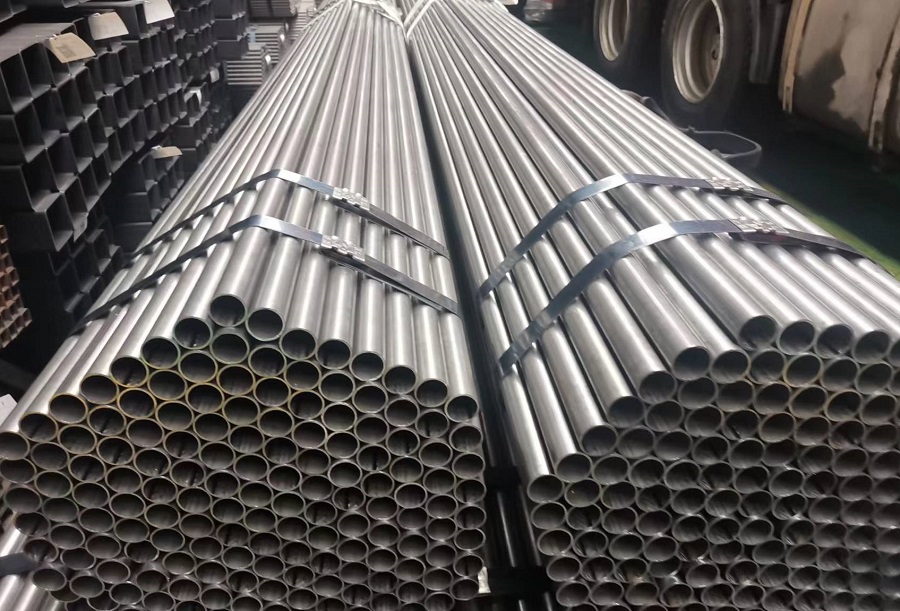
Key Parameters of ASTM A178 Boiler Tube
Three parameters drive nearly every engineering and procurement decision on an ASTM A178 tube: minimum wall thickness, outside diameter, and grade. Each one has a direct effect on pressure capability, heat transfer, formability, and cost.
Minimum Wall Thickness
Wall thickness is specified as a minimum, not as a nominal value with a symmetrical tolerance. That distinction matters because the minimum wall is the number used in pressure and thermal calculations. The specifications typical size range covers minimum wall thicknesses from 0.035 to 0.360 inches [0.9 to 9.1 mm]. Mechanical property requirements do not apply to tubing thinner than 0.015 inch [0.4 mm].
Thicker walls raise pressure capability and corrosion allowance, but they also raise weight, cost, and thermal resistance across the tube wall. In a boiler or superheater, the wall must be thick enough for the design pressure and the expected metal loss, and thin enough to keep heat transfer efficient. The final wall should be confirmed against the project specification, engineers calculation, and manufacturer data.
Outside Diameter
The typical outside diameter range for ASTM A178 is 1/2 to 5 inches [12.7 to 127 mm]. Outside diameter controls the surface area available for heat transfer, the tube count that fits into a given bundle or boiler bank, and the bend radius that can be achieved in a U-bend or superheater element. Smaller diameters pack more surface into a given volume; larger diameters reduce the number of tubes and welds for a given flow area.
Outside diameter and wall thickness are normally specified together as a size pair. Tubes with dimensions outside the published range may be supplied, provided they comply with all other requirements of the specification. That allowance should be confirmed in writing with the manufacturer before the order is placed.
Grade and Chemical Composition
Grade is the parameter that connects chemistry to strength. Grade A is a low-carbon steel intended for general boiler and flue service. Grade C is a medium-carbon steel with a higher minimum tensile strength. Grade D is a carbon-manganese steel with manganese in the 1.00 to 1.50 percent range and a minimum silicon content, giving the highest minimum tensile strength of the three grades. The full chemistry requirements appear in the table below.
Chemical Composition Requirements by Grade
| Element | Grade A (low-carbon steel) | Grade C (medium-carbon steel) | Grade D (carbon-manganese steel) |
|---|---|---|---|
| Carbon | 0.06–0.18 | 0.35 max | 0.27 max |
| Manganese | 0.27–0.63 | 0.80 max | 1.00–1.50 |
| Phosphorus, max | 0.035 | 0.035 | 0.030 |
| Sulfur, max | 0.035 | 0.035 | 0.015 |
| Silicon | Not specified | Not specified | 0.10 min |
If a specific grade is ordered, supplying an alloy grade that requires an element not listed in the table is not permitted by the specification. Chemistry should always be verified against the current edition of ASTM A178/A178M and the project specification.
Mechanical Properties and Tensile Requirements
Grades C and D must meet explicit tensile requirements. For Grade A, the specification provides design-assumed tensile properties rather than a mandatory tension test. The table below summarizes the values defined in the specification.
| Property | Grade A | Grade C | Grade D |
|---|---|---|---|
| Tensile strength, min, ksi [MPa] | 47 [325] | 60 [415] | 70 [485] |
| Yield strength, min, ksi [MPa] | 26 [180] | 37 [255] | 40 [275] |
| Elongation in 2 in. or 50 mm, min, % | 35 | 30 | 30 |
For longitudinal strip tests on Grades C and D, the specification applies a deduction to the basic minimum elongation for each 1/32-inch [0.8 mm] decrease in wall thickness below 5/16 inch [8 mm]. The specification also provides a method for interpolating elongation when the actual wall thickness falls between two tabulated values. Because the exact interpolation rule and the applicable deduction depend on the current edition of the standard, the final values should be confirmed against the specification text and the manufacturers test report.
Heat Treatment After Welding
Post-weld heat treatment is mandatory for ASTM A178 tube. The tube is heated to 1650°F [900°C] or higher and then cooled in air or in the cooling chamber of a controlled atmosphere furnace. The purpose is to normalize the weld and heat-affected zone so that the seam can pass the flattening, reverse flattening, flange, and crush tests and can tolerate expansion and beading in the boiler.
Cold-drawn tube follows a different route. After the final cold-draw pass, the tube is heat treated at 1200°F [650°C] or higher. This treatment restores ductility after the cold work and is separate from the post-weld treatment applied to the welded tube. Both treatments should be documented in the mill test report.
Mandatory Mechanical Tests and Inspection
The specification requires a defined set of mechanical tests on each lot. The test frequency depends on grade and size, and the purchaser can add optional tests in the order.
- Flattening test — required for Grades A, C, and D on specimens from two tubes per lot.
- Flange test — required for Grades A, C, and D; for Grades C and D the flange width must be at least 75 percent of the value specified in ASTM A450/A450M.
- Reverse flattening test — required for each 1500 ft [450 m] of finished tubing.
- Tension test — required for Grades C and D on specimens from two tubes per lot.
- Crush test — performed when specified by the purchaser, on sections 2 1/2 inches [63 mm] long, or 2 1/2 times the outside diameter for tubing under 1 inch [25.4 mm] outside diameter.
- Hydrostatic or nondestructive electric test — every tube must pass one of these tests; the purchaser chooses which one.
- Product analysis — performed on request, at a defined frequency per lot or per heat, with retest rules if the original analysis fails.
For the ultrasonic examination of the weld zone, ASTM A178 references the practices in ASTM E213 and ASTM E273. These are referenced documents, not automatic requirements, and should be specified in the purchase order if weld-zone ultrasonic testing is needed.
How Grade A, Grade C, and Grade D Compare
| Selection factor | Grade A | Grade C | Grade D |
|---|---|---|---|
| Carbon level | Low (0.06–0.18%) | Medium (0.35% max) | Medium (0.27% max) |
| Manganese level | 0.27–0.63% | 0.80% max | 1.00–1.50% |
| Minimum tensile strength | 47 ksi [325 MPa] | 60 ksi [415 MPa] | 70 ksi [485 MPa] |
| Killed steel required | No | No | Yes |
| Safe-end forging suitability | Permitted | Not suitable | Not suitable |
| Typical selection driver | Formability and weldability | Higher strength | Highest strength with manganese addition |
Grade A is the default choice when formability and weldability dominate and the design does not need the higher strength of C or D. Grade C is used when a moderate strength increase is needed without changing the base steel family. Grade D is used where the highest strength in the specification is required and the additional manganese and silicon are acceptable to the design. The restriction on safe-ending for Grades C and D means that a safe-end application normally points back to Grade A or to a different specification.
Design Trade-offs When Selecting ASTM A178 Boiler Tube
Selection is rarely a single-variable decision. The wall thickness, outside diameter, and grade interact, and a change in one usually forces a change in another.
- Strength versus formability. Higher grades raise tensile and yield strength, but they reduce the elongation margin and make bending and flanging less forgiving. If the tube will be expanded, beaded, or bent to a tight radius, the lower-strength grade may be the safer choice.
- Wall thickness versus heat transfer. A thicker wall adds pressure margin and corrosion allowance but adds thermal resistance. In a superheater, the wall is usually set by the design pressure and the expected metal loss, not by heat transfer alone.
- Outside diameter versus bundle density. A smaller outside diameter increases surface area per unit volume but raises the number of tubes, welds, and connections. A larger outside diameter simplifies fabrication but can reduce the achievable bend radius.
- Cost versus test scope. Optional product analysis, crush testing, and weld-zone ultrasonic testing add inspection cost. They should be specified only where the service condition or the project specification calls for them.
All trade-off decisions should be closed out against the project specification, the engineers calculation, and the manufacturers data. Typical ranges quoted in this article are a starting point, not a substitute for a design review.
Typical Applications of ASTM A178 Boiler Tube
ASTM A178 tube is used where a welded carbon or carbon-manganese steel tube must carry heat-transfer duty in a boiler or superheater and must survive expansion and beading at the tube sheet. Common applications include:
- Boiler tubes in industrial and utility boilers.
- Boiler flues and superheater flues.
- Superheater elements, including U-bend configurations.
- Safe ends, using Grade A where forge welding is involved.
- Heat exchanger and economizer service where the specification is accepted by the project.
For U-bend superheater elements, the tube is bent after heat treatment and the bend radius, ovality, and post-bend heat treatment should be agreed with the manufacturer. Lordfintube produces U bend tube for these configurations and can confirm bend capability against the ordered size and grade.
How to Specify and Order ASTM A178 Boiler Tube
A complete purchase order removes ambiguity at the mill and reduces the risk of a hold at goods-in inspection. The specification lists the information that should appear in the order:
- Quantity, in feet, meters, or number of lengths.
- Name of material: electric-resistance-welded tubes.
- Grade: A, C, or D.
- Size: outside diameter and minimum wall thickness.
- Length: specific or random.
- Optional requirements: product analysis, crush test, hydrostatic or nondestructive electric test.
- Test report required, per the certification section of ASTM A450/A450M.
- Specification designation, including the M designation if SI units apply.
- Supplementary requirements, if any.
- Special requirements, such as U-bend radius, end finish, or marking.
The specification notes that inch-pound and SI values are separate standards. Mixing values from both systems in one order can produce nonconformance. The inch-pound units apply unless the M designation is specified. Buyers should state the unit system explicitly on the order.
Packing, Marking, and Shipping
ASTM A178 requires the letters "ERW" to be legibly stenciled on each tube or marked on a tag attached to the bundle or box. The manufacturers name or symbol may be rolled or lightly stamped on each tube before normalizing; a single hand stamp should be at least 8 inches [200 mm] from one tube end. These marks support traceability from the mill test report to the installed tube.
Export packing for boiler tube typically uses hexagonal or square bundles, wooden or steel end protectors, and weather-resistant wrapping, with bundle tags carrying heat number, grade, size, and quantity. This is a typical range of practice rather than a fixed requirement; the final packing, marking, and shipping method should be confirmed with the manufacturer and the project specification, especially for U-bend tubes where bend geometry must be protected in transit.
Frequently Asked Questions
What is an ASTM A178 boiler tube?
An ASTM A178 boiler tube is a minimum-wall-thickness, electric-resistance-welded tube made from carbon steel or carbon-manganese steel. The specification covers tubes for boiler tubes, boiler flues, superheater flues, and safe ends. Type C and D tubes are not suitable for safe-ending for forge welding.
Which grades does ASTM A178 cover?
ASTM A178 covers three grades: Grade A low-carbon steel, Grade C medium-carbon steel, and Grade D carbon-manganese steel. Each grade has its own chemical composition and minimum tensile requirements, and the grade must be stated in the purchase order.
What is the difference between Grade A, Grade C, and Grade D?
Grade A is a low-carbon steel with carbon from 0.06 to 0.18 percent and a minimum tensile strength of 47 ksi [325 MPa]. Grade C is a medium-carbon steel with carbon up to 0.35 percent and a minimum tensile strength of 60 ksi [415 MPa]. Grade D is a carbon-manganese steel with manganese from 1.00 to 1.50 percent, silicon of 0.10 percent minimum, and a minimum tensile strength of 70 ksi [485 MPa]. Grade D steel must be killed.
What size range does ASTM A178 cover?
The specification typically covers outside diameters from 1/2 to 5 inches [12.7 to 127 mm] and minimum wall thicknesses from 0.035 to 0.360 inches [0.9 to 9.1 mm]. Tubes outside this range may be supplied if they meet all other requirements of the specification. Mechanical property requirements do not apply to tubing smaller than 1/8 inch [3.2 mm] inside diameter or 0.015 inch [0.4 mm] in thickness.
How is an ASTM A178 ERW tube heat treated after welding?
After welding, all tubes are heat treated at 1650 degrees F [900 degrees C] or higher and then cooled in air or in the cooling chamber of a controlled atmosphere furnace. Cold-drawn tubes are heat treated after the final cold-draw pass at 1200 degrees F [650 degrees C] or higher.
What mechanical tests are required for ASTM A178 tubes?
Mandatory tests include flattening, flange, and reverse flattening tests, plus a tension test for Grades C and D. A crush test is performed when specified by the purchaser. Each tube must also pass either a hydrostatic test or a nondestructive electric test, and the purchaser chooses which one.
Can ASTM A178 tubes be bent or formed into U shapes?
Yes. Tubes must withstand expanding and beading in the boiler without cracks, flaws, or openings at the weld. Superheater tubes should endure forging, welding, and bending operations needed for the application without developing defects. U-bend configurations are common for superheater and heat exchanger service, and the bend radius should be agreed with the manufacturer.
How do I request a quote for ASTM A178 boiler tubes?
Send the quantity, grade, outside diameter, minimum wall thickness, length, optional test requirements, and any supplementary requirements to the Lordfintube sales team through the contact page. The team will confirm availability, documentation, and delivery details against the project specification.
Request a Quote for ASTM A178 Boiler Tube
Share your grade, outside diameter, minimum wall thickness, length, and test requirements. Lordfintube will review the specification and respond with a quotation for straight or U-bend ASTM A178 boiler tube.