

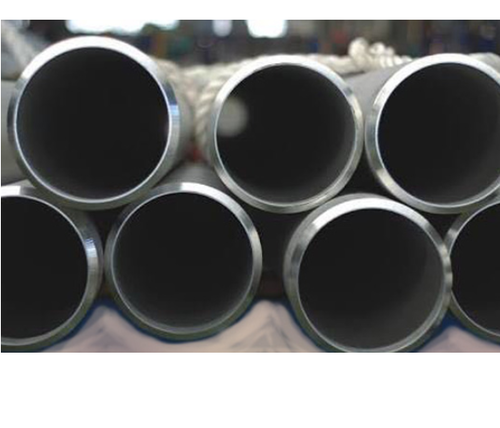
ASTM A268 UNS S44600 is a high-chromium ferritic stainless steel supplied as seamless and welded tube for heat exchanger and high-temperature service. It is specified where carbon steel and standard 300-series austenitic tubes scale away too quickly — typically in oxidising flue gas, sulphurous process gas, and chloride-bearing atmospheres at elevated temperature. Inside ASTM A268 the alloy appears as the TP446-1 and TP446-2 designations; the applicable edition of the standard defines the exact condition requirements for each.
What is ASTM A268 UNS S44600?
The UNS number S44600 identifies the alloy composition; ASTM A268 is the product specification covering seamless and welded ferritic stainless steel tube for general corrosive and high-temperature service. The material is ferritic at room temperature and remains ferritic through its service range, which is the source of two of its practical advantages: no nickel-driven cost volatility, and a lower coefficient of thermal expansion than austenitic grades.
That same ferritic structure also sets the limits an engineer must respect — lower creep strength above roughly 600 °C compared with nickel-bearing austenitic grades, and reduced toughness in heavy sections. Both points are covered later in this article.
What is the chemical composition of UNS S44600?
| Element | Typical range (%) | Function in the alloy |
|---|---|---|
| Chromium (Cr) | 23.0 – 27.0 | Forms the protective Cr₂O₃ oxide scale; drives oxidation and sulphidation resistance |
| Carbon (C) | ≤ 0.20 | Kept low to limit carbide precipitation and embrittlement |
| Manganese (Mn) | ≤ 1.50 | Deoxidation and hot-workability |
| Silicon (Si) | ≤ 1.00 | Improves scale adherence at high temperature |
| Nickel (Ni) | ≤ 0.75 | Residual element; the grade is deliberately nickel-free |
| Nitrogen (N) | ≤ 0.25 | Solid-solution strengthening and grain refinement |
| Phosphorus (P) / Sulphur (S) | ≤ 0.040 / ≤ 0.030 | Tramp elements controlled for weldability and toughness |
What are the mechanical properties of ASTM A268 UNS S44600 tube?
Heat treatment for this grade is annealing in the range of roughly 780–850 °C followed by rapid cooling, which keeps the structure fully ferritic and avoids the sigma-type embrittlement that can develop after long exposure in the 400–550 °C band. The values below are typical range figures; the governing acceptance criteria are those written in the purchase order, the applicable ASTM A268 edition, and the mill test certificate.
| Property | Unit | Typical minimum | Typical achieved |
|---|---|---|---|
| Tensile strength Rm | MPa | 550 | 560 – 650 |
| 0.2 % proof stress Rp0.2 | MPa | 205 | 280 – 380 |
| Elongation A50 | % | 18 | 22 – 30 |
| Hardness | HB | — | 170 – 210 |
| Density | g/cm³ | — | 7.6 – 7.7 |
| Youngs modulus | GPa | — | 200 – 220 |
| Thermal conductivity at 20 °C | W/(m·K) | — | 20 – 24 |
| Coefficient of thermal expansion, 20–500 °C | 10⁻⁶/K | — | 10.5 – 11.5 |
| Maximum continuous service temperature in air | °C | — | 1050 – 1100 |
What do the key tube parameters mean, and how are they calculated?
Three parameters drive nearly every heat exchanger tube decision: outside diameter (Do, mm), wall thickness (t, mm), and effective tube length (L, m). They interact directly — a larger diameter raises the surface area per tube but lowers the shell-side velocity for a given flow, while a thicker wall raises pressure capability at the cost of heat transfer and weight.
Surface area per tube
Ao = π × Do × L
- Ao — outside surface area of one tube, m²
- Do — outside diameter, m (note the unit conversion from millimetres)
- L — effective tube length between tube sheets, m
Total heat transfer area required
A = Q / (U × ΔTlm)
- A — total required surface area, m²
- Q — heat duty, W
- U — overall heat transfer coefficient, W/(m²·K)
- ΔTlm — log mean temperature difference, K
Tube count
N = A / Ao
Round N upward to a layout that fits the tube sheet. Note that U depends on tube-wall thermal resistance t/k, where t is wall thickness in metres and k is thermal conductivity in W/(m·K). Because UNS S44600 has a conductivity of roughly 20–24 W/(m·K), its wall resistance is noticeably lower than that of austenitic stainless tube, which is a small but real advantage in gas-to-gas service.
Thermal expansion
ΔL = α × L × ΔT
- ΔL — free expansion, mm
- α — coefficient of thermal expansion, 10.5–11.5 × 10⁻⁶ per K for this grade
- L — original length, mm
- ΔT — temperature change, K
Because α for UNS S44600 is roughly 35–40 % lower than for TP304 or TP316, fixed tube sheet designs often need less expansion allowance. The calculation method itself is standard; the input values must always come from the project data sheet.
ASTM A268 UNS S44600 compared with other heat exchanger tube grades
The comparison below is a qualitative engineering comparison, not a rating of any suppliers product. Actual performance depends on atmosphere, temperature, stress, and cycle history.
| Grade | Structure | Oxidation resistance in air | Chloride SCC resistance | High-temperature strength | Relative material cost |
|---|---|---|---|---|---|
| UNS S44600 (TP446-1 / TP446-2) | Ferritic, 23–27 % Cr | Very good, up to roughly 1050–1100 °C | Good — ferritic grades resist chloride SCC | Moderate; limited above ~600 °C under load | Low to moderate (nickel-free) |
| TP304 / TP304L | Austenitic, 18 % Cr | Moderate, roughly 870 °C limit | Poor in warm chloride service | Good | Moderate |
| TP316 / TP316L | Austenitic, 16–18 % Cr + Mo | Moderate, roughly 870 °C limit | Improved vs 304 but still SCC-prone | Good | Moderate to high |
| TP321 / TP347 | Stabilised austenitic | Good to roughly 900 °C | Poor in chlorides | Good | High |
| TP310S | Austenitic, 25 % Cr + 20 % Ni | Very good, roughly 1100 °C | Moderate | High | Very high |
| TP409 / TP439 | Ferritic, 11–18 % Cr | Moderate | Good | Low | Low |
Design trade-offs when specifying UNS S44600 tube
- Oxidation versus strength. The high chromium level delivers scale resistance to roughly 1050–1100 °C in clean oxidising atmospheres, but the ferritic matrix softens above about 600 °C under sustained stress. Keep mechanical loading modest when service temperature climbs.
- Wall thickness versus heat transfer. Increasing wall thickness improves pressure rating and corrosion allowance but adds conduction resistance and weight. It also raises tube-to-tubesheet rolling loads, which matters for ferritic grades.
- Diameter versus velocity. Larger diameters reduce pressure drop but can drop shell-side or tube-side velocity below the threshold that keeps fouling in check.
- Welding versus seamless. Seamless tube removes the longitudinal weld from the pressure boundary — preferred for high-pressure or cyclic duty. Welded and cold-worked tube is usually more economical in larger diameters and is fully acceptable where the specification permits it.
- Atmosphere versus published limits. Published maximum temperatures assume clean oxidising air. Sulphidising, carburising, or reducing atmospheres lower the usable ceiling substantially; a laboratory or pilot exposure is often the cheapest way to confirm suitability.
Technical specification range for UNS S44600 heat exchanger tube
| Parameter | Unit | Typical range | Notes |
|---|---|---|---|
| Outside diameter | mm | 6.35 – 76 | Larger diameters generally welded route |
| Wall thickness | mm | 0.8 – 6.0 | Driven by pressure design and corrosion allowance |
| Length | m | up to 12 (random) / fixed lengths on request | Depends on handling and shipping limits |
| Form | — | Seamless, welded + cold worked, U-bent | Bending radius agreed with the mill |
| Delivery condition | — | Annealed and pickled, or bright annealed | Surface finish agreed at order stage |
| Straightness | mm/m | 1.0 – 2.0 | Confirm against purchase order |
| Tube ends | — | Plain, bevelled, plastic-capped | Match the tubesheet rolling or welding method |
Material standards and specification references
UNS S44600 tube is normally ordered against ASTM A268 / A268M, which covers seamless and welded ferritic stainless steel tube for general corrosive and high-temperature service. Equivalent or closely related designations include TP446-1 and TP446-2 within that standard, plus the European designation EN 1.4749 and the historical DIN X18CrN28 reference. Cross-standard equivalence is never exact — chromium, nitrogen, and mechanical property limits can differ between editions and between national standards.
When an order needs a dual-certified tube, state both standards on the enquiry and confirm that the mill can satisfy the tighter of the two limits. Do not assume a grade substitution is acceptable without written confirmation from the engineer responsible for the pressure design. Our superferrite and high-chromium ferritic tube range gives an overview of the related grades we supply for heat recovery duty.
Where is ASTM A268 UNS S44600 tube used?
| Industry | Component example | Operating condition |
|---|---|---|
| Power generation | Economiser and air preheater tubes | Flue gas with acid dew point risk |
| Petrochemical | Gas reaction furnace internals, pyrolysis components | Sulphidising and oxidising gas, elevated temperature |
| Heat treatment | Radiant tubes, annealing boxes, retorts | Cyclic oxidation in air |
| Instrumentation | Thermocouple protection sheaths | Thermal shock, high temperature |
| Waste heat recovery | Finned economiser and evaporator banks | Chloride-bearing flue gas, cycling duty |
| Mineral processing | Hot gas ducting, kiln internals | Abrasive, oxidising, high-temperature gas |
In waste heat recovery, UNS S44600 is frequently used as the base tube under helical or T-type finned tube configurations, where the fin-to-tube joint must survive both thermal cycling and the same corrosive gas that attacks the bare tube surface. Base metal selection and fin material selection should be decided together, because a mismatched pair can shift the failure point from the gas side to the joint.
Selection guidance for UNS S44600 heat exchanger tube
- Define the gas chemistry first. Oxidising, reducing, sulphidising, carburising, and chloride-bearing atmospheres all change the usable temperature ceiling. State the composition, not only the temperature.
- Confirm the stress state. Internal pressure plus thermal stress plus tube weight adds up. Above roughly 600 °C, check whether a ferritic grade still holds the required creep life.
- Fix the pressure design before choosing thickness. Wall thickness follows from the design code calculation plus the corrosion allowance agreed for the service life.
- Decide seamless or welded early. Welded and cold-worked tube is usually acceptable where the standard and the design code allow it, but seamless is the safer default for high pressure or severe cycling.
- Plan the tube-to-tubesheet joint. Ferritic grades work-harden differently from austenitic grades during rolling; rolling torque and clearance should be agreed with the fabricator.
- Check availability before freezing the design. Unusual diameters, heavy walls, and U-bends can add lead time. Confirm before the drawing is released.
Quality inspection for ASTM A268 UNS S44600 tube
Inspection is normally agreed at the enquiry stage. A typical range of checks for this grade includes the items below; the mandatory set is whatever the purchase order, the applicable standard, and the design code require.
- Chemical composition verification by spectrometric analysis on the finished tube
- Tensile test and hardness survey on a sample from each lot
- Hydrostatic test or pneumatic test per the specification
- Eddy current test or ultrasonic test on the tube body
- Visual and dimensional inspection — outside diameter, wall thickness, length, straightness
- Surface condition check: scale, pickling quality, roll marks, handling marks
- Weld quality verification for welded tube — weld bead condition and, where specified, radiography
- Intergranular corrosion test only where explicitly requested
Certificates must be traceable to the heat number. Where a third-party inspection agency is involved, the inspection release note should be issued before packing, not after shipment.
Packaging, handling, and shipping
Ferritic stainless tube is less prone to galling than austenitic tube during handling, but it is still susceptible to surface contamination and to mechanical damage at the tube ends. A typical packing scheme is hexagonal bundles secured with steel or plastic strapping, end caps on every tube, and a wooden crating or steel frame for sea freight. Vibration protection and moisture barriers are advisable for long ocean transit, and bundle weights should be agreed with the receiving yards crane capacity.
Ask for a packing list, heat number mapping, and mill certificates in the same shipment. Where tubes will sit in storage before erection, specify a protective wrapping that can survive a few months outdoors without trapping condensation against the tube surface.
FAQ: ASTM A268 UNS S44600
What does UNS S44600 mean on a tube certificate?
Both the UNS number and the specification should appear on the mill certificate, together with the TP446-1 or TP446-2 designation, the heat number, and the test results.
What is the maximum service temperature of ASTM A268 UNS S44600?
Always confirm the actual limit against the project specification, the engineer of record, and the manufacturers published data for the exact product form and thickness.
Can ASTM A268 UNS S44600 tube be welded?
Preheating and post-weld heat treatment are not universally required and depend on section thickness and the design code. Weld procedure qualification should be carried out on the actual production thickness.
How does UNS S44600 compare with TP310S for high-temperature service?
Choose UNS S44600 when the duty is oxidation-dominated with modest mechanical stress and chlorides are present. Choose TP310S when sustained load at 900 °C and above must be carried by the tube itself.
Which sizes of UNS S44600 heat exchanger tube are available?
These are typical range values only. Availability for a specific combination of diameter, wall, length, and bend geometry should be confirmed with the manufacturer before the design is frozen.
Does UNS S44600 become brittle at low temperature?
Where low-temperature service is unavoidable, impact testing and a section-thickness review should be part of the specification.
How is the quality of a UNS S44600 tube order verified?
For critical duty, add third-party inspection and a pre-shipment dimensional audit. Request the NDT reports and the packing list in the same document package as the certificates.
Need ASTM A268 UNS S44600 heat exchanger tube for a specific duty? Send the tube size, wall thickness, length, gas chemistry, and design temperature. We will confirm the feasible supply range and the inspection plan against your specification.