


ASTM A333 vs. A334: Pipe or Tube for Low-Temperature?
1. Core Distinction: Pipe vs. Tube
ASTM A333 – Pipe
ASTM A333 governs pipe — cylindrical products supplied by nominal pipe size (NPS) and schedule number. These are designed for integration into pressure-containing piping networks where fluid conveyance is the primary function.
Emphasis: pressure integrity and fracture resistance in transport systems.
ASTM A334 – Tube
ASTM A334 governs tube — products specified by outside diameter and minimum wall thickness. These are precision components intended for heat-exchange equipment, where thermal performance and dimensional accuracy are paramount.
Emphasis: heat-transfer efficiency and fabricability in thermal equipment.
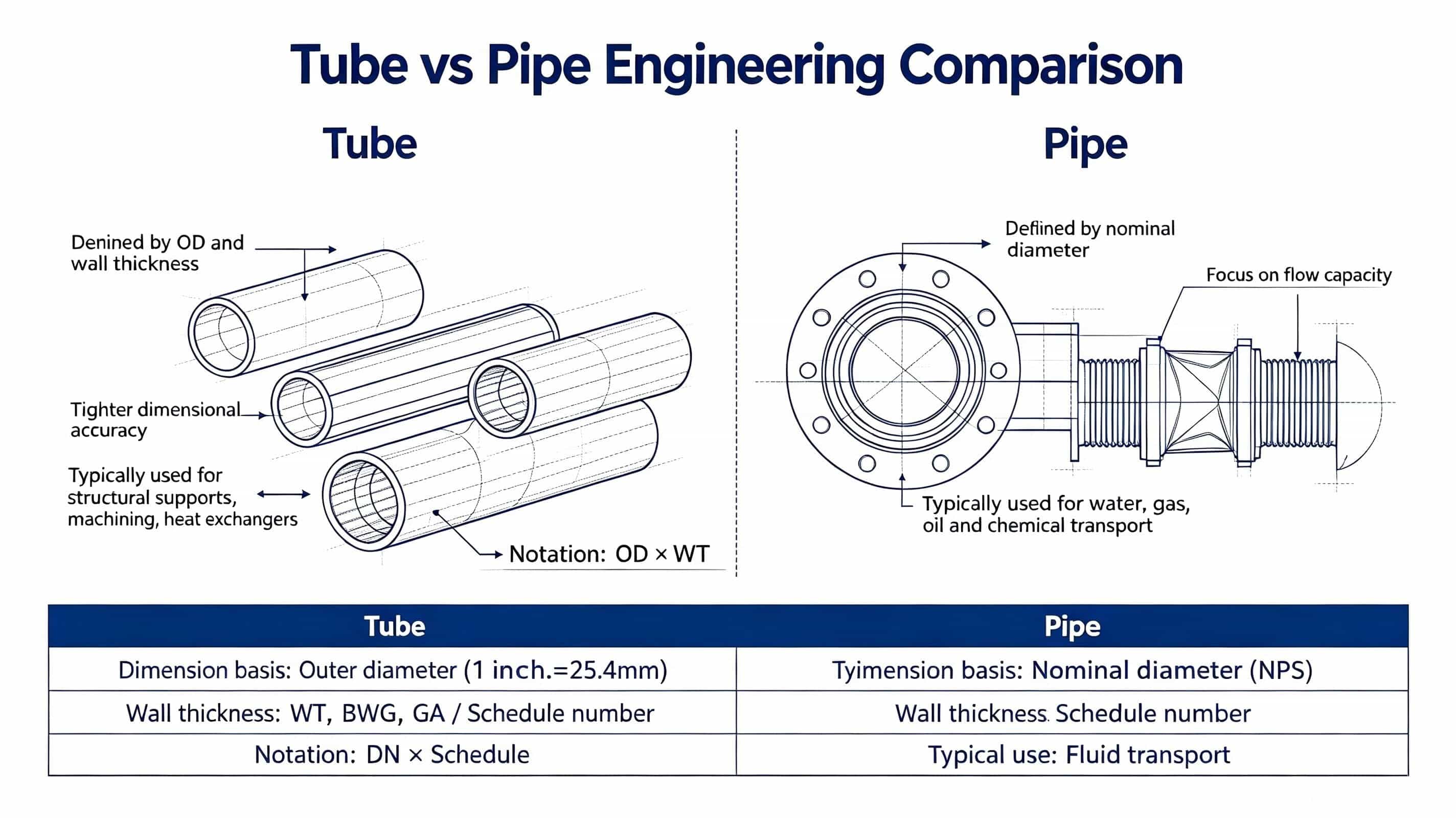
While both are manufactured as seamless or welded products, their design philosophies diverge: A333 emphasizes pressure integrity and fracture resistance in transport systems; A334 prioritizes heat-transfer efficiency and fabricability in thermal equipment.
2. Service Environments and Industrial Applications
ASTM A333 – Piping Systems
- Cryogenic fluid transmission lines (LNG, liquid nitrogen, liquid oxygen)
- Low-temperature process piping in petrochemical complexes
- Arctic and sub‑arctic pipeline infrastructure
- Cold‑section piping in ethylene and ammonia plants
ASTM A334 – Heat‑Exchange Equipment
- Shell‑and‑tube heat exchangers and condensers
- Evaporator tubing in refrigeration systems
- Cryogenic heat‑exchanger bundles in air‑separation units
Both standards address the challenge of maintaining ductility and toughness at subzero temperatures. They mandate strict control of residual elements—particularly phosphorus and sulfur—to mitigate the ductile-to-brittle transition.
3. Grade Systems: Coverage and Overlap
ASTM A333 includes 9 grades: 1, 3, 4, 6, 7, 8, 9, 10, 11.
ASTM A334 includes 7 grades: 1, 3, 6, 7, 8, 9, 11.
Shared grades: 1, 3, 6, 7, 8, 9, 11.
A333‑exclusive: 4 and 10.
Grades 3 and 6 account for the vast majority of commercial production.
Grade Applicability by Temperature
| Grade | Min. Service Temp. | Available |
|---|---|---|
| 1 | –45 °C | Both |
| 3 | –100 °C | Both |
| 4 | –100 °C | A333 only |
| 6 | –45 °C | Both |
| 7 | –75 °C | Both |
| 8 | –195 °C | Both |
| 9 | –75 °C | Both |
| 10 | –60 °C | A333 only |
| 11 | Ultra‑low | Both |
4. Chemical Composition: Identical for Shared Grades
For grades common to both standards, the compositional limits are effectively identical.
| Element | Grade 1 | Grade 3 | Grade 6 | Grade 8 | Grade 11 |
|---|---|---|---|---|---|
| C, max % | 0.30 | 0.19 | 0.30 | 0.13 | 0.10 |
| Mn, % | 0.40–1.06 | 0.31–0.64 | 0.29–1.06 | ≤0.90 | ≤0.60 |
| P, max % | 0.025 | 0.025 | 0.025 | 0.025 | 0.025 |
| S, max % | 0.025 | 0.025 | 0.025 | 0.025 | 0.025 |
| Si, % | — | 0.18–0.37 | ≥0.10 | 0.13–0.32 | ≤0.35 |
| Ni, % | — | 3.18–3.82 | — | 8.40–9.60 | 35–37 |
Grade 1 vs 6: Grade 6 has a minimum Si (≥0.10 %) and slightly higher Mn.
Tighter P/S limits (≤0.025 %) compared to conventional carbon steels (e.g., A106).
Grade 8 (9Ni) achieves –195 °C performance through nickel enrichment (8.4–9.6 %) and specialised heat treatment.
5. Mechanical Properties: Comparable Specifications
| Grade | Tensile (MPa) min | Yield (MPa) min | Elongation (%) min |
|---|---|---|---|
| 1 | 380 | 205 | 35 |
| 3 | 450 | 240 | 30 |
| 6 | 415 | 240 | 30 |
| 7 | 450 | 240 | 30 |
| 8 | 690 | 515 | 22 |
| 9 | 435 | 315 | 28 |
| 11 | 450 | 240 | 18 |
Note: Grade 8 in A334 specifies a slightly higher yield strength minimum of 520 MPa. All grades require a fine austenitic grain size (ASTM No. 5 or finer for Grade 6).
6. Impact Toughness: The Defining Criterion
Charpy V‑notch requirements
Average of three specimens ≥ 18 J
Individual minimum ≥ 14 J
(full‑size 10×10 mm specimens)
For subsize specimens, values are scaled; test temperatures may be adjusted.
Impact test temperatures
| Grade | Temp. |
|---|---|
| 1 | –45 °C |
| 3 | –100 °C |
| 4 | –100 °C |
| 6 | –45 °C |
| 7 | –75 °C |
| 8 | –195 °C |
| 9 | –75 °C |
| 10 | –60 °C |
Grade 8 also requires lateral expansion ≥ 0.38 mm.
7. Dimensional Systems and Wall‑Thickness Philosophy
ASTM A333 – Pipe
Size: NPS (⅛ through 24) and schedule number.
Wall basis: Average (nominal) wall – positive and negative deviations permitted.
Sufficient for pressure integrity; schedule system provides standardised thickness.
ASTM A334 – Tube
Size: Actual outside diameter (3.18 mm up to 101.6 mm) and wall thickness.
Wall basis: Minimum wall – no negative deviation allowed.
Critical for heat exchangers: wall thickness directly affects pressure containment and heat-transfer rate.
Engineering rationale: For tubes, undersized walls compromise strength; oversized walls impair thermal efficiency. The “minimum wall” ensures every tube meets design thickness. Both standards caution that excessive wall thickness can adversely affect impact properties.
8. Testing and Inspection: A334 Imposes Additional Requirements
Common to both
- Chemical (product) analysis per heat
- Tensile testing (yield, tensile, elongation)
- Charpy V‑notch impact testing
- NDE electric test or hydrostatic test (manufacturer’s option)
Additional for A334 only
- Flattening test – ductility and longitudinal defects
- Flaring test (seamless) – end‑expandability
- Flange test (welded)
- Reverse flattening test
- Hardness test
These reflect the cold‑forming demands of heat‑exchanger tubing.
Heat treatment: Both require delivery in normalized (or normalized and tempered) condition, except Grade 8 (quenched and tempered, or double normalized and tempered) and Grade 11 (special).
9. Selection Criteria: Which Standard to Specify?
Choose A333 if
- Pressure piping, fluid transport
- NPS + Schedule dimensions
- Welding, bending
- Standard testing
- Lower cost
Choose A334 if
- Heat exchangers, condensers
- OD + minimum wall
- Flaring, rolling, tight‑radius bending
- Extended testing (formability)
- Moderately higher cost
Cost index (Grade 6 = 1.0)
- Grade 1: ~0.9
- Grade 3 (3.5 % Ni): ~2.5–3.5
- Grade 8 (9 % Ni): ~5–8
ASME equivalents:
A333 ↔ SA‑333
A334 ↔ SA‑334
Critical warning: The two product forms are not interchangeable. Substituting A334 tube for A333 pipe may result in insufficient pressure capacity; substituting A333 pipe for A334 tube will lack the dimensional precision and formability required for heat‑exchanger fabrication.
10. Summary: Key Differences at a Glance
| Feature | ASTM A333 | ASTM A334 |
|---|---|---|
| Product definition | Pipe | Tube |
| Primary application | Fluid transmission | Heat exchange |
| Number of grades | 9 | 7 |
| Dimensional system | NPS + Schedule | OD + min. wall |
| Wall thickness basis | Average (toleranced) | Minimum (no minus) |
| Chemistry (shared grades) | Identical | Identical |
| Mechanical properties | Identical | Identical |
| Impact testing | Mandatory | Mandatory |
| Flattening/flaring | Not required | Mandatory |
| Hardness testing | Not required | Mandatory |
| Reference standard | ASTM A530 | ASTM A450 |