

Which types of finned tubes are suitable for boiler economizers?
The boiler economizer is one of the most important components in this equation of industrial boiler systems—a heat exchanger installed in the boilers flue gas path. Its job is straightforward: recover waste heat from exhaust gases and use it to preheat the boiler feedwater before it enters the steam drum. This simple but effective process boosts overall boiler efficiency and cuts fuel consumption.
At the core of every high-performance economizer is the finned tube. By adding extended surfaces to the tube, finned tubes dramatically increase the heat transfer area, allowing economizers to capture far more waste heat than bare-tube designs.
Do you know the main types of finned tubes used in boiler economizer?
1. H-Type & HH-Type Finned Tubes
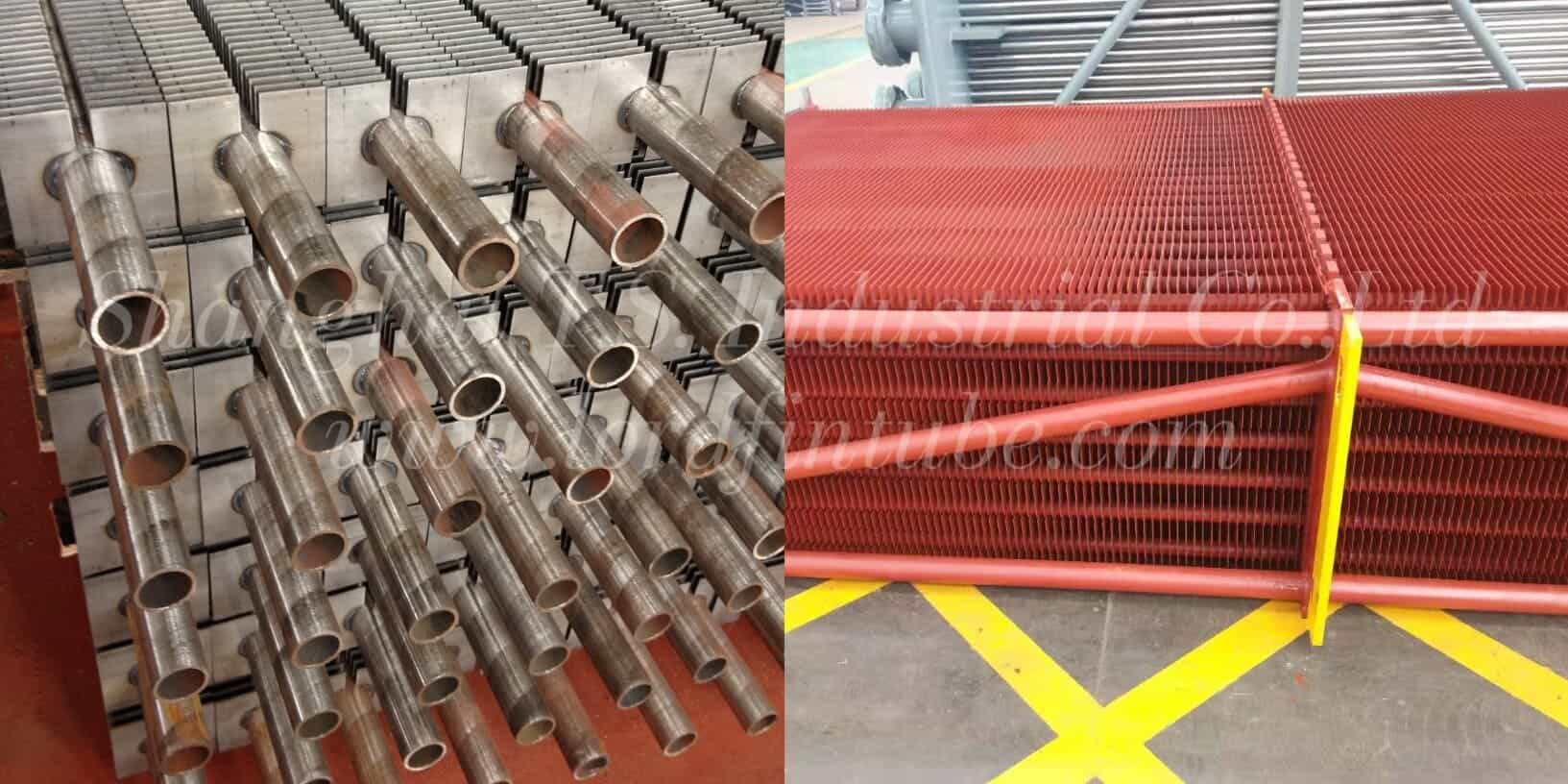
H/HH-type tubes feature two rectangular steel fins symmetrically welded onto a base tube, forming an "H" profile. The HH-type (Double H) pairs two H-units side-by-side, doubling the heat transfer area with enhanced structural rigidity.
In-line layout reduces flue gas velocity peaks, extending tube life by 3–4× compared to bare tubes in high-dust environments.
Straight, open fin gaps prevent ash bridging; ideal for fuels with ash content >15%.
H-shaped wake vortices boost heat transfer coefficient by 15–25% over spiral fins, even at 2–4 m/s gas velocity.
Requires less installation space and lower overall weight than bare-tube economizers.
2. Cast Finned Tubes
Manufactured via integral casting (typically gray or ductile iron), these tubes feature fins that are cast as a single piece with the base tube, eliminating any mechanical joint.
Cast irons uniform structure withstands low-temperature (below 400°C) acidic flue gas, outperforming carbon steel in high-sulfur fuels.
Lower material cost combined with high carbon content (2.11–4%) delivers excellent wear resistance for budget-conscious projects.
Handles flue gas temperatures up to 400°C without deformation or thermal stress fractures.
Improves heat transfer by 40%+ over bare tubes, raising boiler thermal efficiency by 5–8%.
3. HFW (High-Frequency Welded) Finned Tubes
Produced by helically wrapping a steel strip around the tube while applying 200–450 kHz high-frequency current, creating a solid-phase metallurgical bond.
Achieves a >95% weld fusion rate, ensuring excellent tensile strength and fatigue resistance under normal operation.
Delivers roughly 8× the heat dissipation of bare tubes, with metal thermal strength of 1.10–1.20 W/kg·°C.
Supports fin heights of 8–35 mm and thicknesses of 0.8–3.5 mm, available in solid or serrated fin designs.
Tightly welded fins remain secure even in equipment with mechanical vibration.
4. Laser-Welded Finned Tubes
Using a focused laser beam, the fin strip is 100% fused across the entire fin foot, creating a continuous metallurgical bond with zero gaps.
The 100% fusion weld eliminates air gaps, boosting heat transfer efficiency by 8× compared to smooth tubes.
Full penetration prevents crevice corrosion, extending service life by 30% in aggressive chemical or marine environments.
Enables fin pitch as tight as 2.5 mm, increasing surface area by 50% and reducing heat exchanger volume by 40%.
Allows thinner base tubes (0.8–3 mm) and fins, cutting material costs up to 20%; supports coiling and bending for complex geometries.
5. Studded Tubes (Pin Tubes)
Cylindrical metal studs (pins) are resistance-welded onto the tube surface in square or hexagonal patterns, acting as both heat-transfer enhancers and refractory anchors.
Cantilevered pins vibrate under airflow, naturally shaking off sticky soot and heavy ash deposits.
The pin matrix disrupts laminar flow, maintaining high heat transfer even at low gas velocities (3–6 m/s).
Robust pins withstand physical impact from large particulates (wood chips, petcoke) better than thin spiral fins.
Efficiently recovers waste heat even with flue gas temperatures as low as 150°C.
For which type of economizer are these finned tubes suitable?
Choosing the right finned tube isnt just about understanding how each type is made—you also need to match the tube to the specific economizer design (horizontal or vertical layout, high-pressure or low-pressure stage) and the real-world operating conditions (flue gas composition, temperature profile, dust loading, and maintenance strategy). Heres a practical breakdown for each type.
H/HH-Type Finned Tubes
Best suited for: High-capacity utility boiler economizers (especially in the rear flue of pulverized-coal and circulating-fluidized-bed boilers), waste-heat recovery economizers in cement kilns, and metallurgical sinter plants.
Cast Finned Tubes
Best suited for: Low-pressure sectional cast-iron economizers in small-to-medium industrial chain-grate boilers, vertical-tube economizers for hot-water boilers, and some waste-incineration heat-recovery systems operating at low parameters.
HFW Finned Tubes
Best suited for: Standard serpentine-tube economizers for subcritical power plants (below 300 MW), industrial packaged boilers, oil/gas-fired package economizers, and general heat-recovery steam generators (HRSGs) without extreme corrosion demands.
Laser-Welded Finned Tubes
Best suited for: High-pressure feedwater economizers for supercritical and ultra-supercritical power plants, nuclear auxiliary cooling systems, marine offshore platform economizers, and high-end petrochemical waste-heat boilers where reliability is critical.
Studded Tubes
Best suited for: Vertical or horizontal in-line economizers for heavy oil-fired boilers, biomass-fired hot-water economizers, and forced-circulation waste-heat economizers in the chemical and metallurgical industries.
Comparison Summary
Flash resistance welding
Key Strength: Wear resistance, self-cleaning
Best Application: Coal-fired boilers, high-dust environments
Integral casting
Key Strength: Corrosion resistance, low cost
Best Application: Low-pressure industrial boilers (≤2.5 MPa)
High-frequency resistance welding
Key Strength: Cost-effective, high-volume production
Best Application: Standard heat exchange systems, power generation
Laser beam welding
Key Strength: Zero contact resistance, highest efficiency
Best Application: High-performance, corrosive, or high-vibration applications
Resistance welding
Key Strength: Self-cleaning, anti-fouling
Best Application: Oil/gas-fired boilers, heat recovery systems
We understand that different economizer applications demand different material combinations. Thats why we offer a wide selection of base tube materials—including carbon steel, alloy steel, stainless steel, copper alloy, and nickel alloy—paired with fin materials such as carbon steel, stainless steel, aluminum, and copper alloy.
Whether your economizer operates in high-temperature supercritical conditions or low-temperature acidic flue gas environments, we have the material expertise to match your requirements.