


The evaporator is a core heat exchange device widely used in refrigeration, chemical and HVAC industries. Its primary function is to convert liquid media into gaseous state through heat absorption during phase change, and realize process effects such as refrigeration, solution concentration and medium cooling via heat exchange. Among various types of evaporators, the coaxial evaporator has become a mainstream heat exchange device for small-scale refrigeration equipment, heat pump systems and medium-to-small chemical processes due to its compact structure, high heat exchange efficiency and strong adaptability. It is a specialized heat exchange device optimized and upgraded based on the basic evaporation principle.
I. Definition and Core Working Principle of Coaxial Evaporators
A coaxial evaporator is also known as a double-tube evaporator (tube-in-tube evaporator), coaxial evaporators are high-efficiency recuperative heat exchange devices with a double-layer nested coaxial structure and a subdivision category of evaporators. Following the basic principle of heat absorption through liquid phase change, they achieve efficient heat exchange through the countercurrent flow of cold and hot media and complete the vaporization and evaporation process of refrigerants or process liquids.
Its basic working principle is consistent with that of conventional evaporators, relying on the physical property of heat absorption during liquid evaporation: when flowing inside the device, low-temperature liquid media absorb heat from the high-temperature media on the opposite side. The liquid molecules gain sufficient energy to overcome surface tension, undergo boiling and vaporization phase change from liquid to gas, and take away a large amount of heat, thereby realizing the core effects of medium cooling and system refrigeration.
Compared with ordinary evaporators, coaxial evaporators optimize heat exchange efficiency by adopting a countercurrent heat exchange mode. Cold and hot media flow in opposite directions through independent inner and outer tube channels, maintaining a stable temperature difference heat exchange range throughout the process. This greatly improves the sufficiency of heat exchange and solves the problems of uneven heat exchange and low efficiency of traditional heat exchange equipment. In the operation of refrigeration systems, liquid evaporator for refrigeration absorb heat and vaporize in the coaxial channels, continuously removing heat from heat-carrying media such as water and air to achieve cooling and temperature reduction.
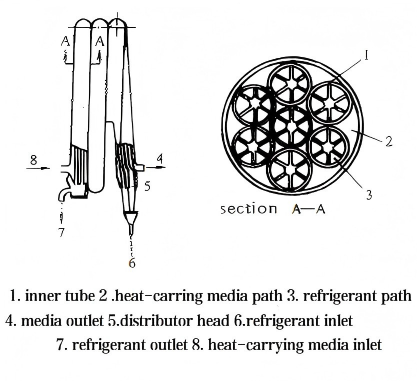
II. Overall Structural Composition of Coaxial Evaporators
Inheriting the core functional structures of heating and gas-liquid separation of traditional evaporators, coaxial evaporators adopt an innovative integrated double-layer casing design with a concise and compact overall structure. They are mainly composed of three parts: the core heat exchange casing body, medium flow channels and auxiliary separation structure. Without complex auxiliary components, they are highly suitable for the installation scenarios of miniaturized equipment.
1. Core Heat Exchange Casing Body
Serving as the core heat exchange and heating unit of the equipment, it replaces the independent heating chamber of traditional evaporators. It adopts a concentric nested structure of inner and outer tubes. The outer tube is mostly made of seamless steel pipe or stainless steel pipe with high pressure resistance and corrosion resistance, while the inner tube is generally made of copper tube or enhanced heat transfer tube such as smooth tube and finned tube to strengthen the heat exchange effect. The double-layer casing can be coiled into round or semicircular shapes according to equipment requirements, which greatly saves installation space.
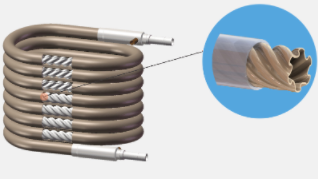
2. Medium Flow Channels
There are two medium flow paths: the inner tube channel and the casing annular channel, with flexible flow direction switching according to working conditions. Under conventional working conditions, the refrigerant flows through the inner tube channel, and heat-carrying media (water, aqueous solution, etc.) flow in the annular gap between the inner and outer tubes. The flow direction can be reversed under special working conditions to adapt to different refrigeration and heat exchange requirements. This channel structure ensures the uniform flow of media without heat exchange dead angles, continuously provides heat required for liquid evaporation, and guarantees the stable boiling and vaporization process.
3. Auxiliary Gas-Liquid Separation Structure
Corresponding to the evaporation chamber function of traditional evaporators, the end of the coaxial evaporator is integrated with a gas-liquid separation structure, and some equipment is equipped with a small defoaming device at the top. After absorbing heat and vaporizing, the media realize complete gas-liquid two-phase separation through the separation structure, which effectively intercepts liquid droplets and impurities entrained in gaseous media to ensure the purity of gaseous media. It also prevents insufficiently evaporated liquid media from flowing out of the equipment, improving medium utilization rate and heat exchange stability.
III. Core Advantages of Coaxial Evaporators
High heat exchange efficiency: Countercurrent mode + enhanced tubes offer large contact area and full ΔT utilization.
Compact structure: Coiled shapes, small footprint, ideal for compact devices.
Stable operation & low failure: Double-wall sealed, anti-scaling, excellent oil return.
Wide working condition adaptation: Compatible with water, antifreeze, various refrigerants, low-temperature & conventional heat exchange.
Energy-saving & durable: Protects compressor, extends equipment lifetime.
| Parameter | Coaxial Evaporator | Traditional Shell-and-Tube |
|---|---|---|
| Heat exchange efficiency | High (countercurrent full temp diff) | Moderate |
| Structure volume | Compact, can be coiled | Large |
| Scaling risk | Low, smooth inner channel | Medium-high |
| Application scenarios | Small HVAC, heat pumps, fine chemicals | Large industrial |
IV. Main Application Fields
HVAC Industry
As a core heat exchange component of small central air conditioners and water chillers, coaxial evaporators enable liquid refrigerants to absorb heat and vaporize inside the casing to cool circulating water and realize indoor air cooling. Suitable for commercial small air conditioners and precision equipment cooling systems.
Heat Pump Energy Saving Industry
Widely applied in water-source, ground-source heat pump units and heat pump water heaters. Through the coaxial heat exchange structure, they absorb low-temperature heat to complete evaporation and phase change, realizing remarkable energy-saving effects.
Fine Chemical Industry
Adapted to medium and small chemical processes for low-concentration solution concentration and light mixture separation, mild heating, solvent vaporization while retaining solute components. Ideal for food, pharmaceutical and fine chemical industries requiring high stability and cleanliness.
V. Conclusion
Based on the basic phase-change heat exchange principle of evaporators, coaxial evaporators optimize the shortcomings of traditional evaporators such as low heat exchange efficiency, bulky structure and poor adaptability through the innovative double-layer casing countercurrent structure, integrating the core functions of heating evaporation, gas-liquid separation and stable heat exchange. Featuring compact structure, high efficiency, energy saving and reliable operation, they have become key equipment for medium and small-sized refrigeration and heat exchange systems, occupying an irreplaceable application value in civil HVAC and industrial fine heat exchange fields, and representing a typical technical application of lightweight and high-efficiency development of small heat exchange equipment.
Summary: Coaxial evaporator (tube-in-tube) integrates high performance, countercurrent flow and space-saving design, ideally suited for modern refrigeration and eco-friendly heat pump systems. The compact coaxial layout ensures low refrigerant charge and high oil return rate.