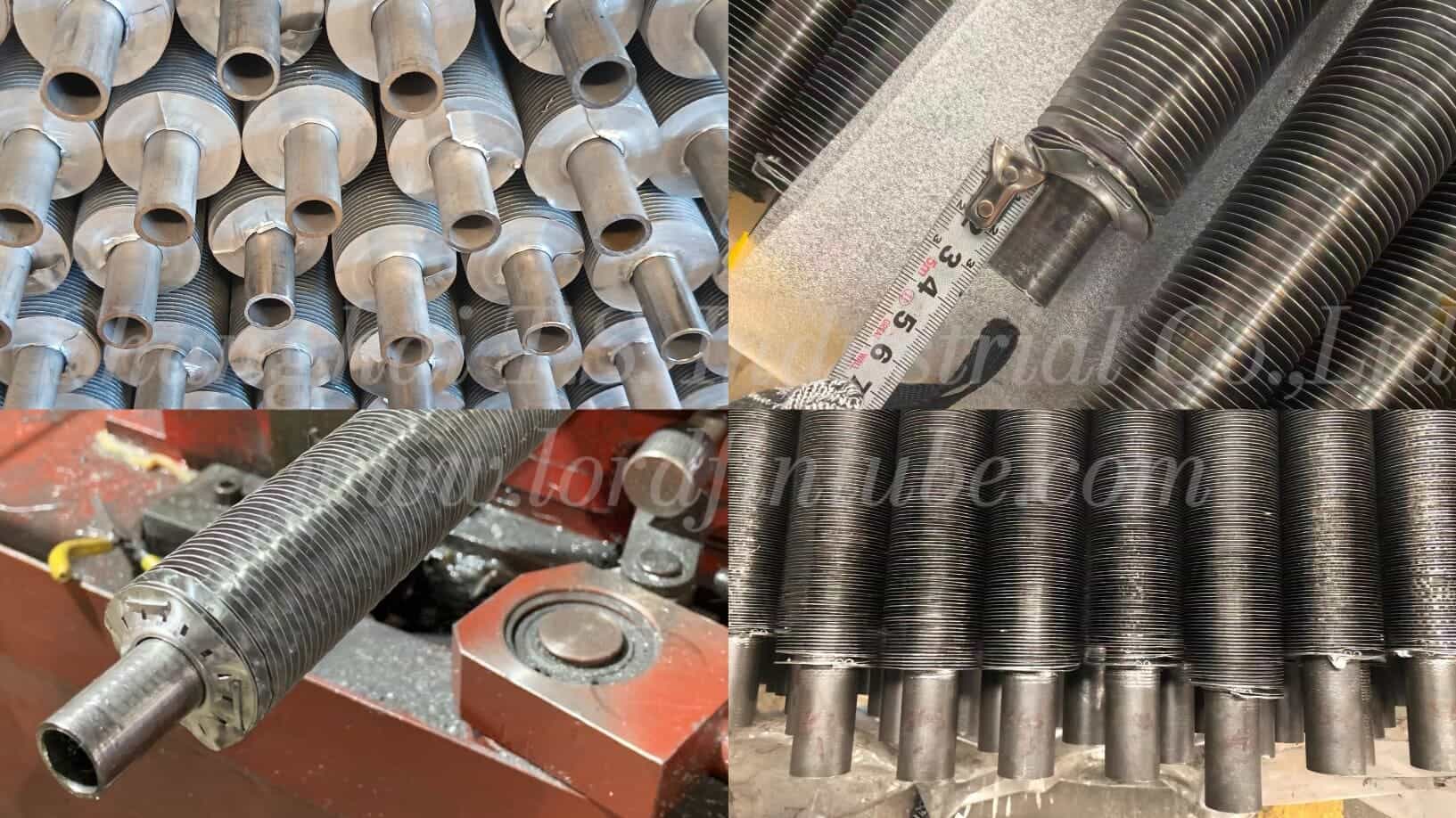

Common Fin Tubes for Air Coolers
Air-cooled heat exchangers (ACHEs), commonly known as air coolers, are essential in industries ranging from petrochemical and power generation to HVAC and natural gas processing. At the heart of every efficient air cooler lies the fin tube — a specialized component designed to maximize heat transfer without the need for cooling water.
Choosing the right fin tube is critical for thermal performance, operational longevity, and cost-effectiveness. Below, we break down the most common fin tube types used in air coolers today, including a new large-diameter brazed flat tube option.
Common 7 Types Finned Tubes for Air Coolers
1. L/LL/KL Fin Tubes (Wrap-On Type)
How they work: An L-shaped aluminum strip is wound tightly around the base tube, with the foot of the "L" locking into a pre-formed groove on the tube surface. KL and LL types offer improved mechanical interlocking.
✓ Advantages
- Economical for moderate-temperature applications.
- Excellent corrosion resistance (aluminum on carbon or stainless steel tube).
- Widely available in various fin densities.
⚠ Limitations
- Maximum operating temperature around 150°C (300°F).
- Moderate fin-to-tube contact → possible air gaps under severe thermal cycling.
Applications: Ambient air cooling, compressor intercoolers, and generator cooling where temperatures remain below 150°C.
2. G-Type (Embedded) Fin Tubes
How they work: A helical groove is cut into the base tube. A metal fin strip (usually aluminum or copper) is then embedded into the groove under tension, followed by a back-filling process to lock the fin in place.
✓ Advantages
- Superior mechanical strength and thermal stability.
- Withstands temperatures up to 400°C (750°F).
- Good resistance to vibration and thermal shock.
⚠ Limitations
- More expensive than L-type; grooving slightly reduces tube wall thickness.
Applications: High-temperature applications such as fired heater convection sections, waste heat recovery, and refinery air coolers.
3. Extruded (Integral) Fin Tubes
How they work: A bi-metallic tube is used — a smooth inner core (e.g., carbon or stainless steel) surrounded by an outer aluminum sleeve. The sleeve is mechanically extruded into fins, creating a seamless, solid fin structure.
✓ Advantages
- Exceptional corrosion protection (base tube completely sealed from atmosphere).
- High mechanical strength and foot-traffic resistance.
- Ideal for highly corrosive or marine environments.
⚠ Limitations
- Highest cost among common fin types; slightly lower thermal efficiency due to aluminum-steel interface.
Applications: Offshore platforms, chemical plants, and any application where external corrosion is a primary concern.
4. Elliptical (Oval) Rectangular Fin
The elliptical rectangular base tube has an elliptical cross-section (e.g., 36mm × 14mm). Rectangular fins are first collared (holes punched and drawn up), then assembled onto the tubes. The assembly is mechanically expanded (tube expanded into the fin collar) to ensure tight contact, followed by welding of the tube ends to the header plates, and finally hot-dip galvanizing for complete corrosion protection.
✓ Advantages
- Lower air pressure drop (30–40% less than round tubes at same face velocity).
- More compact core design with higher heat transfer per unit volume.
- Reduced fan power consumption.
- Hot-dip galvanizing provides excellent long-term corrosion resistance.
⚠ Limitations
- Higher manufacturing complexity; requires specific header designs (not direct drop-in replacement for round tubes).
Applications: Large air coolers where fan energy cost is critical, such as dry cooling towers and air-fin coolers in high-wind areas.
5. Large Diameter Brazed Aluminum Flat Tube with Serpentine Fins
This design uses a large diameter brazed aluminum flat tube (hollow profile) as the base. Serpentine aluminum fins are brazed directly onto the flat tube surfaces in a controlled atmosphere furnace, creating a monolithic, all-aluminum heat transfer matrix.
✓ Advantages
- Extremely high heat transfer density – flat tube maximizes surface contact with airstream.
- All-aluminum brazed construction – no galvanic corrosion, lightweight, high thermal conductivity.
- Ideal for large air volume, low pressure drop (air-cooled condensers, radiator cores).
- Serpentine fins induce turbulence without excessive flow resistance.
⚠ Limitations
- Higher upfront tooling cost; primarily suited for clean air/gas streams (closely spaced fins).
Applications: Large industrial air-cooled condensers, power plant dry cooling systems, heavy-duty radiators for mobile equipment, and HVAC air-handling units with high capacity requirements.
Material Combinations & Selection Factors
| Base Tube Material | Fin Material | Common Application |
|---|---|---|
| Carbon Steel | Aluminum | General industrial air coolers, low cost |
| Carbon Steel | Copper | Refrigeration, HVAC (high conductivity) |
| Stainless Steel (304/316) | Aluminum | Corrosive atmospheres, food/chemical plants |
| Stainless Steel | Stainless Steel | High-temperature, high-corrosion (e.g., flue gas) |
| Copper | Copper | Specialized refrigeration systems |
| Aluminum (flat tube) | Aluminum (brazed) | Large air-cooled condensers, dry cooling, radiators |
Selection Parameters for Your Air Cooler:
Operating Temperature: L-type ≤150°C, G-type ≤400°C, Extruded ≤280°C, Brazed flat tube ≤200°C (dependent on brazing alloy).
Corrosive Environment: Extruded (marine/chemical) > G-type (industrial) > L-type (indoor). For flat tubes, all-aluminum brazed construction is excellent for moderate corrosive environments.
Fouling Tendency: Wide fin spacing for dusty air; close spacing for clean process gas. The brazed flat tube’s serpentine fins are best suited for relatively clean air.
Technical Parameters of Common Fin Tubes
Below are the standard geometric parameters for all five fin tube types.
L, LL, KL, G, and Extruded (Round Base Tube)
| Parameter | Value / Range |
|---|---|
| Base tube outer diameter (OD) | 25.4 mm |
| Fin outer diameter (Fin OD) | 50.8 mm or 57.15 mm |
| Fin thickness | 0.4 mm (same for L/LL/KL/G/extruded) |
| Fin pitch (fins per meter – FPM) | 433 / 394 / 354 / 315 / 276 FPM |
| Fin height | 12.7 mm or 15.88 mm |
Elliptical Finned Tube
| Parameter | Value / Range |
|---|---|
| Base tube dimensions (major × minor) | 36 mm × 14 mm |
| Fin outer dimensions (major × minor) | 55 mm × 26 mm |
| Fin thickness | 0.25 mm |
| Fin pitch (distance between fins) | 2.31 mm / 2.54 mm / 2.82 mm / 3.18 mm |
Corresponding fin densities (fins per meter — FPM):
Pitch 2.31 mm → ≈433 FPM | Pitch 2.54 mm → ≈394 FPM | Pitch 2.82 mm → ≈354 FPM | Pitch 3.18 mm → ≈315 FPM
Large Diameter Brazed Aluminum Flat Tube with Serpentine Fins
| Parameter | Value |
|---|---|
| Base tube outer dimensions (width × height) | 220 mm × 19.1 mm |
| Base tube wall thickness (WT) | 1.5 mm |
| Fin outer dimensions (length × height × depth) | 200 mm × 19.1 mm × 57.3 mm |
| Fin thickness | 0.25 mm |
| Fin pitch | 2.3 mm |
These parameters ensure high mechanical stability and are compatible with most industrial air cooler designs.
Why Choose Lord Fin Tube?
At www.lordfintube.com, we manufacture and supply all five fin tube types — L/LL/KL, G-embedded, extruded, elliptical rectangular, and large diameter brazed aluminum flat tube — with precision tooling and strict quality control. Our products meet ASTM, ASME, and ISO standards, ensuring reliable performance in the harshest air cooler environments.