


Corrugated heat exchanger tube|Corrugated tube heat exchanger
A Corrugated heat exchanger tube rarely draws attention on a specification sheet. It carries no fins, no inserts and no surface coating, yet the shallow rings rolled into its wall change how a shell and tube exchanger performs on almost every front. Plants that move away from smooth tubes usually notice the same two effects: heat recovery improves and cleaning downtime drops.
What a corrugated heat exchanger tube is
The corrugated heat exchange tube is a new type of high-efficiency heat exchange tube that replaces the bare tube. It has the advantages of strong corrosion resistance, longer life, no pitting, and low price.
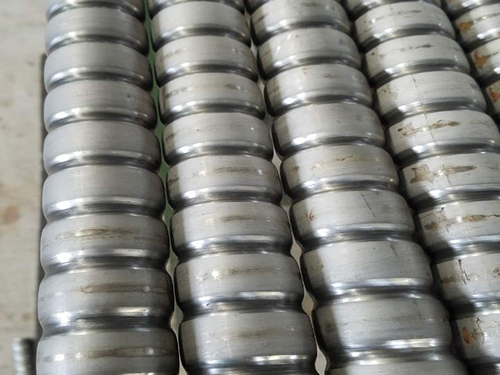
The stainless steel corrugated tube of the corrugated tube heat exchanger is made of high-quality stainless steel, which is resistant to corrosion. What is more important is the special internal and external waveforms of the corrugated tube. The turbulent medium constantly washes the inner and outer surfaces of the heat exchange tube, making it difficult to foul. Accumulate on the surface, even if fouling occurs, because the corrugated tube is a flexible element, the curvature of each part of the corrugated tube changes continuously after being affected by the temperature difference during the working process, although the deformation caused by this curvature change is not It is very large, but the linear expansion coefficient of the dirt and the metal corrugated tube is very different, so there will be a large pull-off force between the dirt and the corrugated tube surface, which is enough to make the dirt fall off to realize automatic cleaning and automatic descaling, especially this One point is that the tube and other heat exchangers cannot be compared, the stress distribution is uniform, and the corrosion resistance is strong.
How a corrugated heat exchanger tube moves heat
Heat never travels freely between two fluids. It has to cross a film of almost still liquid or gas that clings to the metal surface, and that film is where most of the resistance sits. A smooth wall lets the film settle into a stable layer. A corrugated heat exchanger tube does not.
Each ring in the wall forces the flow to separate and reattach. The film is torn apart, rebuilt, and torn apart again along the length of the tube, and the average thickness of that insulating layer falls. Because the boundary layer is thinner, the heat transfer coefficient rises without any increase in pumping power that a designer would consider unacceptable. On the shell side the same effect appears in reverse — the medium sweeping across the outside of the tube keeps the outer surface washed rather than stagnant.
Because the corrugated tube adopts ultra-thin-wall stainless steel material, on the one hand, the service life of the product is increased, and the weight of the product is greatly reduced, and the material is saved. Also, due to the reduction of operation and maintenance costs and the reduction of floor space, The performance-to-price ratio of the product has been greatly improved, and the economic benefits are obvious.
Why a corrugated heat exchanger tube resists fouling
Fouling is a mechanical problem before it becomes a thermal one. Deposits need a quiet surface to grip. Inside a corrugated heat exchanger tube the surface is never quiet — the medium is constantly changing direction, and particles that would otherwise settle are carried past instead.
When scale does form, the geometry works in the operators favour. The corrugated wall is a flexible element rather than a rigid one. As the working temperature swings, the curvature of each section shifts, and the tube expands and contracts differently from the deposit sitting on it. The two materials have very different linear expansion coefficients, so a pull-off force builds up at the interface and the layer breaks away on its own. That self-cleaning behaviour is difficult to reproduce in any other type of heat exchange tube, and it is the reason maintenance intervals stretch out considerably.
Which materials a corrugated heat exchanger tube uses
The alloy is chosen around the medium, not around the tube shape. A corrugated profile works the same way in every grade, so the decision usually comes down to corrosion resistance, temperature, and cost.
| Material | Common grades | Behaviour | Where it is used |
|---|---|---|---|
| Stainless steel | 304, 304L, 316, 316L, 321 | Good general corrosion resistance, easy to form into a corrugated profile | Heating and cooling circuits, food and dairy processing, pharmaceutical duty |
| Duplex stainless steel | 2205, 2507 | High strength, resists chloride stress cracking | Seawater cooling, high-chloride process streams |
| Titanium | Gr2, Gr9 | Excellent resistance to oxidising media, low density | Desalination, brine circuits, chemical condensers |
| Copper alloys | B10, B30, HSn70-1 | Very high thermal conductivity, sensitive to ammonia | Marine condensers, power plant cooling |
| Carbon steel | 10#, 20# | Lowest material cost, needs protection in aggressive media | Steam and water duty, low-temperature utility loops |
Corrugated heat exchanger tube against a bare tube
Designers ask the same question every time: what actually changes when the smooth tube is swapped out? The table below sums up the practical differences that show up on site.
| Point of comparison | Bare tube | Corrugated heat exchanger tube |
|---|---|---|
| Boundary layer | Stable, thickens along the length | Repeatedly disturbed, stays thin |
| Heat transfer coefficient | Baseline | Higher for the same flow rate |
| Fouling rate | Climbs steadily between cleanings | Builds slowly, and partly sheds on its own |
| Thermal stress | Concentrated at fixed joints | Spread evenly along the flexible wall |
| Wall thickness and weight | Thicker wall, heavier bundle | Thinner wall, lighter bundle |
| Cleaning interval | Frequent shutdowns | Longer running periods |
| Footprint | Larger exchanger for the same duty | Smaller exchanger for the same duty |
Where a corrugated heat exchanger tube is installed
Any duty where fouling, thermal cycling or limited floor space causes trouble is a candidate. Typical installations include:
- Crude oil and product coolers in refineries, where deposits build quickly on smooth surfaces
- Steam condensers and feedwater heaters in power stations
- District heating substations and HVAC heat recovery units
- Pasteurisers, CIP circuits and chillers in food and beverage plants
- Seawater and brine exchangers on ships and in desalination trains
- Waste heat recovery on flue gas and exhaust lines
- Chemical reactors and reboilers handling viscous or particle-laden streams
How to specify a corrugated heat exchanger tube
Four variables decide whether the tube performs as expected.
Corrugation depth and pitch. Deeper rings disturb the boundary layer more aggressively, which helps in fouling service but raises pressure drop. A shallower profile suits clean streams where pumping cost matters more than cleaning frequency.
Wall thickness. Thin walls transfer heat faster, but they also set the pressure rating. The wall must satisfy the design pressure and the corrosion allowance for the intended service life before any thermal benefit is counted.
Tube length and support spacing. Because the corrugated wall flexes, baffle spacing and support positions have to be reviewed against vibration. A flexible tube can behave differently from a rigid one under cross-flow.
Connection method. Expansion and rolling at the tubesheet need to match the alloy and the wall thickness. A corrugated tube that is over-rolled at the joint loses the benefit it was bought for.
One practical point that is easy to miss: the pressure drop penalty of a corrugated heat exchanger tube is usually smaller than the penalty of running a fouled smooth tube. Over a full operating cycle, the corrugated option often consumes less pumping energy, not more.
Questions about a corrugated heat exchanger tube
What does a corrugated heat exchanger tube do to pressure drop?
The profile adds friction, so pressure drop rises compared with a smooth tube of the same length and diameter. The increase depends on corrugation depth and pitch. In most designs the rise is modest, and it is offset by the fact that the tube stays clean, so the average pressure drop across a full operating cycle is often lower.
Which corrugation pattern suits a fouling service?
Deeper corrugations with a shorter pitch work best where deposits form quickly, because they disturb the boundary layer most strongly and create the largest pull-off force as the wall flexes. Clean duties are better served by a shallow profile that keeps pumping cost down.
How long does a corrugated heat exchanger tube last?
Service life is set by the alloy, the medium and the operating temperature, not by the shape of the wall. Thin-wall stainless steel corrugated tubes resist pitting and general corrosion well in most water and process duties, and the even stress distribution along the flexible wall reduces the fatigue failures that appear at rigid joints.
Can a corrugated heat exchanger tube replace a plain tube in an existing shell?
In many cases yes, provided the tubesheet holes, tube pitch and baffle spacing are compatible and the pressure drop budget allows for the profile. A vibration review is advisable, because a flexible tube responds differently from a rigid one under cross-flow.
Why does a corrugated heat exchanger tube lower operating cost?
Thinner walls mean less metal and a lighter bundle, which cuts material and handling cost. Longer intervals between cleanings mean fewer shutdowns and less labour. A smaller exchanger can often do the same job, which saves floor space and piping.