


Difference between HRSG and WHRB
If you work in power generation or industrial heat recovery, you have seen HRSG and WHRB used almost interchangeably. Both are boilers that recover waste heat instead of burning fuel directly — but they are not the same thing.
WHRB (Waste Heat Recovery Boiler) is the umbrella term for any boiler that recovers industrial waste heat. HRSG (Heat Recovery Steam Generator) is a specialized type of WHRB that recovers exhaust heat from a gas turbine.
Every HRSG is a WHRB — but not every WHRB is an HRSG.
WHRB vs. HRSG: what is the difference?
Putting the definitions next to each other makes the difference obvious: one is a broad category, the other is a specific machine with a specific job.
What is a Waste Heat Recovery Boiler?
A WHRB recovers heat from a hot gas stream that is a byproduct of another process and converts it into steam or hot water. It burns little or no fuel itself.
- Reciprocating engine exhaust (gas / diesel)
- Kiln and furnace flue gas (cement, glass)
- Incinerator flue gas
- Chemical process off-gas
- Inlet gas roughly 200–600 °C
- Usually single-pressure steam
- Output for process steam, district heating, small power
- A few t/h up to tens of t/h
What is a Heat Recovery Steam Generator?
An HRSG is the dedicated waste-heat boiler installed behind a gas turbine in a combined cycle (CCGT) plant. It turns the turbine’s exhaust — still around 500–650 °C — into steam that drives a steam turbine.
- Gas turbine exhaust (single, dedicated source)
- Inlet gas roughly 500–650 °C, very large flow
- Multi-pressure design (HP / IP / LP) with superheat, often reheat
- Output drives a steam turbine for power generation
- Tens to hundreds of MW steam equivalent
How each system works, at a glance
Follow the heat. The chain behind each name tells you where the waste heat comes from and where the steam goes.
The heat-recovery chain behind a CCGT plant: one fuel charge, two turbines, one generator. Gas turbine exhaust is captured instead of vented.
The general waste-heat chain: the heat source varies widely, and the output serves heating and process loads rather than a dedicated steam turbine cycle.
Side-by-side comparison
The full picture in one table — use it as a quick reference when you are specifying equipment or sending inquiries for pressure parts.
| Aspect | HRSG (Heat Recovery Steam Generator) | WHRB (Waste Heat Recovery Boiler) |
|---|---|---|
| Concept | A specialized type of WHRB | Umbrella term for waste-heat boilers |
| Typical heat source | Gas turbine exhaust | Engine exhaust, kiln / furnace flue gas, incinerator gas, process off-gas, etc. |
| Inlet gas temperature | ≈500–650 °C (typical) | Wide range, ≈200–600 °C |
| Primary application | Combined cycle (CCGT) power generation | Industrial CHP, process steam, district heating |
| Steam system | Multi-pressure (HP / IP / LP), reheat common | Usually single-pressure, occasionally dual-pressure |
| Supplementary firing | Optional (duct burner) | Generally not used |
| Typical scale | Large — tens to hundreds of MW | Small to medium — a few to tens of t/h |
| Typical layout | Horizontal water-tube, modular | Horizontal or vertical; water-tube or fire-tube; finned tube / heat pipe |
| Design complexity | High (temperature matching, flow distribution) | Moderate |
Why the difference matters when sourcing boiler pressure parts
Both HRSGs and WHRBs live or die by their pressure parts — drums, headers, superheater and reheater coils, evaporator banks, economizers, finned tubes, piping, and fittings. The differences above drive real design decisions.
- Materials. Drum plates are typically carbon steel (e.g., SA-516 Gr.70); headers and piping may be SA-106 Gr.B or alloy grades such as SA-335 P11 / P22 / P91; superheater tubes in high-temperature HRSGs often require alloy grades like SA-213 T22 / T91 / T92 or stainless grades such as TP304H / TP347H.
- Multi-pressure systems. An HRSG with HP / IP / LP stages contains more drums, headers, and coil bundles than a single-pressure WHRB — with tighter metallurgical margins.
- Gas-side heat transfer. Finned tubes are widely used in both designs; fin type, spacing, and material (carbon steel or stainless) are selected based on gas temperature, dust loading, and corrosion / erosion risk.
- Codes and fabrication. Pressure parts are typically designed and fabricated to ASME Section I (or Section VIII), PED 2014/68/EU, or GB/T 16507, with documented NDT (RT, UT, MT / PT) and hydrostatic testing.
- Corrosion and erosion. Flue-gas velocity, ash content, and boiler water chemistry all affect tube life — a reason to specify wall thickness and material grade carefully rather than reusing the last project’s spec.
When you send an inquiry for pressure parts, include: heat source type, gas flow and inlet / outlet temperatures, required steam conditions (pressure / temperature / capacity), design code, and layout constraints. That information lets a fabricator quote the right drums, headers, and tube bundles the first time.
How to choose: HRSG or WHRB?
The equipment class follows the heat source and the end use — there is usually no genuine tie to break.
- Gas turbine exhaust + steam turbine for power → you need an HRSG (combined cycle).
- Engine exhaust, kiln / furnace gas, or incinerator gas for process steam or heating → a general WHRB is the right category.
- In between? If a WHRB happens to be installed on a gas turbine exhaust stream, it is — by definition — performing the duty of an HRSG.
Frequently asked questions
What is a CCGT combined cycle?
CCGT stands for Combined Cycle Gas Turbine. It stacks two power cycles on top of each other: the gas turbine runs a Brayton cycle (the “top” cycle), and its hot exhaust — instead of being vented — is captured by an HRSG, which raises steam to drive a steam turbine in a Rankine cycle (the “bottom” cycle). One fuel charge therefore produces electricity twice.
This is why combined cycle plants are the most efficient fossil-fuel power route today:
The roughly 20-point gain over simple cycle is exactly the waste heat that the HRSG recovers. The latest units approach 64%.
Is an HRSG a waste heat boiler?
Yes. It is the specialized waste-heat boiler used behind gas turbines in combined cycle plants — a subset of the broader WHRB family.
Can a WHRB be used with a gas turbine?
It can, but for gas turbine exhaust duty the design is normally called an HRSG and must handle very large gas flow with multi-pressure steam generation to reach combined cycle efficiency.
Which one is more efficient?
Both recover the same kind of waste heat. What matters is the overall plant efficiency: a combined cycle with an HRSG typically reaches 58–63%, far above simple-cycle operation. A WHRB in an industrial setting should be judged by how much of the available waste heat it turns into usable steam or hot water.
Do HRSGs need different pressure parts than WHRBs?
Generally yes. Multi-pressure HRSGs demand more components — multiple drums, headers, and coil bundles — and higher-grade materials, especially for superheaters and reheaters operating at elevated temperatures.
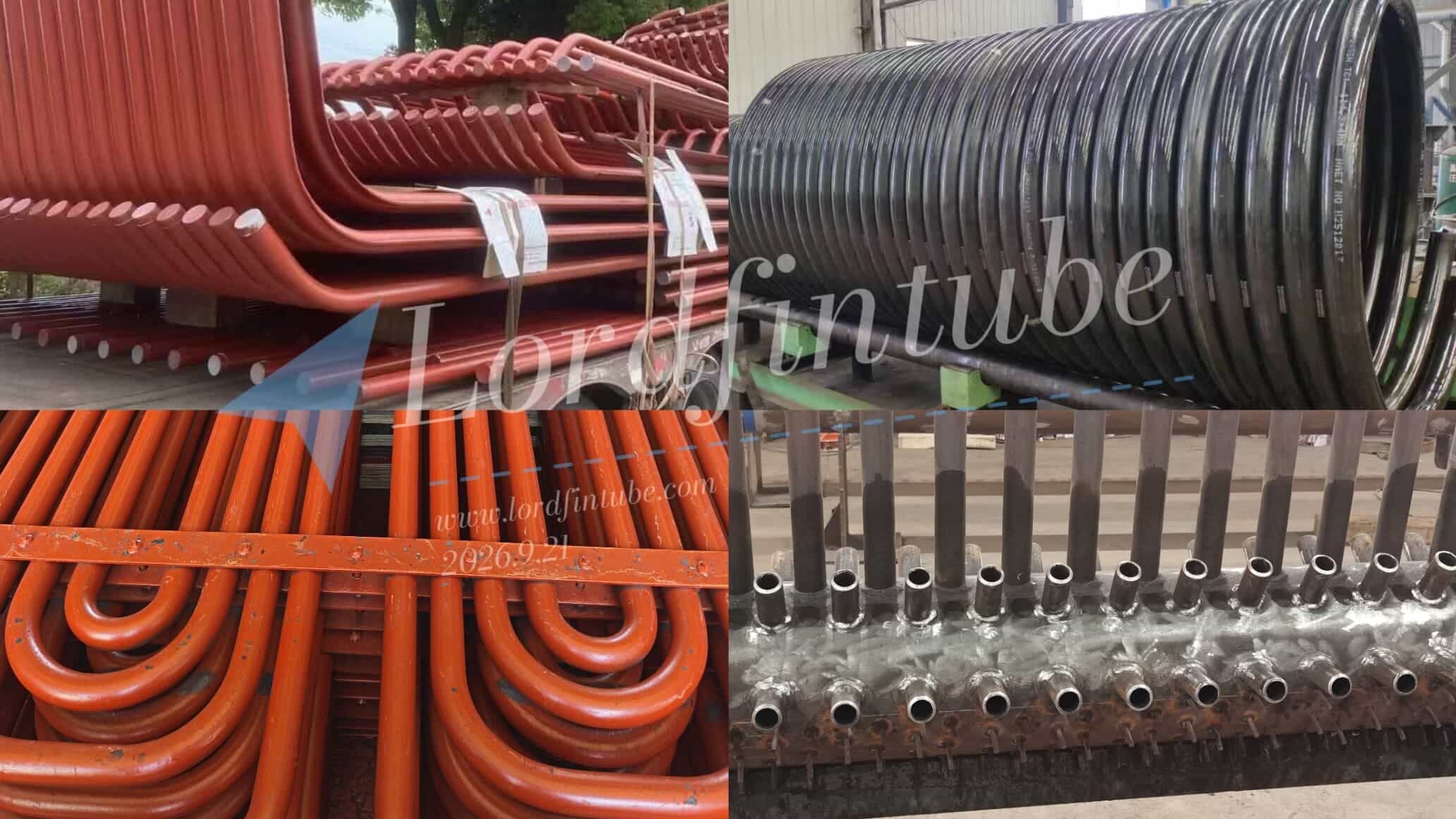
Putting experience into every pressure part
At Shanghai T.S. Industrial Co.,Ltd, we supply boiler pressure parts for both HRSGs and WHRBs — steam drums, headers, superheater and reheater coils, economizers, finned tube bundles, and associated piping — designed and fabricated to ASME, PED, or GB/T standards. Whether you are upgrading a combined cycle HRSG or adding waste-heat recovery to an industrial process, our team can help you select and supply the right pressure parts, matched to your operating conditions.
Send us your gas flow and steam conditions for a free engineering review: sales@lordfintube.com · www.lordfintube.com
Contact our engineering team