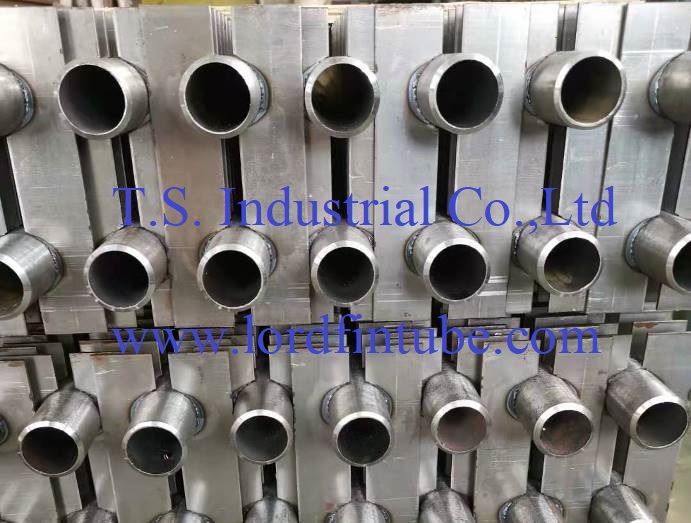

Lord Fin Tube-Double H fin tube SA192
Double H fin tube SA192
What are SA192 Double H fin tubes?
SA192 Double H fin tubes are specialized heat exchanger components crafted from seamless carbon steel tubes according to the ASME SA192 standard. The unique design involves incorporating two SA192 bare tubes within each finned tube unit. This configuration, commonly referred to as "H type carbon steel finned tubes," maximizes heat transfer efficiency by combining the thermal conductivity of carbon steel with the enhanced surface area provided by the Double H fin design.
These finned tubes are designed to withstand demanding operating conditions. The design temperature is specified as 200°C, and the design pressure is set at 23 bar (gauge pressure). This indicates that these finned tubes are intended for applications involving high temperatures and pressures, making them suitable for processes such as superheating and high-pressure heat exchange.
The ASME SA192 standard lays out the requirements for seamless carbon steel boiler and superheater tubes used in high-pressure service. The tubes covered by this standard are expected to have minimum wall thickness to withstand the stress and conditions associated with high-pressure environments.
What makes Double H fin tube SA192 unique?
The Double H fin tube SA192 stands apart from conventional finned tubes due to its dual-tube configuration. Each finned unit incorporates two base tubes joined by H-shaped fins, effectively doubling the heat transfer surface area per unit length compared to single-tube designs. This geometry creates more turbulent flow across the fin surfaces, which significantly enhances convective heat transfer coefficients. The ASME SA192 material specification ensures the base tubes possess the necessary creep strength and oxidation resistance for sustained high-temperature operation, while the carbon steel fins provide excellent thermal conductivity and mechanical robustness.
Another distinctive feature lies in the manufacturing process. The fins are resistance-welded to the base tubes, creating a metallurgical bond that minimizes contact resistance and ensures long-term thermal performance. This welding method also contributes to the structural integrity of the fin-tube assembly, allowing it to withstand thermal cycling and mechanical vibration commonly encountered in industrial boiler environments.
Which industries use Double H fin tube SA192?
► Water Walls: In coal-fired, biomass-fired, and waste-to-energy boilers.
► Economizers: In various industrial and utility boilers.
► Waste Heat Recovery Boilers: Where flue gases might contain particulates.
► Process Heaters: In industries like refining and petrochemicals where fouling resistance is needed.
► Air Heaters (Less Common): Sometimes used in specific designs.
SA192 Double H fin tubes can find applications in industries such as power generation, petrochemicals, refineries, and other high-pressure and high-temperature processes where efficient heat transfer is essential for optimal performance.
Beyond these core sectors, Double H fin tube SA192 is increasingly adopted in combined heat and power (CHP) plants, industrial drying systems, and marine boiler applications where space constraints demand compact heat exchanger designs with high thermal output per unit volume.
How does Double H fin tube SA192 improve heat transfer?
The Double H fin geometry creates a substantially larger effective heat transfer surface area compared to bare tubes or even single-fin designs. The extended fins disrupt the boundary layer of the fluid flowing across the tube bank, promoting turbulence and enhancing the convective heat transfer coefficient. This is particularly effective in gas-side heat transfer applications, where the thermal resistance on the gas side often dominates the overall heat transfer process.
Additionally, the H-shaped fin configuration provides multiple heat transfer paths from the base tube to the fin tips. The symmetrical fin arrangement ensures uniform heat distribution across both tubes in the assembly, minimizing thermal gradients and reducing the risk of localized overheating. For engineers designing heat recovery systems, this translates to more predictable performance and improved thermal efficiency across a wide range of operating conditions.
Why choose carbon steel for Double H fin tube SA192?
Carbon steel, as specified by ASME SA192, offers an optimal balance of strength, thermal conductivity, and cost-effectiveness for high-pressure boiler applications. The material exhibits excellent resistance to thermal fatigue and creep at temperatures up to 200°C, making it suitable for continuous operation in demanding environments. The chemical composition of SA192 carbon steel ensures consistent mechanical properties and weldability, which is critical for the resistance-welding process used in fin attachment.
Compared to alloy steels or stainless steels, carbon steel provides superior thermal diffusivity, allowing faster heat transfer from the tube wall to the fin surfaces. This property is particularly beneficial in applications where rapid thermal response is required. Furthermore, carbon steels cost advantage makes Double H fin tube SA192 an economically viable solution for large-scale heat exchanger projects without compromising performance or reliability.
Double H fin tube SA192 Chemical Composition
| ASME SA192 Chemical Composition (W.T. %) | |||||
| Elements | Carbon | Mn | P | S | Si |
| Standard Requirement | 0.06-0.18 | 0.27-0.63 | ≤ 0.0035 | ≤ 0.0035 | ≥ 0.25 |
Double H fin tube SA192 Specifications
| SA192 Double H Fin Tube | ||||
| Base Tube Material | Fin Material | Tube Length (mm) | Fin length (mm) | Fin Tube Quantity (Pc) |
| ASME SA192 | Carbon Steel | 5200 | 5000 mm | 660 |
| Base Tube O.D (mm) | Base Tube Thickness (mm) | Fin Height (mm) | Fin Thickness (mm) | Fin Pitch (mm) |
| 31.8 | 3.2 | 70*140 | 2 mm | 25 mm |
Double H fin tube SA192 Performance Parameters
| Parameter | Value / Range |
| Design Temperature | 200°C |
| Design Pressure (gauge) | 23 bar |
| Thermal Conductivity (Base Tube) | ~ 45 W/m·K |
| Fin Efficiency | 85% – 92% |
| Max Operating Temperature | 220°C (continuous) |
| Burst Pressure (min) | ≥ 80 bar |
Double H fin tube SA192 vs. Other Fin Tube Types
| Feature | Double H fin tube SA192 | Single H Fin Tube | Solid Fin Tube |
| Heat Transfer Area | Highest | Medium | Low |
| Pressure Drop | Moderate | Low | Low |
| Fouling Resistance | Excellent | Good | Poor |
| Structural Rigidity | High | Medium | Low |
| Cost Efficiency | Balanced | Moderate | Low |
| Typical Applications | Boilers, Economizers | Air Heaters | Low-pressure exchangers |
How is Double H fin tube SA192 manufactured?
The manufacturing process for Double H fin tube SA192 begins with seamless carbon steel tubes that meet ASME SA192 specifications. These tubes are carefully inspected for dimensional accuracy and surface quality before proceeding to the finning stage. The H-shaped fins are formed from carbon steel strip material through a precision stamping process, ensuring consistent fin height, thickness, and pitch.
The fins are then resistance-welded to the base tubes using automated high-frequency welding equipment. This process creates a continuous metallurgical bond along the entire fin length, eliminating gaps that could impair thermal performance. After welding, the finned tubes undergo heat treatment to relieve residual stresses and restore the materials mechanical properties. Final operations include straightening, end preparation, and hydrostatic testing to verify the integrity of the tube-fin assembly.
Which quality tests apply to Double H fin tube SA192?
Quality assurance for Double H fin tube SA192 encompasses a comprehensive suite of tests designed to verify material properties, dimensional accuracy, and performance characteristics. These tests include:
► Chemical composition analysis to confirm compliance with ASME SA192 requirements.
► Tensile and hardness testing to validate mechanical strength.
► Hydrostatic pressure testing at 1.5 times the design pressure to ensure leak-tightness.
► Dimensional inspection of fin height, thickness, pitch, and tube O.D. using precision gauges.
► Metallographic examination of the weld zone to verify bond integrity and absence of defects.
► Eddy current testing (ECT) for detection of surface and subsurface discontinuities.
Each Double H fin tube SA192 is traceable through a unique identification marking, allowing full material and process traceability from raw material to finished product.