


Finned Heat Exchange Tubes: An Engineering Workhorse for Heat Transfer Enhancement
Finned heat exchange tubes, commonly referred to as finned tubes, are core heat transfer components that enhance heat transfer by adding fins (ribs) on the outer or inner surface of a base tube (bare tube). Their fundamental principle is to expand the heat transfer area, effectively breaking the heat transfer bottleneck between fluid and tube wall. In industrial heat exchange scenarios, the heat transfer coefficient of the fluid outside (or inside) the tube often restricts the overall heat transfer efficiency. The adoption of finned heat exchange tube can greatly boost heat transfer capacity at a relatively low cost. Thanks to this advantage, finned tubes are widely used in boilers, petrochemicals, power generation, refrigeration and air conditioning, waste heat recovery and many other industrial sectors.
Structure and Working Principle
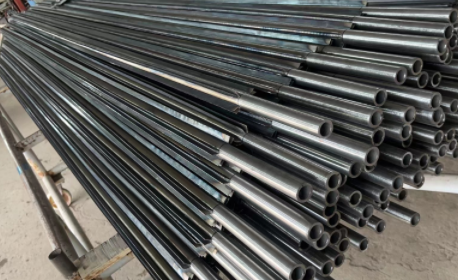
A typical finned tube consists of two parts: a base tube and fins. The base tube is usually circular, while elliptical or flat special-shaped tubes are also available, with fluid flowing inside. Fins are thin metal sheets attached to the outer or inner wall of the base tube, featuring diverse surface profiles including plain fins, serrated fins, corrugated fins and perforated fins.
The heat transfer enhancement mechanism can be summarized into two points:
Increasing effective heat transfer area: The addition of fins greatly expands the heat transfer area on the fluid side. Compared with bare tubes, finned tubes can increase the heat transfer area by 2 to 10 times and raise the heat transfer coefficient by 1 to 2 times, significantly reducing the overall thermal resistance. For example, integrally low-finned tubes have an external surface area 2.5 to 3 times that of bare tubes of the same specification.
Enhancing fluid turbulence: The structural design of fins not only enlarges the area but also disturbs the fluid. When fluid flows through the passages between fins, the flow direction changes continuously, disrupting the development of the thermal boundary layer and thereby strengthening convective heat transfer. For instance, finned tubes with internal threads or special structures can substantially increase fluid turbulence intensity for further improved heat transfer coefficients.
Classification and Manufacturing Processes
Finned tubes can be classified in multiple ways, mainly by manufacturing process and fin geometry.
Classification by Manufacturing Process
| Manufacturing Process | Features & Advantages | Performance Level |
|---|---|---|
| Integrally extruded/rolled | Fins and base tube are integrally rolled or cast from the same material with no clearance in between, resulting in zero contact thermal resistance, high heat transfer efficiency and good mechanical strength. | Optimal |
| Welded type (including high frequency welded finned tube) | Fins are welded onto the base tube via high-frequency welding, laser welding or brazing. High-frequency welding is one of the most widely adopted methods at present, featuring high automation, no flux, high productivity and excellent thermal and mechanical properties. | Excellent |
| Mechanically assembled type | Including wrapped fins, sleeved fins, embedded fins and other processes. Simple process and low cost, yet contact thermal resistance exists between fins and base tube. Such thermal resistance may rise under high-temperature conditions due to differential thermal expansion and impair long-term stability. | General |
Classification by Fin Shape
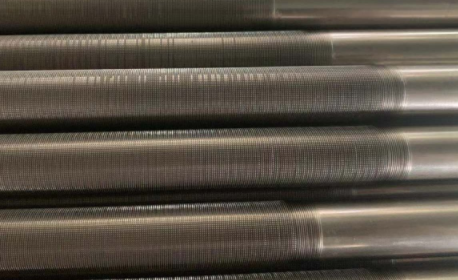
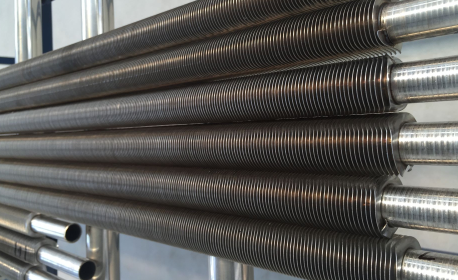
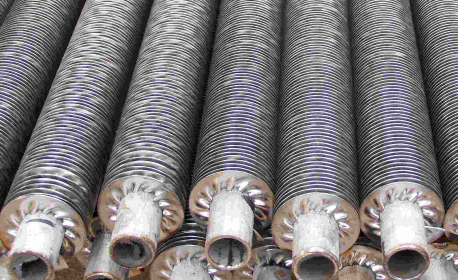
Finned tubes are mainly divided into longitudinal finned tubes and radial (transverse) finned tubes. Radial fins (such as spiral fins) see the widest application. Spiral finned tubes can be integrally rolled, welded or wound. In addition, various high-performance variants such as pin finned tubes and corrugated finned tubes are available.
Engineering Applications
Finned tubes are applied to meet the engineering demands for compact, high-efficiency and low-cost heat exchangers.
Waste heat recovery: In waste heat boilers, utility boilers and other equipment, finned tubes efficiently recover heat from high-temperature flue gas, reduce exhaust gas temperature and improve energy utilization efficiency.
Process industry: In petroleum and chemical sectors, finned tubes are extensively used in various shell-and-tube heat exchangers for gas-gas or gas-liquid heat transfer conditions such as air coolers. Finned tubes made of corrosion-resistant alloys (e.g. titanium, stainless steel) can handle corrosive environments effectively.
Refrigeration and air conditioning: Finned tubes serve as core heat transfer components in surface air coolers, evaporators and condensers of air conditioning systems. Optimized fin structures can greatly improve air-side heat transfer efficiency.
Special and advanced fields: High-performance finned tubes (small diameter, highly compact tube bundles) play critical roles in nuclear power plant moisture separator reheaters (MSR), passive cooling systems for main control rooms, and thermal management systems of aero-engines.
Performance Evaluation and Optimization
The performance of finned tubes is generally evaluated by heat transfer efficiency, flow resistance (pressure drop), service life and other indicators. During engineering design and model selection, a balance must be struck between heat transfer enhancement and increased flow resistance.