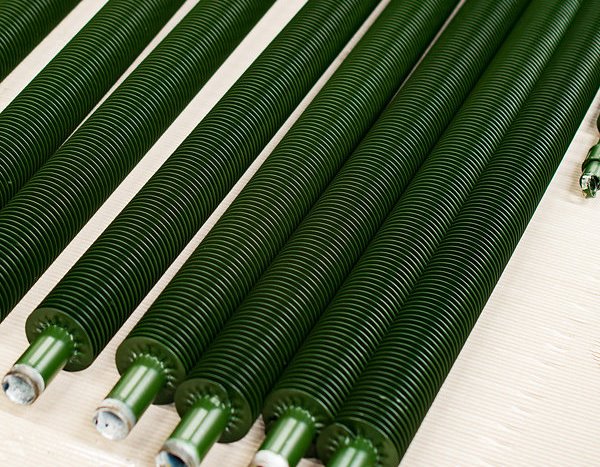

What are finned heat exchanger tubes?
Finned Heat Exchanger Tubes Basics
Finned heat exchanger tubes are tubes with fins attached to their outer surface. These fins increase the heat transfer coefficient by expanding the surface area in contact with the fluid. What makes them essential in industries like chemical, petrochemical, power generation, and HVAC is their ability to handle fluids with low thermal conductivity and significant temperature differences.
How do the fins work? They come in types such as plain, serrated, or spiral, and their shape and spacing depend on the application. Attachment methods include welding, brazing, or mechanical means. When selecting finned tubes, factors like fluid type, flow rate, temperature, and pressure are critical. Heat transfer coefficients can be predicted using empirical correlations or simulations.
Finned Heat Exchanger Tubes Types
Which fin types are available for heat exchanger tubes? Here is a comparison to help you choose the right one for your needs:
| Fin Type | Construction Method | Typical Applications | Heat Transfer Efficiency |
|---|---|---|---|
| Plain Fins | Welded or brazed | HVAC systems, air coolers | Moderate; suitable for clean fluids |
| Serrated Fins | Mechanical attachment | Power plants, high-fouling environments | High; enhances turbulence |
| Spiral Fins | Spiral winding | Oil and gas, chemical processing | Very high; maximizes surface area |
| T-Shaped Fins | Specialized welding | Waste heat recovery, marine | Exceptional; for extreme conditions |
What should you consider when comparing types? Look at factors like durability, cost, and compatibility with fluids. For example, T-shaped fins offer robust performance in harsh environments—learn more about finned heat exchanger tubes with this design.
Finned Heat Exchanger Tubes Effectiveness
Finned heat exchanger tubes boost heat exchanger effectiveness in multiple ways. How do they achieve this? Here are the key mechanisms:
1. Increased Surface Area: Fins expand the tubes outer surface, raising the heat transfer coefficient and overall rate. This is crucial for applications where space is limited.
2. Enhanced Turbulence: Fins disrupt fluid flow, promoting mixing and reducing fouling. This leads to more consistent performance over time.
3. Improved Heat Transfer Coefficient: With a larger contact area, finned tubes transfer heat more efficiently, allowing for smaller, cost-effective heat exchangers.
4. Higher Heat Transfer Rate: The combined effects of surface area and turbulence enable more heat transfer in less time, ideal for high-demand industrial processes.
5. Better Thermal Performance: This translates to energy savings, lower operating costs, and improved system reliability across sectors like oil and gas, marine, and HVAC&R.
What are the real-world benefits? Finned tubes can capture waste heat or cool fluids using air, making them versatile for water, oil, or gas systems. Their design often involves air as the cooling or heating medium, which is efficient and environmentally friendly.
Finned Heat Exchanger Tubes Selection
How do you select the right finned tubes for your project? Consider these aspects:
Which fluids are involved? For gases like air, serrated fins may be best due to their turbulence enhancement. For liquids, plain or spiral fins could suffice based on viscosity.
What about operating conditions? High temperatures or pressures might require welded fins for strength, while corrosive environments benefit from corrosion-resistant materials.
How to optimize cost and performance? Balancing fin density (spacing) with airflow resistance can reduce energy consumption. Consulting with suppliers for custom solutions is often helpful.