


Floating Head or Fixed Tubesheet? How to Choose Heat Exchanger?
If youve spent any time sizing exchangers for real process conditions, you already know the debate: floating head or fixed tubesheet heat exchanger?
Both have been around forever. Both will do the job — until they dont.
The trick is knowing where each one fails. Because that’s where the other one shines.
How are floating or fixed heat exchanger built differently?
The structural difference is not subtle.
Fixed Heat Exchanger
Two tube sheets welded directly to the shell. Tubes are rolled or welded into both tube sheets. The shell, tube sheets, and tubes form a rigid, single piece. No moving parts. The tube bundle cannot be removed without cutting the shell.
Floating Heat Exchanger
One tube sheet is fixed at the front (stationary). The other tube sheet — the floating head — is free to move axially inside the shell. A floating head cover bolts onto it. The entire bundle can slide and be pulled out from the front after removing the shell flange.
That one difference drives everything else: thermal behavior, cleaning access, gaskets, and cost.
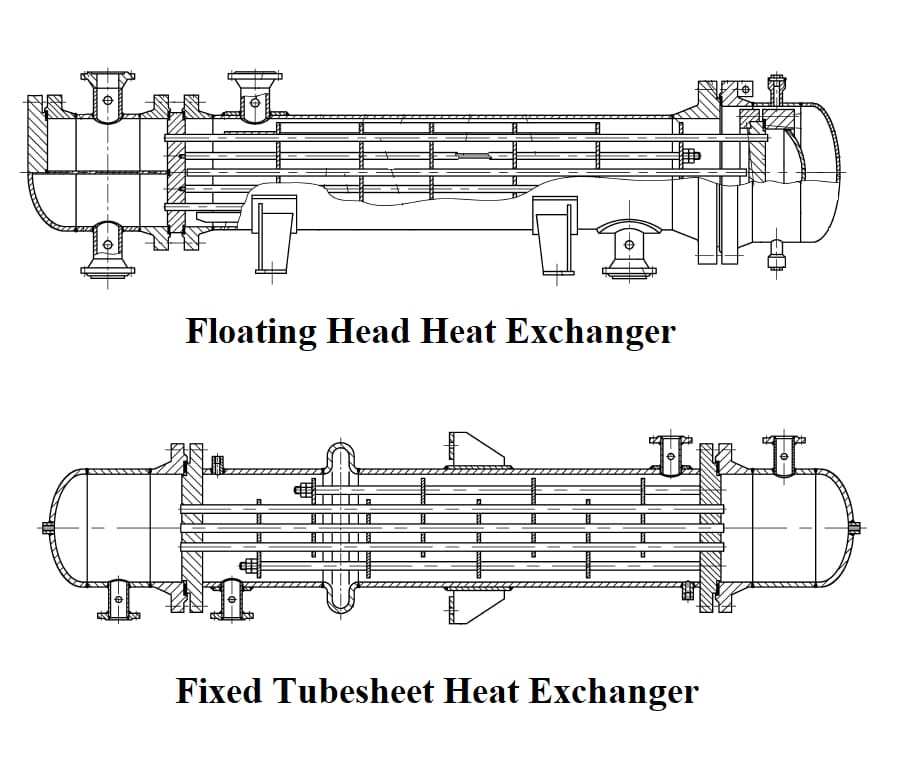
Four questions you must ask before choosing
When pick an exchanger type, we always run through these four. Not from the datasheet alone — from the real operating curve.
1. Thermal expansion between tube side and shell side
Fixed tubesheet type: Tubes and shell expand at different rates. No room to move. You either add an expansion joint on the shell (limited help) or risk high stresses, tube buckling, or pulled tubesheets.
Floating head type: The floating head slides. Differential expansion is absorbed mechanically. No stress buildup.
If your ΔT (mean metal temperature difference) exceeds about 80–100°C, go floating head.
2. Flow direction and pass arrangement on the tube side
How fluid travels through the tubes matters for both designs.
Both types support multiple tube passes (1, 2, 4, 6, etc.) by partitioning the stationary head. No fundamental difference here.
The real distinction shows up on the shell side — which is question three.
3. How you control shell-side fluid flow (shell passes)
Correction from earlier versions: both fixed tube sheet and floating head can have longitudinal baffles installed inside the shell to create two or more shell passes.
Fixed tubesheet type: Straightforward. You can weld longitudinal baffles to the shell. Multiple shell passes are common.
Floating head type: Also possible, but more involved. The longitudinal baffle must accommodate the floating head movement — usually by leaving a gap or using a sliding seal. It adds complexity, but its done.
So if you truly need multiple shell passes, both designs can deliver — but fixed tube sheet does it with less internal complication.
4. Simplicity of maintenance and operation
Fixed tubesheet type: No internal gaskets or loose bolts. Leaking tube? Just plug it — fast. But you cannot access the outside of tubes for mechanical cleaning. Shell-side fouling is a problem.
Floating head type: Bundle is removable. You can clean both sides mechanically. But floating head gasket and split ring add leak points. Repairing a floating head gasket leak means a full teardown. That costs days, not hours.
Ask yourself: what hurts more — thermal stress, or downtime for maintenance?
Similarities & Differences between Floating and Fixed Heat Exchanger
| Item | Aspect | Fixed Tube Sheet | Floating Head |
|---|---|---|---|
| 1 | Tube bundle removable? | No (except by cutting shell) | Yes — bundle pulls out from front |
| 2 | How to reduce differential thermal expansion | Add expansion joint on shell (limited range) | Floating head slides freely — no joint needed |
| 3 | Can you replace a single tube? | Yes — weld replacement | Yes — same, but bundle must be pulled first |
| 4 | Chemical cleaning — tube inside & outside | Inside: yes. Outside: only by shell-side chemical circulation (no direct access) | Inside: yes. Outside: yes — bundle out, full access |
| 5 | Mechanical cleaning — tube inside | Yes — brush or drill through tube | Yes — brush or drill through tube |
| 6 | Mechanical cleaning — tube outside | No — tubes cannot be reached externally | Yes — with bundle removed, outside of tubes accessible |
| 7 | Double tube sheet feasible? | Yes — used for lethal/leak‑tight services | Yes — also feasible, but floating head end requires careful sealing design (more complex) |
Where each design actually ends up?
Fixed tube sheet works best for:
- Clean shell-side service
- Small to moderate temperature differences (ΔT < 80°C)
- Applications where quick tube plugging is valuable
- When you want the simplest path to multiple shell passes
Floating head is the safer choice for:
- High temperature differentials (>100°C)
- Shell-side fouling that requires mechanical cleaning
- Refinery and chemical plant duties with thermal cycling
- When you accept more internal complexity for full bundle pullability
The final say
Neither is universally better. Theyre trade‑offs.
– Fixed tube sheet gives you simplicity, fewer leaks, and lower cost — but you lose shell-side mechanical cleaning and thermal freedom.
– Floating head gives you thermal expansion handling and a removable bundle — but you pay with more gaskets, larger footprint, and longer repair time for internal leaks.
Match the design to your actual operating conditions — not the ideal case on paper.