


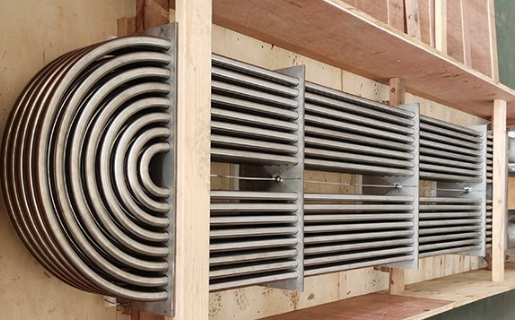
ASTM B622 Hastelloy C-276 (UNS N10276) seamless tube is a solid‑solution strengthened nickel‑chromium‑molybdenum‑tungsten corrosion resistant alloy tubing widely specified for aggressive industrial environments. As a high‑performance alloy, this ASTM B622 Hastelloy C-276 seamless tube is commonly deployed for heat exchangers, sour gas sampling runs, chlorine circuits and flue gas desulfurization hardware. This technical article covers standard definitions, chemical and mechanical properties, corrosion behaviour, fabrication constraints and inspection requirements for ASTM B622 UNS N10276 seamless tube. Lordfintube supplies a full range of Hastelloy alloy tubular products to global process and energy clients.
Material & Applicable Standards
The primary governing standard is ASTM B622, and the equivalent ASME designation is ASME SB622. Additional referenced standards for project acceptance include NACE MR0175 / ISO 15156 for sour gas service and EN 10204 for material test certification. Final applicable standards shall be confirmed by project engineers and end‑user specifications. ASTM B622 defines requirements for cold‑finished seamless nickel alloy tube, with a formal scope limit of outer diameter ≤ 88.9 mm. Larger diameter Hastelloy C‑276 seamless pipe is normally manufactured and certified against ASTM B517.
| Element | Specification Range |
|---|---|
| Ni | Balance |
| Cr | 14.5 – 16.5 |
| Mo | 15.0 – 17.0 |
| W | 3.0 – 4.5 |
| Fe | 4.0 – 7.0 |
| Co | ≤ 2.5 |
| Mn | ≤ 1.0 |
| Si | ≤ 0.08 |
| C | ≤ 0.010 |
| P | ≤ 0.040 |
| S | ≤ 0.030 |
Mechanical and Physical Parameters
All values below are typical range for solution annealed ASTM B622 Hastelloy C‑276 seamless tube at room temperature. Exact values are subject to mill test certificates and project acceptance criteria. Solution annealing is the standard delivery condition for Hastelloy C‑276 tubing to restore maximum corrosion resistance after cold forming or welding.
| Property | Minimum Requirement |
|---|---|
| Tensile Strength | ≥ 690 MPa |
| 0.2% Offset Yield Strength | ≥ 283 MPa |
| Elongation (50 mm gauge length) | ≥ 40 % |
| Hardness | ≤ 100 HRB |
Physical Properties
- Density: 8.9 g/cm³
- Melting range: 1325 ℃ ~ 1370 ℃
- Thermal expansion: lower than common austenitic stainless steel
Typical Dimension Range
- Outer Diameter: 3 mm ~ 88.9 mm (typical range, ASTM B622 scope limit: OD ≤ 88.9 mm; sizes above 88.9 mm follow ASTM B517)
- Wall Thickness: 0.5 mm ~ 20 mm (typical range, not restricted by ASTM B622 scope clause, subject to mill capability and design requirements)
- Length: random, fixed cut or custom fabricated length
Formula & Calculation Note
Not applicable to this product type. ASTM B622 Hastelloy C‑276 seamless tube is specified by dimensional schedule, material grade and corrosion performance rather than a fixed design formula. Tube weight calculation can be completed by standard tubular weight formula, but corrosion rate and service life require corrosion testing data specific to each process medium and temperature.
Alloy Comparison Table
| Grade | Key Strength | Main Limitation |
|---|---|---|
| Hastelloy C‑276 | Balanced oxidizing & reducing resistance, chloride SCC resistance, suitable for sour gas | Poor performance in hot concentrated nitric acid and molten alkaline media |
| Hastelloy C‑22 | Better oxidation resistance | Lower molybdenum content, less suitable for heavy reducing conditions |
| 904L | Cost advantage for mild acid | Limited resistance to high chloride and mixed acid service |
| 316L | General‑purpose stainless steel | Easy to suffer pitting and SCC under high chloride environment |
Design & Selection Trade‑Off Factors
Engineers must balance multiple factors when selecting ASTM B622 UNS N10276 tube. Higher wall thickness improves pressure containment but increases material cost and thermal resistance. Tight tolerance bright finish tubing delivers cleaner internal surface for high‑purity chemical service, but it carries longer lead time and higher manufacturing cost than standard pickled finish. NACE MR0175 qualified Hastelloy C276 seamless tube for sour gas service requires extra documentation and testing, which adds inspection expense. If the process only contains mild corrosion, alternative alloys may reduce total investment. Users shall confirm medium composition, chloride level, H₂S partial pressure and operating temperature before final material specification.
Application Industries
Hastelloy C‑276 seamless tube is widely used in chemical processing, sour gas oil & gas, flue gas desulfurization, wastewater treatment, pharmaceutical and fine chemical, biomass energy and waste incineration industries. It is frequently deployed for shell and tube heat exchangers, process transfer piping, instrument sampling lines, chlorine handling and mixed acid reaction loops. The grade is selected when 316L, duplex stainless steel or 904L cannot satisfy local corrosion requirements.
Selection Guide
- Confirm medium: distinguish oxidizing, reducing or mixed acid conditions, and test chloride, H₂S and oxidant concentration.
- Verify service specification: confirm whether NACE MR0175 or special corrosion acceptance is required; confirm applicable standard (ASTM B622 for OD ≤88.9 mm, ASTM B517 for larger OD).
- Match dimension and tolerance: select standard schedule or custom tight tolerance for precision heat exchanger tubing.
- Define certification level: choose EN 10204 3.1 for general use or EN 10204 3.2 certificate for third‑party witnessed projects.
- Review fabrication constraints: confirm welding and heat treatment capacity on site.
Quality Inspection & Testing Items
Typical quality tests include PMI positive material identification, tensile test, hardness test, eddy current test, ultrasonic test, liquid penetrant test and hydrostatic test on request. Additional tests such as intergranular corrosion test can be arranged for critical projects. All test records shall be traceable to heat number and melt source. The test scope shall follow purchase order and project specification.
Packing & Shipping Requirements
Standard packing uses wooden crates, wooden pallets or waterproof packaging to avoid surface scratch and contamination. Each bundle is marked with heat number, grade, standard, dimension and batch identification. Bright finished Hastelloy C‑276 seamless tube will be protected with plastic caps to keep internal bore clean. Final packing scheme can be adjusted according to sea freight or air freight requirements.
Frequently Asked Questions
Yes. Hastelloy C‑276 provides outstanding resistance to chloride induced pitting, crevice corrosion and stress corrosion cracking, which is one of the main reasons it is preferred over common austenitic stainless steel for high‑chloride process and sour gas service.
Qualified ASTM B622 UNS N10276 tube can be accepted for sour gas service complying with NACE MR0175 / ISO 15156. You need to confirm the material test certificate and supplementary qualification with the supplier before ordering.
GTAW (TIG) is the preferred welding process. Matching Hastelloy C‑276 filler metal must be used. Carbon steel contamination shall be strictly avoided, and heat input should be controlled to minimize dwell time in the sensitization temperature range.
ASTM B622 covers seamless nickel alloy tube with OD ≤ 88.9 mm, while ASTM B517 is the specification for seamless nickel alloy pipe for outside diameters above 88.9 mm.
For most routine corrosive services, Hastelloy C‑276 can be used in the as‑welded condition. For extremely critical corrosive environments, users may specify post‑weld solution annealing to restore maximum corrosion resistance.
EN 10204 3.1 is standard. EN 10204 3.2 certificate with third‑party witness inspection is available for critical oil, gas and chemical EPC projects.
Contact Lordfintube for technical datasheets, MTC support and custom Hastelloy C‑276 seamless tube supply for corrosive process and energy projects.