


Which finned tubes are suitable for high temperature applications?
Selecting the Right Finned Tube for High-Temperature Applications: A Comprehensive Guide
When process temperatures climb above 500°C (932°F), the selection of finned tubes becomes a critical engineering decision. High-temperature environments—including fired heaters, reformer furnaces, waste heat recovery units, and gas turbine exhaust systems—demand finned tubes that can withstand thermal stresses, oxidation, fouling, and creep while maintaining efficient heat transfer.
Through years of industry practice, six primary finned tube types have proven their reliability in high-temperature service: HFW (High-Frequency Welded) finned tubes, square/rectangular finned tubes, studded tubes, longitudinal finned tubes, cast finned tubes, and laser-welded finned tubes. Each offers distinct advantages depending on operating conditions, gas cleanliness, and maintenance requirements.
This guide examines each type to help you make an informed selection for your specific application.
The Challenges of High-Temperature Service
Before diving into tube types, it is essential to understand the unique challenges posed by elevated temperatures:
- Oxidation and corrosion – Accelerated metal loss at high temperatures, especially in the presence of sulfur, vanadium, or chlorides.
- Thermal fatigue – Repeated expansion and contraction can cause fin-to-tube bond failure or cracking.
- Creep rupture – Sustained mechanical loads at high temperatures lead to gradual deformation and eventual failure.
- Fouling and coking – Process fluids may deposit carbon or ash, reducing heat transfer efficiency.
- Abrasion and erosion – Dust-laden or particle-bearing gas streams can wear down fin surfaces over time.
To overcome these issues, the finned tube must combine a robust geometry, a metallurgically stable bond, and high-grade alloys.
Six Finned Tube Types for High-Temperature Applications
HFW Finned Tubes
High-frequency welded finned tubes are manufactured using high-frequency currents skin and proximity effects. This process creates a solid-phase weld that integrates fin and tube into a unified structure.
Key Advantages: 95%+ welding rate, 8x heat dissipation vs. bare tubes, metallurgical bond quality.
Up to 816°C (1500°F)Square / Rectangular Finned Tubes
Square and rectangular finned tubes feature fins with straight edges—often in an "H" configuration—welded to the base tube. The H-type finned tube consists of two steel plates symmetrically welded to the tube.
Key Advantages: 15–25% more surface area than circular fins, 50–150 W/m²K heat transfer coefficients.
Up to 650°CStudded Tubes
Studded tubes are manufactured by resistance welding metal studs directly onto the outside of a steel tube. Unlike continuous fins, studded tubes feature discrete protrusions.
Key Advantages: Superior durability, excellent fouling resistance, withstands abrasion and thermal cycling.
Up to 650°C+Longitudinal Finned Tubes
Longitudinal finned tubes feature fins welded continuously along the tube axis, running parallel to the tube length. The fin strip is formed into a U-shaped channel and resistance welded.
Key Advantages: All-welded structure, excellent drainage, ideal for double-pipe heat exchangers.
450–800°CCast Finned Tubes
Cast finned tubes are manufactured through casting processes where fins are integrally formed with the tube body or cast as separate components and assembled.
Key Advantages: Exceptional durability, integral construction eliminates fin-to-tube bond failure, high-temperature resistance.
Extreme temperaturesLaser-Welded Finned Tubes
Laser-welded finned tubes represent the latest advancement in finned tube technology. The fins and base tubes are firmly connected using laser welding technology.
Key Advantages: Exceptional high-temperature resistance, zero shedding, small heat-affected zone, reduced fouling.
Up to 800°C1. HFW (High-Frequency Welded) Finned Tubes
High-frequency welded finned tubes are manufactured using high-frequency currents skin and proximity effects. This process simultaneously heats a steel strip and the base tube surface to a plastic or melted state while winding under pressure, creating a solid-phase weld that integrates fin and tube into a unified structure.
Key Advantages:
- Superior metallurgical bond quality – Achieves a 95%+ welding rate with excellent joint integrity.
- High-temperature capability – With appropriate materials (e.g., TP321H), HFW tubes can operate from 427°C to 816°C (800°F to 1500°F) in thermal cycling environments.
- 8x heat dissipation compared to bare tubes.
- Wide material compatibility – Base tubes can be stainless steel, ND steel (for corrosive environments), or carbon steel; fin materials include carbon steel, corrosion-resistant steel, stainless steel, and alloy steel.
Design Variants:
- Solid (flat) fins – Standard continuous fin design for general-purpose applications.
- Serrated (toothed) fins – Create turbulence that breaks the boundary layer, providing an additional 35–45% increase in the heat transfer coefficient compared to standard solid fins.
Applications: Boiler economizers, air preheaters, process heaters, reformers, and furnace heat recovery systems.
2. Square / Rectangular Finned Tubes
Square and rectangular finned tubes feature fins with straight edges—often in an "H" configuration—welded to the base tube. The H-type finned tube consists of two steel plates symmetrically welded to the tube, forming an "H" shape. A single tube configuration is typically called a square finned tube, while a double-tube configuration is known as a rectangular finned tube.
Key Advantages:
- Superior surface area – Rectangular fins provide approximately 15–25% more surface area compared to circular fins of similar dimensions.
- High heat transfer coefficients – Achieve 50–150 W/m²K in air applications, significantly higher than bare tubes (10–30 W/m²K).
- Welded fin attachment – Precision resistance welding creates excellent mechanical bond strength that withstands thermal cycling and vibration.
- Compact design – Particularly effective where space constraints and thermal performance are critical.
| Material | Max Temperature | Applications |
|---|---|---|
| Carbon Steel (ASTM A179, A192, A210) | 450°C | Boilers, economizers |
| Alloy Steel (T5, T11, T22, T91) | 600°C | High-pressure boilers, superheaters |
| Stainless Steel (304, 316, 321, 310) | 650°C | Corrosive environments, high-temperature processes |
Applications: Utility boilers, industrial boilers, economizers, waste incinerators, and heat exchangers in coal and oil installations.
3. Studded Tubes
Studded tubes are manufactured by resistance welding metal studs directly onto the outside of a steel tube. Unlike continuous fins, studded tubes feature discrete protrusions that increase heat transfer area while creating turbulence that improves gas-side heat transfer.
Key Advantages:
- Superior durability – Thick, firmly welded studs withstand abrasion, thermal cycling, and aggressive cleaning.
- Excellent fouling resistance – The open structure is easier to clean and less susceptible to blockage than continuous fin designs.
- High-temperature capability – Suitable for operation above 500°C, with some designs reaching 650°C+.
- Strong mechanical bond – Withstands extreme mechanical loads and stress during process operation and cleaning.
Studded Tube
Heat Transfer Area: 2–3× bare tube
Operating Temperature: Up to 650°C+
Fouling Resistance: Excellent
Abrasion Resistance: Excellent
Best Application: Dirty, abrasive gas
Finned Tube (comparison)
Heat Transfer Area: 4–9× bare tube
Operating Temperature: Depends on fin type
Fouling Resistance: Moderate
Abrasion Resistance: Limited
Best Application: Clean gas service
Applications: Refinery fired heaters, petrochemical process heaters, waste heat boilers, circulating fluidized bed (CFB) boilers, and incinerators.
Materials: Available in alloy steels such as ASTM A335 Grade P5, P9, and stainless steel 304 for extreme environments.
4. Longitudinal Finned Tubes
Longitudinal finned tubes feature fins welded continuously along the tube axis, running parallel to the tube length. The fin strip is formed into a U-shaped channel and resistance welded in place, typically in pairs diametrically opposed.
Key Advantages:
- Particularly suited to high-temperature, high-pressure applications with high fin-side temperatures.
- All-welded structure reduces thermal resistance, resulting in faster heat transfer.
- Excellent drainage – Fin orientation facilitates fluid drainage when tubes are vertically oriented.
- Double-pipe compatibility – Ideal for telescoping inside larger tube shells in double-pipe and multi-pipe heat exchangers.
Design Options:
- Cut and twisted – Fins are cut circumferentially and bent to create turbulence, enhancing heat transfer efficiency.
- Number of fins – Must always be a multiple of four; maximum number depends on tube outside diameter.
Temperature Range: 304/316 stainless steel versions can withstand 450–800°C.
Applications: Shell-and-tube heat exchangers, double-pipe heat exchangers, and installations where helical fins would block fluid flow.
5. Cast Finned Tubes
Cast finned tubes are manufactured through casting processes where fins are integrally formed with the tube body or cast as separate components and assembled. This construction method creates a monolithic structure with inherent strength.
Key Advantages:
- Exceptional durability – The integral construction eliminates fin-to-tube bond failure concerns.
- High-temperature resistance – Cast materials can be formulated to withstand extreme temperatures and corrosive environments.
- Adaptability – Suitable for various heat exchangers and heating furnaces where corrosion resistance and high-temperature resistance are critical.
Applications: High-temperature heat exchangers, recuperators, and furnace systems requiring robust construction.
6. Laser-Welded Finned Tubes
Laser-welded finned tubes represent the latest advancement in finned tube technology. The fins and base tubes are firmly connected using laser welding technology, which focuses a laser beam on the joint to create a localized melt pool.
Key Advantages:
- Exceptional high-temperature resistance – Designed with 304/310S stainless steel base tubes and corrugated fins, resistant to 800°C high temperature and flue gas corrosion.
- Small heat-affected zone – Laser welding concentrates heat, minimizing thermal impact on the fins and base tube.
- Zero shedding – The metallurgical bond ensures fins never detach.
- Reduced fouling – Serrated or corrugated fin structures reduce ash accumulation by up to 40%.
- High precision – Cleaner weld seams, less distortion, and higher welding precision make them suitable for high-performance applications.
Material Options:
- Stainless Steel (304, 316L, 310S) – High temperature and corrosion resistance.
- Carbon Steel / Low-Alloy Steel (20#, Q345) – Cost-effective for industrial heat exchangers.
Applications: Boilers, high-temperature, high-pressure systems, and dusty flue gas environments.
Temperature Range: Up to 800°C with stainless steel materials.
Selection Guide by Operating Condition
| Operating Condition | Recommended Tube Type | Key Consideration |
|---|---|---|
| Clean gas, 400–650°C | HFW or Rectangular Finned | Maximize heat transfer area |
| Dirty/abrasive gas, >500°C | Studded Tube | Fouling and abrasion resistance |
| Vertical installation with drainage | Longitudinal Finned | Facilitates fluid drainage |
| Extreme durability, >800°C | Laser-Welded or Cast | Superior bond integrity and temperature resistance |
| Space-constrained, high efficiency | Rectangular/Square Finned | 15–25% more surface area |
| Double-pipe heat exchangers | Longitudinal Finned | Allows fluid flow between fins |
Critical Material Selection
Fin and tube materials must be chosen based on maximum operating temperature, atmosphere composition, and required creep strength. Below is a practical guide:
| Base Tube Material | Max Continuous Temp (°C) | Recommended Fin Types | Typical Use Case |
|---|---|---|---|
| Carbon steel (A106, A179) | 450 | HFW, Rectangular | Economizers, air heaters |
| Alloy steel (T11, T22) | 550–600 | HFW, Rectangular, Studded | High-pressure boilers |
| Stainless 304 / 316 | 650 | HFW, Rectangular, Laser-Welded | Corrosive environments |
| Stainless 310 / 310S | 800–850 | Laser-Welded, Longitudinal | Extreme oxidation resistance |
| Alloy steel P5 / P9 | 650+ | Studded | Refinery fired heaters |
Note: For temperatures above 700°C, never use aluminum or copper fins—they melt or oxidize rapidly.
Why Choose Lord Fintube for High-Temperature Solutions?
At Lord Fintube, we specialize in custom-engineered finned tubes for extreme conditions. Our manufacturing capabilities include:
- HFW finned tubes – With 95%+ welding rate and superior metallurgical bond quality.
- Rectangular/Square finned tubes – Precision resistance welding for excellent mechanical strength.
- Studded tubes – Automatic resistance welding for durability in fouling environments.
- Longitudinal finned tubes – Custom fin counts and heights for double-pipe applications.
- Laser-welded finned tubes – Zero shedding, 800°C resistance, and 40% less ash accumulation.
- Material traceability – All alloys certified to ASTM/ASME standards.
- Finite element analysis (FEA) – To predict thermal stresses and optimize fin geometry for your specific process.
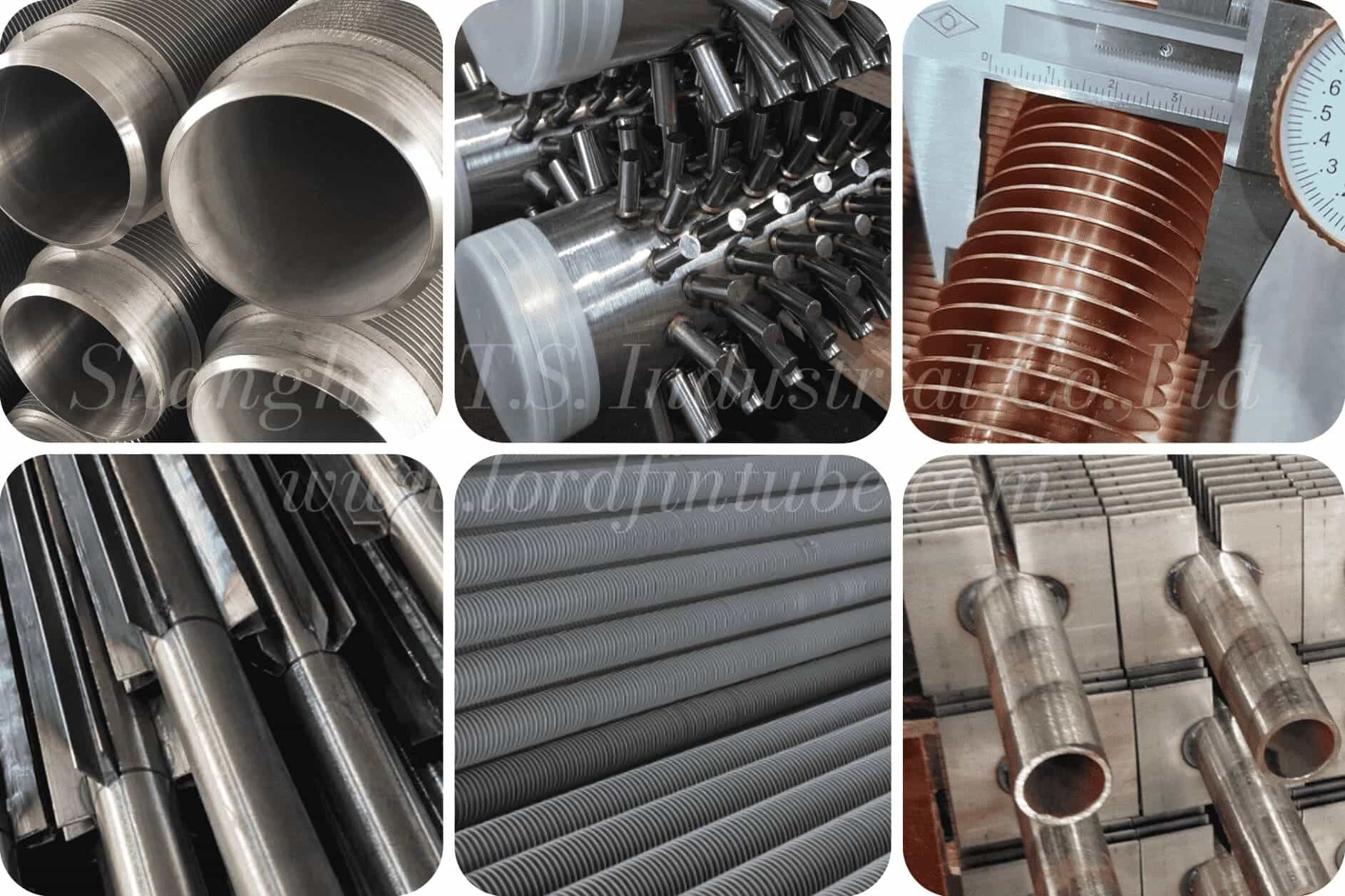
We supply to refineries, petrochemical plants, power generation, and heat recovery projects worldwide. Every tube is tested for bond integrity, dimensional accuracy, and surface finish.
Explore our high-temperature finned tube portfolio – visit www.lordfintube.com for product datasheets, case studies, and a quick quote request form.