


Mixed Feed Finned Convection Coil|Finned Convection Coil
Fired heaters and process furnaces represent the thermal backbone of modern crude oil refineries and petrochemical facilities. Within these multi-zone heating units, the convection section captures residual heat from high-temperature flue gases migrating upward from the radiant chamber. Modern process designs frequently implement a mixed feed finned convection coil to heat heterogeneous process streams—such as combined hydrocarbon feeds, water-steam mixtures, or dual-phase chemical reactants—before they enter primary reaction zones. By installing helically finned tubes in these upper coil banks, furnace designers dramatically expand the external heat transfer surface area. This enhanced surface area extracts maximum enthalpy from the flue gas stream without requiring an excessively large heater footprint, thereby driving up fuel efficiency and lowering carbon emissions across plant operations.
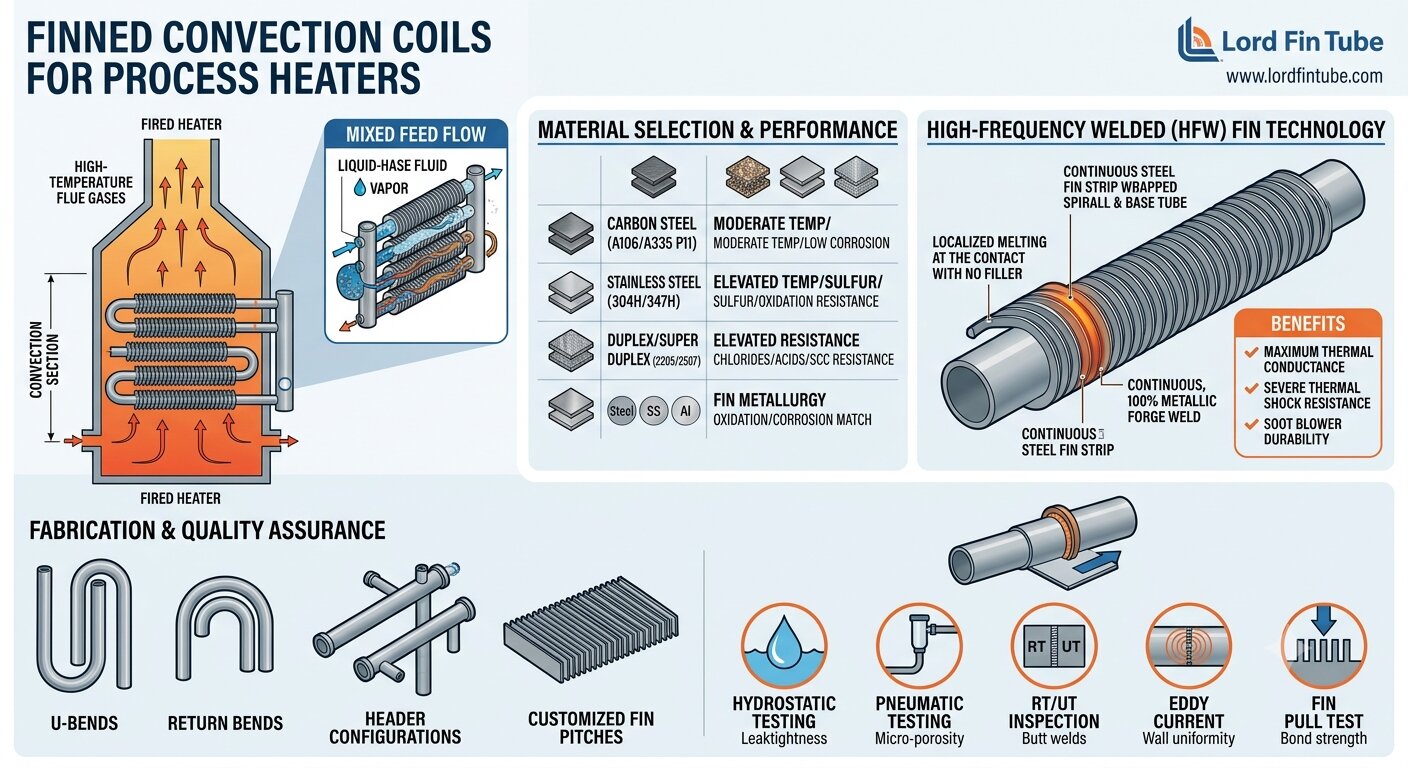
What makes the mixed feed finned convection coil particularly valuable is its ability to handle fluids with varying physical properties within a single coil pass. The extended surface geometry ensures that even when the process stream contains both vapor and liquid phases, the heat absorption remains uniform across the entire coil bank. This capability directly translates to more stable reactor inlet temperatures and improved overall process yields.
Finned Convection Coil Mixed Feed Processing
Processing mixed feed streams inside heat exchanger coils presents distinct thermodynamic and mechanical design challenges. Mixed feeds often consist of vapor and liquid phases existing simultaneously under fluctuating pressures and temperatures. If fluid distribution across parallel passes becomes uneven, dry-out, localized overheating, or severe thermal cracking can occur along the tube walls.
Consequently, the engineering of a mixed feed finned convection coil must balance internal hydraulic stability with external heat absorption rates. Tube internal diameters, bend radii, header configurations, and fin dimensions must be calculated to prevent phase separation and excessive friction pressure drops. Selecting an optimized combination of tube pitch and fin density maintains a uniform temperature gradient, protecting both the process fluid and the mechanical integrity of the coil structure.
Which design parameters matter most for mixed feed service? The ratio of liquid to vapor mass flux, the orientation of the coil passes, and the placement of return bends all influence how effectively the two phases remain mixed. Engineers often employ computational fluid dynamics to simulate phase distribution before finalizing the tube layout. Additionally, the fin density—expressed as fins per inch—must be selected to avoid fouling while still providing sufficient surface area for heat recovery.
Why does this matter for procurement decisions? A poorly designed Finned Convection Coil can lead to premature tube failure, unplanned furnace shutdowns, and costly maintenance overhauls. Understanding the hydraulic and thermal behavior of mixed feeds is the first step toward specifying a coil that delivers reliable performance over its full service life.
Finned Convection Coil Material Selection
Industrial fired heaters subject internal components to severe combination stresses, including high pressure, cyclic thermal expansion, external sulfurous flue gases, and internal chemical attack. Selecting the correct metallurgical pairing for the base tubes and extended fin surfaces is fundamental to preventing catastrophic furnace shutdowns.
Suitable for moderate operating temperatures and low-corrosion convection zones. Low-carbon steels offer excellent weldability and high thermal conductivity at competitive cost points, making them ideal for pre-heating clean process streams.
Engineered for elevated temperatures above 550 degrees Celsius and sulfur-bearing process streams. High-chromium and nickel alloys resist internal oxidation, intergranular corrosion, and high-temperature creep during prolonged continuous operation.
Chosen for aggressive mixed feeds containing elevated chloride levels, naphthenic acids, or sour gas components. These alloys deliver superior yield strength and exceptional resistance to stress corrosion cracking.
Outer fin strips must match or exceed the oxidation resistance of the surrounding flue gas environment. High-frequency welded carbon steel or alloy fins ensure continuous metallic fusion, preserving heat conduction channels under extreme thermal cycling.
| Material Grade | Max Service Temp (°C) | Corrosion Resistance | Typical Application |
|---|---|---|---|
| A106 Gr.B | 425 | Low (suitable for clean service) | Preheat coils, moderate duty |
| A335 P11 | 540 | Moderate (chromium-molybdenum) | Hydrocarbon preheat |
| 304H Stainless | 815 | Good (oxidation resistant) | High-temperature convection |
| 316L Stainless | 815 | Excellent (sour service) | Sulfur-bearing feeds |
| 321H Stainless | 870 | Good (stabilized against sensitization) | Cyclic high-temperature duty |
| 2205 Duplex | 600 | Exceptional (chloride & acid resistance) | Aggressive mixed feeds |
| 2507 Super Duplex | 650 | Superior (naphthenic acid + sour gas) | Severe corrosive environments |
How does one choose between these options? The decision hinges on three primary factors: the operating temperature profile, the chemical composition of the process fluid, and the expected service life. For mixed feed applications where both high temperature and corrosive species are present, duplex stainless steels often provide the optimal balance of cost and longevity. Meanwhile, carbon steel remains a practical choice for the upper, cooler regions of the convection section where corrosion risks are minimal.
Finned Convection Coil High-Frequency Welding
The thermal efficiency of a convection coil depends directly on the mechanical bond quality between the base tube and the helical fin. For severe refinery service, High-Frequency Resistance Welding (HFW) stands as the premier manufacturing methodology.
During the HFW process, a continuous steel fin strip is wrapped spirally around the rotating base tube while high-frequency electrical current creates localized melting at the contact point. This produces a continuous, 100% metallic forge weld without requiring filler metal.
Unlike mechanical tension-wound or embedded fin options, HFW finned tubes withstand severe thermal shocks, heavy mechanical vibration, soot blower impact, and extreme flue gas velocities. The continuous weld line eliminates air gaps, guaranteeing maximum thermal conductance throughout decades of continuous operation.
Which industries benefit most from HFW finned convection coils? Refineries, petrochemical plants, and power generation facilities all rely on this technology to maintain uptime and reduce energy consumption. The weld integrity ensures that even under rapid startup and shutdown cycles, the fins remain firmly attached to the tube surface, preserving heat transfer performance over the long term.
Why is HFW preferred over alternative fin attachment methods? The metallurgical bond created by high-frequency welding offers superior fatigue resistance and thermal cycling endurance. In contrast, mechanical fins can loosen over time, creating air gaps that drastically reduce heat transfer and accelerate tube corrosion.
| Parameter | Typical Range | Impact on Performance |
|---|---|---|
| Fin Height | 10 – 25 mm | Higher height increases surface area but may reduce flue gas flow |
| Fin Pitch (fins per inch) | 4 – 12 FPI | Denser fins boost heat transfer but increase fouling risk |
| Fin Thickness | 0.8 – 1.5 mm | Thicker fins resist erosion but add weight and cost |
| Tube Outside Diameter | 25 – 89 mm (1–3.5 inch) | Larger diameter improves flow capacity and mechanical strength |
| Weld Penetration Depth | 0.5 – 1.2 mm | Deeper penetration ensures stronger bond and higher thermal conductance |
Finned Convection Coil Custom Fabrication
No two process furnaces share identical dimensions, feed compositions, or thermal duties. Securing custom manufacturing services ensures that mixed feed finned convection coils match the exact physical and operational requirements of existing or retrofitted fired heaters. Custom engineering encompasses precision tube bending for U-bends and return bends, custom fin pitch variations, plain end preparation for field header welding, and complete modular coil frame assembly. Rigorous quality control is imperative to verify structural soundness before job-site installation. Critical non-destructive examination standards include:
How does custom fabrication add value for plant operators? By tailoring every aspect of the coil to the specific furnace geometry and process conditions, operators can achieve optimal heat recovery, minimize pressure drop, and extend the interval between turnarounds. Furthermore, custom coils can incorporate advanced features such as segmented fins for thermal expansion management or sacrificial coatings for enhanced erosion protection.
Finned Convection Coil Engineering Excellence
Lord Fin Tube is a premier global manufacturer specializing in custom heat transfer tubing and complex coil assemblies for the refining, petrochemical, power generation, and heavy process industries. Our state-of-the-art manufacturing facilities house advanced high-frequency welding lines, precision tube bending machinery, and automated coil assembly stations capable of producing heavy-duty convection components to exact customer drawings and ASME code standards.
By maintaining strict control over raw material sourcing—including seamless carbon steel, high-temperature austenitic stainless steel, and duplex alloys—we deliver finished convection coils engineered for long-term operational safety and peak thermal yield. Our engineering team assists B2B procurement managers and plant engineers through every phase, from initial metallurgical consultation and CAD drafting to final non-destructive testing and export-grade packaging.
Visit www.lordfintube.com to review our complete range of finned tube configurations, request technical documentation, or consult with our thermal engineering specialists on your upcoming fired heater overhaul.
Finned Convection Coil Frequently Asked Questions
The following questions address common technical and procurement considerations for mixed feed finned convection coils.
Q: What is a mixed feed finned convection coil and how does it function inside a fired heater?
A mixed feed finned convection coil is a heat transfer assembly installed in the convection section of a fired heater. It captures residual thermal energy from high-temperature flue gases that rise from the radiant chamber. The coil features helically wound fins on the external tube surface, which dramatically increase the heat transfer area. This design allows the coil to preheat heterogeneous process streams—such as combined hydrocarbon feeds or dual-phase chemical reactants—before they enter the primary reaction zone, thereby boosting overall furnace thermal efficiency.
Q: Which materials are commonly selected for finned convection coils operating in high-temperature and corrosive environments?
Material selection depends on operating temperature, fluid corrosivity, and mechanical stress. Carbon steel and low-alloy grades like ASTM A106 and A335 P5/P9/P11 are cost-effective for moderate conditions. Stainless steel grades including 304H, 316L, 321H, and 347H resist oxidation and creep above 550°C. Duplex and super duplex alloys such as 2205 and 2507 offer exceptional resistance to chloride-induced stress corrosion cracking in aggressive mixed feeds. Fin strips are typically fabricated from solid steel, stainless steel, or aluminum, matched to the flue gas environment.
Q: How does high-frequency resistance welding improve the durability and thermal performance of finned convection coils?
High-frequency resistance welding creates a continuous, 100% metallic forge weld between the fin strip and the base tube without using filler metal. This produces a bond that eliminates air gaps and ensures maximum thermal conductance. The welded joint withstands severe thermal shocks, mechanical vibration, soot blower impacts, and high-velocity flue gas flows, making HFW finned tubes far more durable than mechanical tension-wound or embedded fin alternatives.
Q: Why is custom fabrication essential for mixed feed finned convection coils in refinery and petrochemical applications?
Every fired heater has unique dimensions, thermal duty requirements, and feed compositions. Custom fabrication ensures the convection coil matches the exact physical and operational parameters of the specific furnace. This includes precision U-bends and return bends, variable fin pitch configurations, plain end preparation for header welding, and complete modular frame assembly. Rigorous non-destructive testing—including hydrostatic pressure testing, radiographic inspection, and eddy current evaluation—verifies structural integrity before installation.
Q: What quality assurance protocols are applied during the manufacturing of finned convection coils?
Manufacturers employ a comprehensive quality assurance framework that includes hydrostatic pressure testing to verify leak-tightness, pneumatic testing to detect micro-porosity, radiographic and ultrasonic inspection of butt welds, eddy current testing for tube wall uniformity, and fin-to-tube weld pull testing to measure mechanical bond strength. These protocols ensure the coil meets ASME code standards and delivers reliable performance over decades of continuous operation.