

HRSG boiler tubes are the heat-transfer tubes inside a heat recovery steam generator that turn gas turbine exhaust heat into steam. Material grade, tube dimensions, fin type, and manufacturing standard determine how long the tubes last and how often the plant shuts down for repairs. This article answers what plant engineers and procurement teams ask most: which materials work at each temperature zone, which ASTM and ASME standards apply, why tubes fail, and how to select tubes for a replacement or new-build project.
What are HRSG boiler tubes and where do they sit in a combined cycle plant?
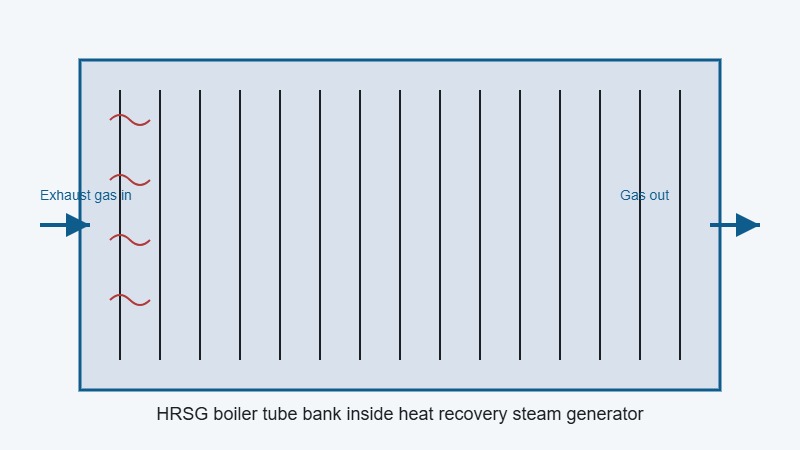
HRSG boiler tubes are seamless or welded steel tubes arranged in tube banks inside a heat recovery steam generator (HRSG), the component that captures exhaust heat from a gas turbine and produces steam for a steam turbine.
They are grouped by duty:
- Economizer tubes — preheat feedwater using the coolest exhaust gas.
- Evaporator tubes — boil water into saturated steam at low, intermediate, or high pressure.
- Superheater tubes — raise steam temperature to the design value before it enters the steam turbine.
- Reheater tubes — reheat steam returning from the high-pressure turbine in selected configurations.
Unlike radiant furnace tubes, HRSG tubes sit in a convection-only environment. Exhaust gas sweeps across finned or bare surfaces, so extended surface area drives heat-transfer performance. Many HRSG tubes therefore carry spiral, serrated, or H-type fins welded to the base tube.
What material is best for HRSG boiler tubes?
There is no single best material. Metal temperature at the tube wall, steam pressure, flue gas composition, and whether the unit runs base load or cycles daily all change the answer.
| Material | Specification | Max metal temp. (approx.) | Typical HRSG section | Trade-offs |
|---|---|---|---|---|
| Carbon steel (SA192 / SA210 A1 / C) | ASTM A192 / ASME SA192; ASTM A210 / ASME SA210 | ~450 °C (840 °F) | Economizer, LP evaporator | Low cost and easy to weld, but creep strength limits high-temperature use |
| 1¼Cr-½Mo (T11) | ASTM A213 / ASME SA213 T11 | ~593 °C (1,100 °F) | IP evaporator, moderate-temperature superheater | Better creep strength than carbon steel; still relatively easy to fabricate |
| 2¼Cr-1Mo (T22) | ASTM A213 / ASME SA213 T22 | ~649 °C (1,200 °F) | HP superheater, reheater | Higher creep resistance; needs controlled welding and PWHT |
| 9Cr-1Mo-V (T91) | ASTM A213 / ASME SA213 T91 | ~650 °C (1,202 °F) | High-temperature HP superheater | Excellent creep strength; strict preheat, interpass, and PWHT controls |
| Austenitic stainless (TP304H / TP347H) | ASTM A213 / ASME SA213 TP304H, TP347H | 700 °C+ (1,292 °F+) | Ultra-supercritical superheater | Superior oxidation resistance; higher cost, higher thermal expansion |
Practical selection notes
- Superheater outlet below 600 °F (315 °C): carbon steel is usually sufficient.
- Metal temperature above 600 °F: T11 is the standard step up.
- Metal temperature above 1,100 °F: T22 or T91 is required.
- Ultra-supercritical designs: T91, T92, or TP347H.
Suitable for alloy grades: plants with high superheater outlet temperatures, frequent cycling, or a documented FAC history in low-alloy sections.
Carbon steel remains reasonable for: base-load plants with stable water chemistry, low-pressure economizer and evaporator sections, and moderate metal temperatures.
Which ASTM and ASME standards apply to HRSG boiler tubes?
The governing specification for alloy-steel HRSG tubes is ASTM A213 / ASME SA213. Carbon steel tubes follow ASTM A192 / ASME SA192 or ASTM A210 / ASME SA210, and header piping often references ASTM A335 / ASME SA335.
ASTM A213 / ASME SA213
Covers seamless ferritic and austenitic alloy-steel boiler, superheater, and heat-exchanger tubes. Grades include T5, T9, T11, T12, T22, T23, T91, and T92 (ferritic), plus TP304H, TP316H, TP321H, and TP347H (austenitic). Chemical composition, tensile properties, dimensional tolerances, and heat-treatment requirements are all defined in this standard.
ASTM A192 / ASME SA192
Seamless carbon steel boiler tubes for high-pressure service. Common in economizer and low-temperature evaporator sections.
ASTM A210 / ASME SA210
Seamless medium-carbon steel boiler and superheater tubes, Grades A1 and C. Frequently specified for HRSG economizer and LP evaporator service.
ASTM A335 / ASME SA335
Seamless ferritic alloy-steel pipe for high-temperature service. Grades P11, P22, P91, and P92 appear in header connections and large-diameter HRSG components.
Typical HRSG tube dimensions
| Parameter | Range |
|---|---|
| Base tube outside diameter (OD) | 26–65 mm for carbon and alloy steel; up to 88.9 mm for finned tubes |
| Wall thickness | 2.5–12.7 mm depending on pressure class |
| Tube length | Up to 20 m or longer for modern HRSG modules |
| Fin height | 10–25 mm (spiral finned tubes) |
| Fin thickness | 0.8–2.0 mm |
Lord Fin Tube produces HRSG boiler tubes with base tube OD from 19.05 mm to 88.9 mm and wall thickness from 1.5 mm to 12.7 mm, with spiral, serrated, and H-type fin options.
Why do HRSG boiler tubes fail, and what causes most forced outages?
Flow-accelerated corrosion (FAC) is the single largest cause of HRSG tube failures, followed by thermal fatigue, corrosion fatigue, and steam-side oxidation.
1. Flow-accelerated corrosion (FAC)
Reported industry data attributes more than 40% of HRSG tube failures to FAC. Turbulent water flow destabilizes the protective magnetite layer on the internal tube surface of carbon and low-alloy steel tubes. The low-pressure evaporator is the highest-risk location.
Contributing factors include:
- pH or dissolved oxygen outside the recommended range
- Local turbulence from tube geometry, bends, or header connections
- Mass flow rate and temperature above design conditions
2. Thermal fatigue and creep-fatigue
HRSGs designed for base load now cycle frequently. Repeated thermal expansion and contraction concentrate stress at tube-to-header welds and attachment welds, producing fatigue cracks that grow with each start-stop cycle.
3. Corrosion fatigue
Cyclic stress combined with a corrosive environment cracks tubes at bends and weld heat-affected zones, especially where water chemistry control is weak.
4. Steam-side oxidation and exfoliation
Above roughly 600 °C, steam-side oxidation forms oxide scales on the internal surface. When those scales spall, they block downstream tubes and cause overheating. T91 and T92 tubes are particularly sensitive to this mechanism, and EPRI has published specific Grade 91 temperature guidance tied to steam oxidation.
- Hold water chemistry inside EPRI / IAPWS limits
- Specify T11 or higher for high-temperature and high-flow sections
- Design tube-to-header joints to reduce stress concentration
- Run wall-thickness checks on a fixed schedule at FAC-prone locations
How do I choose HRSG boiler tubes for a new-build or replacement project?
Start from design metal temperature, not steam temperature, then work outward through material grade, dimensions, fin type, welding requirements, and supplier capability.
Step 1 — Establish design metal temperature and pressure per section
Metal temperature controls material selection. Calculate it using ASME Section I or the applicable design code, accounting for heat flux, gas-side temperature, and steam-side cooling.
Step 2 — Pick the base material grade
Use Table 1 as a starting point, then add a design margin above the expected maximum metal temperature. For cyclic service, derate the allowable temperature to account for fatigue.
Step 3 — Set tube OD and wall thickness
Wall thickness follows from design pressure, outside diameter, allowable stress at design temperature, and corrosion allowance. Typical HRSG corrosion allowances run from 0.5 mm to 1.5 mm depending on water chemistry and target service life.
Step 4 — Choose the fin configuration
Finned tubes raise surface area and cut tube count in economizer and evaporator sections. Options:
- Spiral solid fin — standard for clean exhaust gas
- Serrated fin — higher heat-transfer coefficient; moderate fouling service
- H-fin (square or rectangular) — self-cleaning geometry for dusty or ash-laden exhaust
Lord Fin Tube manufactures H-type and spiral finned tubes for HRSG and waste heat recovery service.
Step 5 — Specify welding and manufacturing requirements
- Qualified WPS/PQR per ASME Section IX
- Post-weld heat treatment where the alloy grade requires it
- 100% radiographic or ultrasonic examination of butt welds
- For T91/T92: minimum 200 °F (93 °C) interpass temperature and controlled purge gas
Step 6 — Vet the supplier and lead time
- Material test certificates to EN 10204 3.1 or equivalent
- Dimensional inspection reports
- Third-party inspection coordination (TÜV, Lloyds, BV)
- Heat-number traceability from raw material to finished tube
What does HRSG tube replacement cost, and how long does it take?
Based on project data reported through 2026, targeted single-tube replacement typically runs from about USD 95,000 to USD 280,000, while bundle or module replacement and full HRSG outages fall in the USD 3.5 million to USD 8 million range.
| Scope | Estimated cost (USD) |
|---|---|
| Targeted single-tube replacement | 95,000–280,000 |
| Bundle or module replacement | 3,500,000–8,000,000 |
| Full HRSG outage (refractory, access, hydro test, recommissioning) | 3,500,000–8,000,000 |
Treat these as planning ranges, not quotations. Actual cost depends on access conditions, retained-tube condition, material grade, and the schedule window available.
Cost drivers
- Access and scaffolding — many HRSG layouts require partial or full module removal.
- Retained tube condition — corroded tube stubs can expand the replacement scope.
- Material lead time — T91 and TP347H have longer procurement cycles than carbon steel or T11.
- Welding complexity — T91/T92 need preheat, interpass control, and PWHT; carbon steel and T11 are simpler.
Typical lead times
- Carbon steel and T11 tubes: 4–8 weeks from order confirmation
- T22 and T91 tubes: 8–14 weeks depending on quantity and supplier backlog
- Custom finned bundles: 10–16 weeks
Plants that bring the tube supplier in during outage planning rather than after a failure consistently see better schedule certainty and avoid emergency procurement premiums.
Who should specify high-alloy HRSG boiler tubes, and who can stay with carbon steel?
High-alloy tubes pay off when metal temperature, cycling frequency, or water chemistry risk is high. Carbon steel remains the right answer for low-temperature, stable-operation sections.
| Operating profile | Recommended material direction |
|---|---|
| Base-load plant, stable water chemistry, metal temp. below 450 °C | Carbon steel (SA192 / SA210) |
| Metal temp. 450–593 °C, moderate cycling | T11 |
| Metal temp. 593–649 °C, HP superheater duty | T22 |
| Metal temp. above 649 °C, ultra-supercritical steam | T91, T92, or TP347H |
| Documented FAC history in LP evaporator | Upgrade to T11 or apply FAC-resistant chemistry program |
Not a fit for high-alloy tubes: plants with low metal temperatures, stable base-load operation, and well-controlled water chemistry will not recover the added material and welding cost.
Frequently asked questions about HRSG boiler tubes
What is the difference between HRSG boiler tubes and conventional boiler tubes?
Conventional boiler tubes sit in radiant furnaces and absorb direct flame radiation at very high heat flux. HRSG boiler tubes operate in a convection-only environment — gas turbine exhaust flows across finned or bare surfaces. HRSG tubes see lower peak heat flux but are more exposed to water-side flow-accelerated corrosion and gas-side acid dew-point corrosion.
What material is used for the superheater section of an HRSG?
T11 is common up to roughly 1,100 °F (593 °C). Above that, T22 (up to 1,200 °F / 649 °C) and T91 (up to 1,202 °F / 650 °C) are standard. Ultra-supercritical HRSGs may require T92 or austenitic stainless such as TP347H.
How often should HRSG boiler tubes be inspected?
Inspection intervals depend on operating regime and water chemistry. A reasonable baseline:
- Base-load units — full tube inspection every 4–6 years; targeted FAC-prone checks every 2–3 years.
- Cycling units — annual inspection of the LP evaporator, superheater outlet, and tube-to-header welds.
EPRI HRSG tube failure manuals and cycle chemistry guidelines are widely used to define these programs.
Can HRSG boiler tubes be repaired instead of replaced?
Localized failures can often be repaired by cutting out the damaged section and welding in a replacement stub. Repair feasibility depends on access, the condition of adjacent tube material, and whether the failure mechanism is localized or systemic. If wall-thickness readings show widespread degradation, module or bundle replacement is more cost-effective than repeated repairs.
Which fin type is best for HRSG economizer tubes?
Spiral solid fins suit clean exhaust gas. Serrated fins raise the heat-transfer coefficient but foul more easily in particulate-laden streams. H-fin tubes (square or rectangular fins welded to the tube) offer a self-cleaning effect and are preferred for dusty or ash-laden exhaust.
How do I verify HRSG boiler tube quality before installation?
Request the following from the supplier:
- Material test certificate to EN 10204 3.1 showing chemical composition and mechanical properties
- Dimensional inspection report (OD, wall thickness, length, straightness)
- Hydrostatic or eddy-current test report
- Weld procedure qualification records for fin welding and tube-to-header joints
- Heat-number traceability documentation
What is the typical lead time for HRSG boiler tube replacement?
Carbon steel and T11 tubes typically run 4–8 weeks from order confirmation. T22 and T91 run 8–14 weeks depending on quantity and backlog. Custom finned bundles run 10–16 weeks. Emergency expediting is sometimes possible at premium cost.
Does Lord Fin Tube supply HRSG boiler tubes with finning?
Yes. Lord Fin Tube manufactures HRSG boiler tubes with spiral solid fins, serrated fins, and H-type fins, using base tubes in carbon steel, alloy steel (T11, T22, T91), and stainless steel. Complete HRSG economizer and evaporator tube bundles are also fabricated to customer specifications.
Request HRSG boiler tube quotation or technical data
Send your HRSG design conditions — section, design metal temperature, pressure, tube OD, wall thickness, material grade, and fin type. The engineering team will match the tube specification to your operating conditions and provide material certificates, dimensional reports, and third-party inspection documentation.
Email sales@lordfintube.com →Typical response time: one business day. T11, T22, T91, and stainless steel grades available.
Sources and further reading
- ASME Boiler and Pressure Vessel Code, Section I — Power Boilers. ASME, New York.
- ASTM A213 / ASME SA213 — Standard Specification for Seamless Ferritic and Austenitic Alloy-Steel Boiler, Superheater, and Heat-Exchanger Tubes. ASTM International, West Conshohocken, PA.
- EPRI Heat Recovery Steam Generator Tube Failure Manual. Electric Power Research Institute, Palo Alto, CA.
- EPRI Cycle Chemistry Guidelines for Heat Recovery Steam Generators. Electric Power Research Institute, Palo Alto, CA.
- IAPWS Technical Guidance Documents. International Association for the Properties of Water and Steam.