


An internally rifled tube and an internally grooved tube are not two versions of the same interchangeable part. They belong to different product families with different service envelopes. Internally rifled tubes are mainly boiler tubes with raised internal ribs for water walls and evaporator circuits. Internally grooved tubes are mainly heat-exchange and refrigeration tubes with recessed internal grooves for condensers and evaporators. An internally rifled tube vs internally grooved tube comparison is therefore a comparison of application, pressure boundary, geometry, materials, inspection, and procurement requirements, not a direct performance contest inside one heat exchanger.
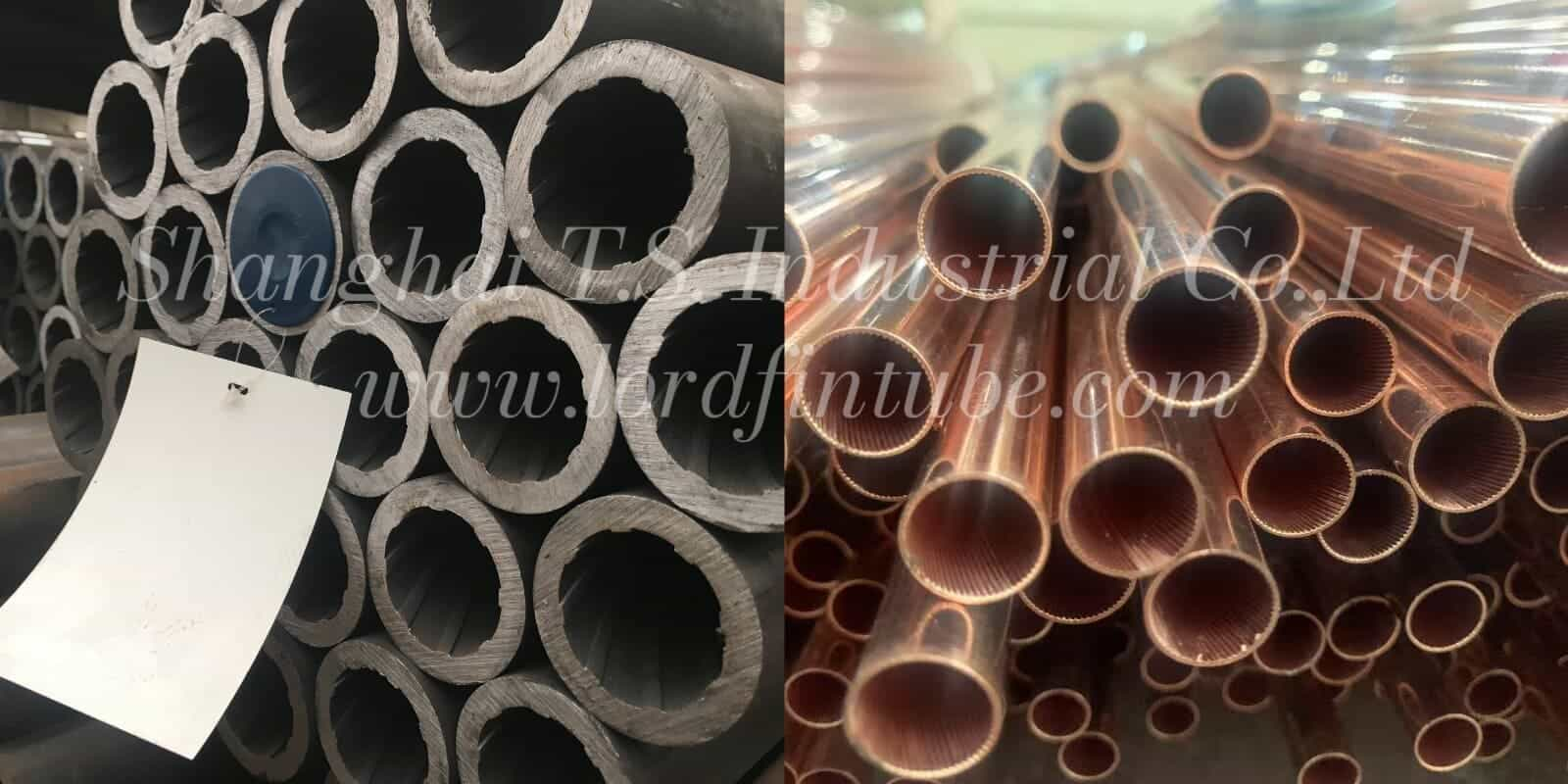
What is an internally rifled tube and where is it used?
An internally rifled tube is a boiler tube with raised helical ribs formed on the inner wall. The ribs increase internal surface area and disturb the boundary layer of the working fluid. In boiler service, this geometry is used to improve tube-side heat transfer, reduce wall temperature, and support stable flow in evaporator and water-wall circuits. It is commonly associated with boiler water walls, economizers, and evaporator sections, with the exact design governed by the boiler design and applicable pressure-part code.
Because a rifled tube is often a pressure part, the rib root and minimum wall thickness are not minor details. They affect pressure containment, corrosion allowance, and fabrication. A rifled tube drawing should state rib height, rib count, helix angle or lead, minimum wall, outside diameter, length, material grade, and inspection requirements.
What is an internally grooved tube and where is it used?
An internally grooved tube is a heat-exchange tube with recessed grooves on the inner wall. Grooves may be straight or helical. In refrigeration and HVAC service, the groove profile can promote liquid spreading, condensate drainage, and flow mixing in condensers and evaporators. The groove is recessed rather than raised, so the bore profile and wall section differ from a rifled boiler tube.
Grooved tubes are used in air-conditioning condensers, refrigeration evaporators, heat pumps, chillers, and other heat-exchange equipment where refrigerant-side phase change and pressure drop are part of the thermal design. The tube drawing should state groove depth, groove width, lead or helix angle, groove count, minimum wall, outside diameter, length, material temper, cleanliness, and leak-test requirements.
Why are internally rifled tubes and internally grooved tubes not interchangeable?
The two products sit in different design systems. A rifled tube is selected as part of a boiler pressure boundary. A grooved tube is selected as part of a heat exchanger or refrigeration circuit. Substituting one for the other without a full design review would change heat transfer, pressure drop, wall thickness, cleaning, connection details, and code compliance.
- Service boundary: rifled tubes are tied to boiler water/steam circuits; grooved tubes are tied to refrigerant or secondary-refrigerant heat exchange.
- Pressure boundary: boiler rifled tubes require pressure-part design, minimum wall control, and boiler-code inspection; grooved tubes follow the heat exchanger or refrigeration equipment specification.
- Geometry: rifled tubes use raised ribs; grooved tubes use recessed channels. The two profiles cannot be described by one common internal-fin ratio.
- Materials: boiler tubes are typically carbon steel or low-alloy steel; grooved tubes are often copper, copper alloy, stainless steel, or aluminum, depending on refrigerant compatibility.
- Inspection: rifled boiler tubes need dimensional, wall-thickness, pressure, and nondestructive checks under the boiler specification; grooved tubes need groove geometry, cleanliness, leak, and expansion or fabrication checks under the heat exchanger specification.
Which parameters and units define each tube type?
Every inquiry should state units on the drawing. Values not fixed by the project should be treated as a typical range and confirmed by the engineer and manufacturer before production. No universal range applies across both product families.
| Parameter | Internally rifled tube | Internally grooved tube | Unit |
|---|---|---|---|
| Internal profile | Raised helical rib height, h | Recessed groove depth, h | mm |
| Angular geometry | Helix angle, beta, or lead, L | Groove lead, L, or helix angle, beta | degree or mm |
| Profile count | Rib count, N | Groove count, N | count |
| Pressure-boundary section | Minimum wall at rib root, t | Minimum wall at groove root, t | mm |
| Tube size | Outside diameter and length | Outside diameter and length | mm |
How is internal surface area estimated for a rifled tube?
For early geometry screening of a rifled tube, the internal area ratio can be approximated from rib count, rib height, and nominal bore. This is only a geometric estimate. It does not replace boiler thermal design, pressure-drop calculation, or manufacturer geometry data.
A_i / A_s ≈ 1 + (2 × N × h) / (π × d_i)
- A_i = approximate internal wetted area of the rifled tube, mm².
- A_s = internal wetted area of a smooth tube with the same nominal bore, mm².
- N = number of internal ribs, count.
- h = rib height, mm.
- d_i = nominal internal diameter, mm.
The formula assumes a simple rib profile and ignores helix angle, fillet radius, and rib shape. For a grooved tube, the area change is smaller and depends on groove width, depth, and edge radius; it should be taken from the actual groove drawing. Do not apply the rifled-tube formula to a grooved tube or mix data from different manufacturers.
Internally rifled tube vs internally grooved tube: comparison table
| Comparison dimension | Internally rifled tube | Internally grooved tube |
|---|---|---|
| Primary product family | Boiler tube with internal ribs | Heat-exchange or refrigeration tube with internal grooves |
| Typical equipment | Boiler water walls, economizers, evaporator circuits | Condensers, evaporators, heat pumps, chillers |
| Heat transfer role | Increase tube-side heat transfer and support stable boiler flow | Promote refrigerant-side mixing, liquid spreading, or drainage |
| Pressure boundary | Boiler pressure part; minimum wall and code inspection apply | Heat exchanger or refrigeration circuit; leak and fabrication checks apply |
| Typical materials | Carbon steel or low-alloy steel, subject to boiler design | Copper, copper alloy, stainless steel, or aluminum, subject to refrigerant compatibility |
| Cleaning and fouling | Boiler water chemistry and flow stability are central | Refrigerant cleanliness and oil return are central |
| Procurement basis | Boiler drawing, material certificate, pressure test, and nondestructive inspection | Heat exchanger drawing, groove geometry, cleanliness, leak test, and packing |
What design trade-offs apply to each product family?
For an internally rifled tube, the trade-off is between rib height and pressure drop, wall thinning at the rib root, and boiler flow stability. A taller rib can increase heat transfer and surface area, but it also raises flow resistance and requires a minimum-wall review. The helix angle affects swirl and axial mixing. These variables interact, so the rib height, rib count, and helix angle should be selected as a set under the boiler design.
For an internally grooved tube, the trade-off is between groove depth and refrigerant-side pressure drop, liquid drainage, oil return, and cleanability. A deeper groove can change condensate or evaporator behavior, but it may increase pressure loss and affect tube expansion or bending. Groove width and edge radius also matter. The final groove profile should be confirmed with thermal-hydraulic data for the exact refrigerant and operating envelope.
Technical parameter table
Typical range values are project-specific for both product families. The table below shows the parameters to fix on the purchase drawing; final values must follow the project specification, engineer approval, and manufacturer data.
| Parameter | Internally rifled tube | Internally grooved tube | Unit |
|---|---|---|---|
| Rib height or groove depth, h | Defined by boiler design | Defined by heat exchanger design | mm |
| Helix angle or lead | Defined by boiler design | Defined by refrigeration design | degree or mm |
| Rib or groove count, N | Defined by boiler design | Defined by heat exchanger design | count |
| Minimum wall, t | Boiler pressure-part requirement | Heat exchanger and fabrication requirement | mm |
| Outside diameter and length | According to boiler specification | According to heat exchanger specification | mm |
Which materials and standards apply?
Material selection follows the service. For internally rifled boiler tubes, typical range materials are carbon steel and low-alloy steel, with grade and delivery condition set by the boiler design. For internally grooved heat-exchange tubes, typical range materials include copper, copper alloy, stainless steel, and aluminum, with selection based on refrigerant compatibility, pressure, temperature, and fabrication method. Final material must be confirmed against the project specification and manufacturer data.
Standards are according to project specification and the applicable boiler or heat exchanger code to be confirmed. Do not mix a boiler tube specification with a refrigeration tube specification. The purchase order should state the design code, material grade, temper, test plan, internal surface requirement, and any restriction on repair or rework.
Which industries use each tube type?
- Power generation and industrial boilers: internally rifled tubes for water walls, economizers, and evaporator circuits.
- HVAC and refrigeration: internally grooved tubes for condensers, evaporators, heat pumps, and chillers.
- Chemical and petrochemical processing: rifled tubes in boiler-related duty; grooved tubes in refrigeration and heat-exchange duty where the fluid and pressure envelope fit.
- Food and beverage: grooved or enhanced heat-exchange tubes where cleanability and refrigerant compatibility are defined by the project.
How should a project team specify between the two tube types?
- Identify the equipment first: boiler pressure part or refrigeration/heat-exchange tube.
- State the fluid, phase, design pressure, design temperature, and flow direction.
- Fix the applicable code and standard to be confirmed before geometry review.
- For a boiler, specify rib height, rib count, helix angle, minimum wall, and pressure-test requirements.
- For a refrigeration heat exchanger, specify groove depth, groove width, lead, count, cleanliness, and leak-test requirements.
- Require manufacturer-verified thermal and hydraulic data for the exact geometry and material.
- Confirm packing, end protection, documentation, and shipping marks before order release.
The question is not which tube has the better internal profile. The question is which tube family fits the equipment, code, fluid, and inspection system. A grooved refrigeration tube is not a drop-in replacement for a rifled boiler tube, and a rifled boiler tube is not a generic upgrade for a condenser or evaporator.
What quality checks and packing requirements apply?
For internally rifled tubes, typical range checks include outside diameter, minimum wall, rib height, rib count, helix angle, straightness, roundness, visual bore inspection, pressure test, and nondestructive inspection according to the boiler specification. Material certificates and traceability should match the purchase order.
For internally grooved tubes, typical range checks include outside diameter, wall thickness, groove depth, groove width, lead, count, bore cleanliness, roundness, leak test, and fabrication checks such as expansion or bending where applicable. The final test plan must follow the heat exchanger specification and the manufacturer’s approved procedure.
Packing should protect the internal profile and keep the bore clean. Typical range packing includes end caps, rust-preventive protection where specified, bundle separators, and wooden cases or crates for export. Boiler tubes may require long-length handling and impact protection. Grooved refrigeration tubes may require moisture protection and clean end caps. Final packing must match the project requirement and shipping method.
FAQ
What is an internally rifled tube used for?
An internally rifled tube is mainly used as a boiler tube in water walls, economizers, and evaporator circuits. Raised internal ribs improve tube-side heat transfer and support stable boiler flow. The exact rib geometry and minimum wall must follow the boiler design and applicable pressure-part code.
What is an internally grooved tube used for?
An internally grooved tube is mainly used in heat-exchange and refrigeration equipment such as condensers, evaporators, heat pumps, and chillers. Recessed grooves can promote refrigerant-side mixing, liquid spreading, or drainage. The groove profile must be confirmed for the refrigerant, pressure drop, and cleanliness requirement.
Are internally rifled tubes and internally grooved tubes interchangeable?
No. They belong to different product families with different pressure boundaries, materials, inspection requirements, and service conditions. A rifled tube is typically a boiler pressure part, while a grooved tube is typically a refrigeration or heat-exchange tube. Substitution requires a full design and code review.
How do I choose between an internally rifled tube and an internally grooved tube?
Choose by equipment and service first. Use an internally rifled tube for boiler water-wall or evaporator duty when the boiler design requires internal ribs. Use an internally grooved tube for condenser or evaporator duty in refrigeration and HVAC when the thermal design requires internal grooves. Do not select by internal profile alone.
Which parameters define an internally rifled tube?
The main parameters are rib height in mm, rib count, helix angle in degrees or lead in mm, minimum wall in mm, outside diameter, length, material grade, and inspection standard. Rib height, rib count, and helix angle interact and should be fixed as a set under the boiler design.
Which parameters define an internally grooved tube?
The main parameters are groove depth in mm, groove width in mm, groove count, lead or helix angle, minimum wall in mm, outside diameter, length, material temper, bore cleanliness, and leak-test requirement. The groove profile should be confirmed with thermal-hydraulic data for the refrigerant.
Can a grooved tube be used in a boiler?
Not as a general substitution. Boiler service requires a boiler-grade tube, pressure-part design, minimum-wall control, and inspection under the applicable boiler code. A grooved refrigeration tube should not be used in a boiler unless the boiler designer and code requirements specifically approve it.
What information is needed to request a quote?
Provide the equipment type, fluid, phase, design pressure and temperature, outside diameter, wall thickness, length, material grade, internal geometry if fixed, applicable standard, inspection requirement, cleanliness requirement, and packing method. If a parameter is open, state the target range so the manufacturer can propose a confirmed geometry.
Request a Quote for Internally Rifled or Grooved Tubes
Send the equipment type, service fluid, design conditions, tube dimensions, material grade, internal geometry, inspection standard, and packing requirement. Lordfintube will review the internally rifled tube or internally grooved tube option against your project specification.
Request a Quote