


Internally rifled tubes are tubes with helical ridges formed on the inner surface. In boiler and heat exchanger service, these tubes are often called rifled boiler tubes. The internal ribs disrupt the boundary layer, promote swirling flow, and increase the heat transfer coefficient compared with a smooth bore tube. This article explains the geometry, key parameters, calculation methods, design trade-offs, materials, inspection, and selection factors for internally rifled tubes.
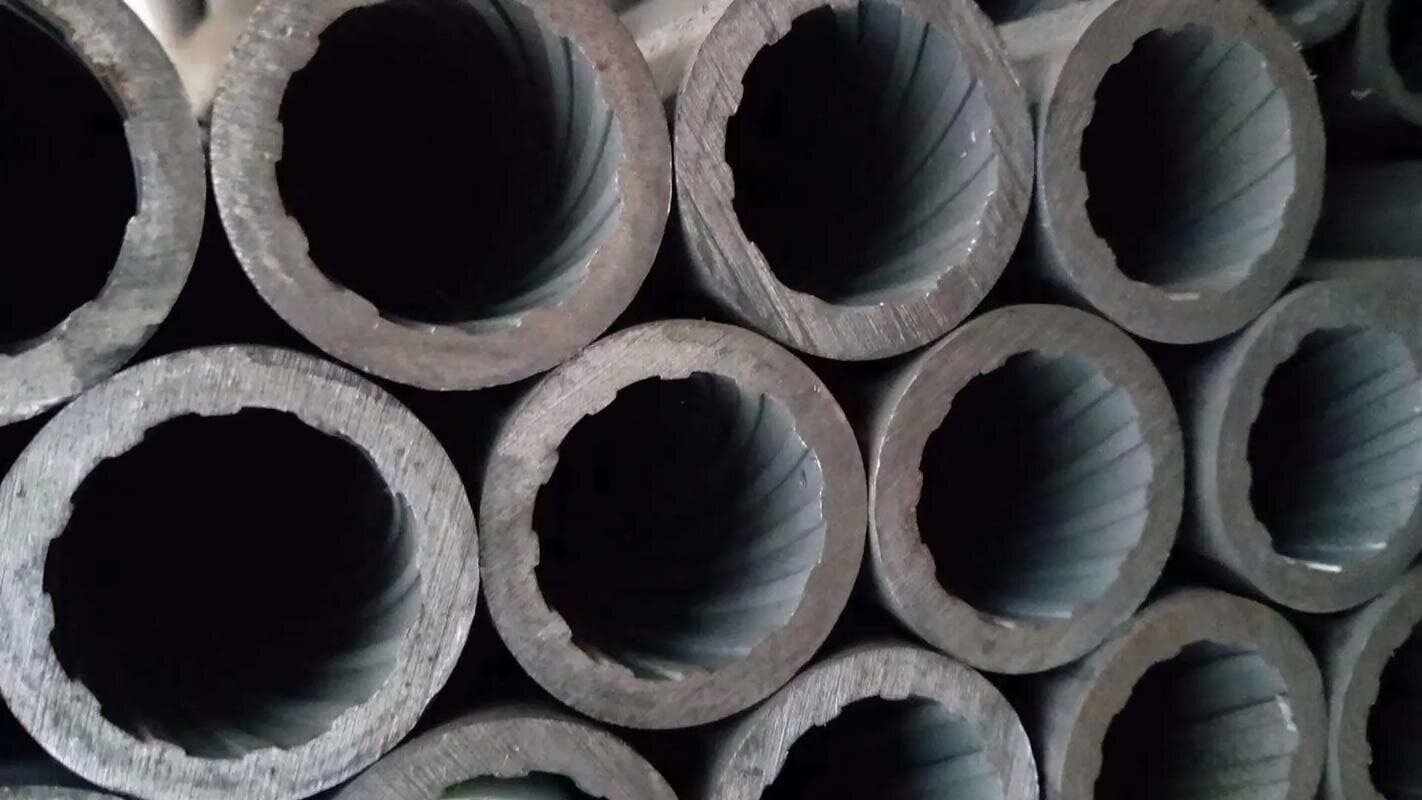
What Are Internally Rifled Tubes?
Internally rifled tubes are seamless or welded tubes whose inner wall carries one or more helical ribs. The ribs are produced by cold drawing, hot rolling, or a combination of forming and sizing operations. The outer surface can remain plain or be finned depending on the application. The internal rifling is defined by lead, number of starts, rib height, and helix angle.
In a boiler water wall or superheater, the rifled geometry improves departure from nucleate boiling (DNB) margin and allows higher heat flux without excessive wall temperature. In heat exchangers, the same geometry increases tube-side heat transfer, which can reduce surface area or improve duty within a fixed shell.
Lordfintube supplies internally rifled tubes for boiler, heat recovery, and process industries. The product family covers multiple leads, starts, and materials to match project specifications.
Higher heat transfer
Swirl flow renews the fluid film at the wall and raises the convective coefficient.
Better DNB margin
Liquid contact is maintained longer at high heat flux, delaying film boiling.
Higher pressure drop
Ribs add friction, so pumping power or circulation head must be checked.
How Internally Rifled Tubes Improve Heat Transfer
The helical ribs create a rotating flow pattern. This rotation increases the tangential velocity near the wall and renews the fluid film. The result is a higher convective heat transfer coefficient. The effect is strongest in single-phase flow and in subcooled boiling regions.
For boiling service, the ribs help maintain liquid contact on the tube wall and delay the transition to film boiling. This is why rifled boiler tubes are common in high heat flux zones of fossil-fuel boilers and heat recovery steam generators (HRSG).
The penalty is additional pressure drop. The same ribs that increase turbulence also raise friction. Designers must balance heat transfer gain against pumping power or natural circulation head.
Key Parameters and Units for Internally Rifled Tubes
Rifling lead
Axial distance for one full 360° revolution of a rib. Shorter lead means tighter helix and stronger swirl, but higher pressure drop. Typical range: 20 mm to 200 mm per revolution.
Number of starts
Count of independent helical ribs around the circumference. Common values are 2, 4, 6, and 8. Typical range: 2 to 8 starts.
Rib height
Radial height of the rib from the base wall. Taller ribs increase turbulence but reduce flow area. Typical range: 0.5 mm to 1.5 mm for boiler tubes.
Helix angle
Angle between the rib and the tube axis. Larger angle means tighter helix relative to the axis. Typical range: 10° to 45°.
Formula and Variables: Relating Lead, Helix Angle, and Inside Diameter
The relationship between lead, helix angle, and inside diameter is geometric. For a single rib, the unrolled helix forms a right triangle. The circumference is the base, and the lead is the height.
Where:
- Lead = axial distance per full revolution, mm/rev
- Di = tube inside diameter, mm
- α = helix angle, degrees (°)
- π = 3.14159...
Example: if Di = 50 mm and Lead = 100 mm/rev, then α = arctan(π × 50 / 100) = arctan(1.5708) ≈ 57.5°. If a tighter helix is required, reduce the lead. If the lead is fixed by tooling, the helix angle changes with inside diameter.
Different standards and manufacturers may define lead and helix angle with slightly different reference points. Always confirm the definition used on the tube drawing. Do not mix values from different standards without conversion.
Comparison: Smooth Tubes vs Internally Rifled Tubes
| Dimension | Smooth Tube | Internally Rifled Tube |
|---|---|---|
| Tube-side heat transfer coefficient | Baseline | Higher, often 1.3 to 2.0 times smooth tube, depending on flow and geometry |
| Pressure drop | Baseline | Higher, typically 1.5 to 3.0 times smooth tube for the same flow rate |
| DNB margin in boiling | Limited | Improved, especially at high heat flux |
| Fouling tendency | Lower | Higher in dirty service; requires careful water chemistry |
| Manufacturing cost | Lower | Higher due to rifling operation and tooling |
| Typical application | Low heat flux, clean fluids | High heat flux, boiler water walls, superheaters, HRSG |
Design Trade-offs and Selection Factors
Selecting internally rifled tubes involves several trade-offs. The main conflict is heat transfer enhancement versus pressure drop. A shorter lead and taller rib increase heat transfer but also increase friction. In natural circulation boilers, excessive pressure drop can reduce circulation ratio. In forced circulation systems, it increases pump power.
Fouling and cleaning
Rifled tubes are harder to clean mechanically. In dirty service, deposit buildup may outweigh the heat transfer benefit.
Manufacturing cost
More starts, tighter leads, and taller ribs increase tooling wear and cycle time.
Material selection
Higher-strength alloys may be needed to hold rib geometry at elevated temperature.
Flow stability
In two-phase flow, the swirl can improve stability but may also interact with system acoustics.
Selection factors include heat flux, mass flux, operating pressure and temperature, water chemistry, tube diameter and wall thickness, and available pump head. The final choice should be based on a heat transfer and hydraulic model validated by the project engineer and manufacturer.
Technical Specifications (Typical Range)
| Parameter | Typical Range | Unit | Notes |
|---|---|---|---|
| Inside diameter (Di) | 20 to 70 | mm | Depends on boiler or exchanger design |
| Wall thickness | 3 to 12 | mm | Selected by pressure and temperature |
| Rifling lead | 20 to 200 | mm/rev | Shorter lead = tighter helix |
| Number of starts | 2 to 8 | — | Integer count of ribs |
| Rib height | 0.5 to 1.5 | mm | Measured from base wall |
| Helix angle | 10 to 45 | degrees | Linked to lead and Di |
| Length | Up to 25 | m | As per order; handling limits apply |
Materials and Standards
Internally rifled tubes are produced in carbon steel, alloy steel, and stainless steel. Common grades include SA-210, SA-213 T11, T22, T91, TP304, TP316, and TP347. Material selection depends on temperature, pressure, corrosion, and oxidation resistance.
Applicable standards may include ASME SA-213, ASTM A213, EN 10216-2, and project-specific specifications. When a standard is not stated, the tube shall be supplied according to project specification or applicable standard to be confirmed. Dimensional tolerances, chemical composition, and mechanical properties must be verified against the purchase order.
Applications in Power Generation and Process Industries
Boiler water walls
High heat flux zones in fossil-fuel boilers.
Superheaters and reheaters
Steam-side tubes where wall temperature control matters.
HRSG
Heat recovery steam generators in combined cycle plants.
Industrial boilers
Waste heat boilers and process steam generation.
Solar receivers
Concentrated solar thermal absorber tubes.
Process exchangers
Petrochemical and chemical heat exchangers.
In each application, the rifled geometry is chosen to meet a specific heat flux and pressure drop target. The tube is not a universal replacement for smooth tubes; it is a targeted solution for high heat flux or compact exchanger duties.
Selection Guide for Internally Rifled Tubes
- Define the heat duty, mass flow, inlet and outlet temperatures, and allowable pressure drop.
- Calculate the required tube-side heat transfer coefficient with and without rifling.
- Select a candidate lead, number of starts, rib height, and helix angle.
- Check pressure drop against available pump head or natural circulation head.
- Review fouling and cleaning requirements.
- Confirm material and standard with the project specification.
- Validate the design with the tube manufacturer and project engineer.
Quality Inspection and Testing
Typical inspection and testing for internally rifled tubes include:
Chemical analysis
Verifies grade and composition against the standard.
Mechanical tests
Tensile, yield strength, and hardness.
Pressure test
Hydrostatic test as specified.
Nondestructive tests
Eddy current and ultrasonic inspection.
Dimensional checks
Inside diameter, wall thickness, lead, rib height, number of starts.
Visual and surface
Surface finish and visual inspection; metallography when specified.
Test certificates are issued according to the applicable standard. Specific test requirements must be agreed at the time of order. Typical range only; final inspection plan follows project specification and manufacturer data.
Packaging and Shipping Requirements
Bore protection
End caps or plastic plugs keep the rifled bore free of damage.
Surface protection
Rust-preventive oil unless otherwise specified.
Bundling
Steel straps, wooden crates, or wooden skids.
Labeling
Heat number, size, quantity, and destination on each bundle.
For sea transport, a moisture barrier and desiccant may be added. Packaging must comply with the purchase order and international shipping requirements. Final packing details to be confirmed with the manufacturer.
Frequently Asked Questions
What are internally rifled tubes?
Internally rifled tubes are tubes with helical ribs on the inner surface. They are used in boilers and heat exchangers to increase heat transfer and improve boiling stability compared with smooth tubes.
What is the rifling lead in internally rifled tubes?
Rifling lead is the axial distance for one full 360° revolution of a rib. It is measured in mm/rev. A shorter lead produces a tighter helix and stronger swirl, but higher pressure drop. Typical range is 20 mm to 200 mm per revolution, to be confirmed by project specification.
How does the number of starts affect performance?
The number of starts is the count of independent helical ribs. More starts distribute the swirl and can reduce local hot spots, but increase manufacturing complexity. Typical range is 2 to 8 starts. Final value must follow the tube drawing and engineer approval.
How do you calculate the helix angle of an internally rifled tube?
Use the geometric relationship: Lead = π × Di / tan(α), where Di is inside diameter in mm and α is helix angle in degrees. Rearranged: α = arctan(π × Di / Lead). Confirm the definition used on the tube drawing before calculation.
Why choose rifled boiler tubes over smooth tubes?
Rifled boiler tubes provide higher heat transfer coefficients and better departure from nucleate boiling (DNB) margin. They are chosen for high heat flux zones where smooth tubes would risk overheating or require more surface area.
What materials are used for internally rifled tubes?
Common materials include carbon steel, alloy steel such as T11, T22, T91, and stainless steels such as TP304, TP316, and TP347. Material selection depends on temperature, pressure, corrosion, and oxidation resistance. Final grade must be confirmed with the project specification.
How are internally rifled tubes inspected?
Typical inspection includes chemical analysis, tensile test, hardness, hydrostatic test, eddy current, ultrasonic test, and dimensional checks for lead, rib height, and number of starts. The final inspection plan follows the applicable standard and purchase order.
What is the typical lead range for boiler rifled tubes?
The typical lead range is 20 mm to 200 mm per revolution, depending on tube diameter and duty. This is a typical range only. Final lead must be confirmed by the project engineer and manufacturer based on heat transfer and pressure drop calculations.
Need internally rifled tubes for a boiler or heat exchanger project? Lordfintube supplies rifled boiler tubes in multiple leads, starts, and materials. Send your specification and drawing for a technical review.