


Lord Fin Tube--ASTM A 179 L type finned tube
ASTM A179 L Type Finned Tubes
L-Foot Aluminum Fins on Seamless Cold-Drawn Steel Base Tube
What Makes ASTM A 179 L Type Finned Tube Effective?
ASTM A 179 L type finned tube combines a seamless cold-drawn low-carbon steel base tube with helically wound aluminum fins that feature an L-shaped foot. This L-foot design — a 1/16-inch wide ridge formed along one edge of the fin strip — locks the fin firmly onto the tubes outer diameter through mechanical tension during winding. No adhesive or brazing is required for standard applications, yet the resulting bond withstands thermal cycling and vibration across a wide operating range.
What sets this finned tube apart is the balance between thermal conductivity and structural integrity. Aluminum offers roughly 2.5 times the thermal conductivity of carbon steel, while the steel base tube provides pressure-containing strength and resistance to internal corrosion. The L-foot geometry maximizes the contact area between fin and tube, minimizing contact resistance and ensuring that heat flows efficiently from the tube wall into the extended fin surface.
The manufacturing process itself contributes to performance consistency. Precision winding equipment applies controlled tension to the aluminum strip as it wraps around the rotating tube. The L-foot is forced into a slight interference fit with the tube surface, creating a permanent mechanical lock. Standard fin densities range from 8 to 14 fins per inch, with 10 fins per inch being the most common specification for general heat exchange duties.
Key engineering fact: The L-foot mechanical bond maintains contact integrity even after thousands of thermal cycles from ambient to 500°F (260°C), a critical advantage in processes with frequent start-stop operation or load swings.
This tube type is manufactured under ASTM A179 specification, which governs the chemical composition, mechanical properties, and dimensional tolerances of the seamless steel tube. The aluminum fin material typically conforms to ASTM B209 or equivalent standards for wrought aluminum alloys, with 1100 or 3003 series alloys commonly used for their combination of formability and corrosion resistance.
How Does ASTM A 179 L Type Finned Tube Transfer Heat?
Heat transfer in ASTM A 179 L type finned tube occurs through a combination of conduction along the fin base and convection from the extended fin surfaces to the surrounding fluid. The steel tube carries the primary heat flux from the internal fluid (typically a hot gas, steam, or liquid) through the tube wall. Once heat reaches the outer surface, it conducts into the aluminum fin along the L-foot interface and then radially outward along the fin height.
The extended surface area provided by the fins dramatically increases the overall heat transfer coefficient on the external side. For a bare tube, the external heat transfer area is simply the tube outer circumference multiplied by the tube length. With L-foot fins, the effective surface area can be 8 to 12 times greater, depending on fin density, height, and thickness. This area amplification allows the finned tube to transfer the same amount of heat with a much smaller footprint or, alternatively, to achieve higher heat duty within the same envelope.
Thermal performance depends on several interrelated parameters:
- Fin density (fins per inch): Higher density increases surface area but also raises air-side pressure drop and may reduce fin efficiency due to closer fin spacing.
- Fin height: Taller fins add more surface area but lower the fin efficiency because the temperature gradient along the fin height becomes more pronounced.
- Fin thickness: Thicker fins conduct heat more effectively along their length but add weight and material cost.
- Air velocity: Higher cross-flow velocity improves the external heat transfer coefficient but increases fan power consumption.
For typical air-cooled heat exchanger applications, the overall heat transfer coefficient (U-value) for ASTM A179 L-foot finned tubes ranges from 8 to 15 Btu/hr·ft²·°F, depending on the specific geometry and operating conditions. This compares to 3 to 6 Btu/hr·ft²·°F for bare steel tubes under similar conditions, representing a 100% to 300% improvement in thermal performance.
Performance insight: The L-foot design delivers a contact conductance that is 30% to 40% higher than wrapped-on (G-type) finned tubes, because the mechanical interference fit eliminates the air gap that often forms between fin and tube in other attachment methods.
Which Standards Govern ASTM A 179 L Type Finned Tube?
ASTM A 179 L type finned tube is governed by a combination of material, dimensional, and performance standards that ensure consistency and reliability across manufacturers. The base tube must meet the requirements of ASTM A179 / A179M, which covers seamless cold-drawn low-carbon steel tubes for heat exchangers and condensers. This standard specifies chemical composition limits (carbon 0.06–0.18%, manganese 0.27–0.63%, phosphorus and sulfur each ≤ 0.035%), tensile strength (≥ 325 MPa), yield strength (≥ 180 MPa), and elongation (≥ 35%).
For the aluminum fin material, manufacturers typically reference ASTM B209 for aluminum sheet and plate, with common alloys being 1100 (commercially pure) or 3003 (with manganese addition for increased strength). The fin strip thickness, width, and temper are selected based on the required fin height, pitch, and mechanical properties.
In addition to material standards, the finished finned tube assembly is often inspected and tested according to industry-accepted practices. These include:
- Hydrostatic or pneumatic pressure testing of the base tube to verify leak-tightness.
- Dimensional inspection of fin height, pitch, thickness, and overall tube length.
- Visual and dye-penetrant examination of the fin-to-tube bond for any signs of separation or defects.
- Pull-out testing to measure the force required to dislodge the fin from the tube, verifying bond integrity.
Many purchasers also require compliance with ASME Section VIII, Division 1 for pressure vessel applications, or with TEMA (Tubular Exchanger Manufacturers Association) standards for heat exchanger design and fabrication. These additional requirements ensure that the finned tubes are suitable for the specific service conditions of the end user.
| ASTM A179 L Type Fin Tubes — Standard Specifications | ||||
| Base Tube Material | Fin Material | Tube Length (mm) | Fin Length (mm) | Fin Tube Quantity (Pc) |
|---|---|---|---|---|
| ASTM A179 | Aluminum 1100 | 9144 | 9024 | 200 |
| Base Tube O.D (mm) | Base Tube Thickness (mm) | Fin Height (mm) | Fin Thickness (mm) | Fin Pitch (mm) |
| 25.4 | 2.11 | 15.88 | 0.40 | 2.54 |
| Material note: ASTM A179 seamless cold-drawn low-carbon steel provides excellent thermal conductivity (≈ 51 W/m·K) and formability for heat exchanger service. Aluminum 1100 fins offer thermal conductivity of ≈ 222 W/m·K and good atmospheric corrosion resistance. | ||||
Beyond the basic dimensional and material specifications, the thermal performance of the finned tube is often characterized by the fin efficiency and the overall heat transfer coefficient. These values depend on the fin geometry, base tube dimensions, and the thermal properties of both materials. Manufacturers typically provide performance curves or computer-generated data for specific configurations upon request.
Why Specify ASTM A 179 L Type Finned Tube?
Specifying ASTM A 179 L type finned tube offers a set of distinct advantages that make it a preferred choice for engineers and procurement professionals in heat exchange applications. The combination of material properties, manufacturing precision, and operational reliability translates into tangible benefits for plant operators and project owners.
- Thermal efficiency: The L-foot design provides a low-resistance thermal path from the tube wall to the fin tip. The mechanical interference fit eliminates the need for solder or adhesive, reducing the number of interfaces that can degrade over time. This results in sustained heat transfer performance over the service life of the equipment.
- Mechanical durability: The cold-wound L-foot attachment creates a bond that resists loosening under thermal expansion, vibration, and mechanical shock. Unlike brazed or soldered fins, which can fail at the joint due to thermal fatigue, the L-foot maintains its grip through mechanical interference alone.
- Corrosion management: Aluminum fins provide excellent resistance to atmospheric corrosion, particularly in environments with moderate humidity or airborne contaminants. The steel base tube, protected by the overlying fins and the process fluid inside, offers strength and resistance to internal corrosion when properly specified for the service fluid.
- Cost-effectiveness: Compared to all-copper or all-stainless steel finned tubes, the steel-aluminum combination of ASTM A179 L-foot tubes offers superior performance at a fraction of the material cost. This makes them an economical choice for large heat exchanger bundles where material costs represent a significant portion of the total investment.
- Design flexibility: L-foot finned tubes can be manufactured with a wide range of fin densities, heights, and lengths to match specific thermal and mechanical requirements. Standard tooling covers most common configurations, while custom designs are readily achievable for special applications.
Economic perspective: The extended surface area of L-foot finned tubes can reduce the required heat exchanger footprint by 40% to 60% compared to bare-tube designs, leading to lower structural costs, smaller plot space, and reduced fan power for air-cooled systems.
Another consideration is the availability and lead time. ASTM A179 L-foot finned tubes are produced by multiple manufacturers worldwide, with established supply chains that ensure competitive pricing and reasonable delivery schedules. The standardization of dimensions and materials also simplifies replacement and maintenance, as tubes can be sourced from different suppliers with confidence in interchangeability.
When Is ASTM A 179 L Type Finned Tube Recommended?
ASTM A 179 L type finned tube is recommended for a wide range of operating conditions where the combination of temperature, pressure, and fluid characteristics aligns with the material capabilities. Understanding these boundaries helps engineers select the most appropriate tube type for each application.
The base tube, made from ASTM A179 low-carbon steel, is suitable for operating temperatures from cryogenic levels up to approximately 500°F (260°C). Above this temperature, the mechanical properties of the steel may degrade, and the aluminum fins may soften or oxidize more rapidly. For higher-temperature services, other fin materials (such as copper or stainless steel) or different base tube materials (like ASTM A213 T11 or T22) may be required.
Pressure ratings depend on the tube wall thickness and the allowable stress of the material at the operating temperature. For the common 25.4 mm OD x 2.11 mm wall tube, the maximum allowable working pressure (MAWP) at ambient temperature is approximately 1,500 psi (10.3 MPa) based on ASME B31.3 calculations. Higher pressures can be accommodated with thicker walls or by using higher-strength base tube materials, though this may affect the finning process and the overall tube dimensions.
Specific application scenarios where ASTM A179 L-foot finned tubes are particularly well suited include:
- Air-cooled heat exchangers in petrochemical refineries, gas processing plants, and power generation facilities.
- Condensers and evaporators in HVAC systems, refrigeration units, and industrial cooling towers.
- Waste heat recovery systems where exhaust gases are cooled to recover thermal energy for preheating or other uses.
- Oil and gas production where produced fluids must be cooled before separation or further processing.
- Compressor intercoolers and aftercoolers where compressed air or gas must be cooled between stages.
When the process fluid on the tube side is corrosive — such as sour gas, seawater, or acidic solutions — the internal surface of the ASTM A179 tube may require additional protection. Options include applying a corrosion-resistant coating to the inside diameter, using a higher-grade tube material (e.g., stainless steel or duplex steel) for the base tube, or employing a liner. In such cases, the finned tube design can be adapted to use a different base tube material while retaining the L-foot aluminum fins, provided the thermal expansion compatibility is verified.
Selection tip: For applications with frequent thermal cycling or vibration, the L-foot mechanical bond provides superior fatigue resistance compared to adhesive-bonded or wrapped-on fins. This makes it the preferred choice for compressor stations, engine exhaust systems, and other dynamic environments.
Where Is ASTM A 179 L Type Finned Tube Applied?
ASTM A 179 L type finned tube finds extensive use across a broad spectrum of industries, where its thermal performance, mechanical reliability, and cost-effectiveness make it a standard solution for heat exchange challenges. The following sectors represent the most common deployment areas, though the versatility of the tube design allows for many other specialized applications.
Petroleum & Chemical
Heat exchange in refinery distillation columns, catalytic cracker units, and chemical reactor cooling loops.
Power Generation
Steam turbine exhaust condensing, feedwater heating, and auxiliary cooling in fossil-fuel and nuclear plants.
Natural Gas Treatment
Cooling and condensation in amine gas treating, glycol dehydration, and natural gas liquefaction processes.
Steel & Metals
Blast furnace stoves, converter hood cooling, and continuous casting machine heat removal systems.
HVAC & Refrigeration
Air-cooled condensers, evaporator coils, and heat recovery ventilators using various refrigerants.
Waste Management
Heat recovery from incineration flue gases, landfill gas treatment, and biogas conditioning systems.
Within each of these industries, the specific configuration of the ASTM A179 L-foot finned tube — including tube diameter, fin density, fin height, and tube length — is tailored to the unique thermal duty, pressure drop, and spatial constraints of the installation. For example, in an air-cooled heat exchanger for a natural gas processing plant, the finned tubes might be arranged in multiple rows with a fin density of 10 fins per inch and a fin height of 5/8 inch, while a condenser in a power plant might use 11 fins per inch with a fin height of 3/4 inch to maximize surface area within a given bundle footprint.
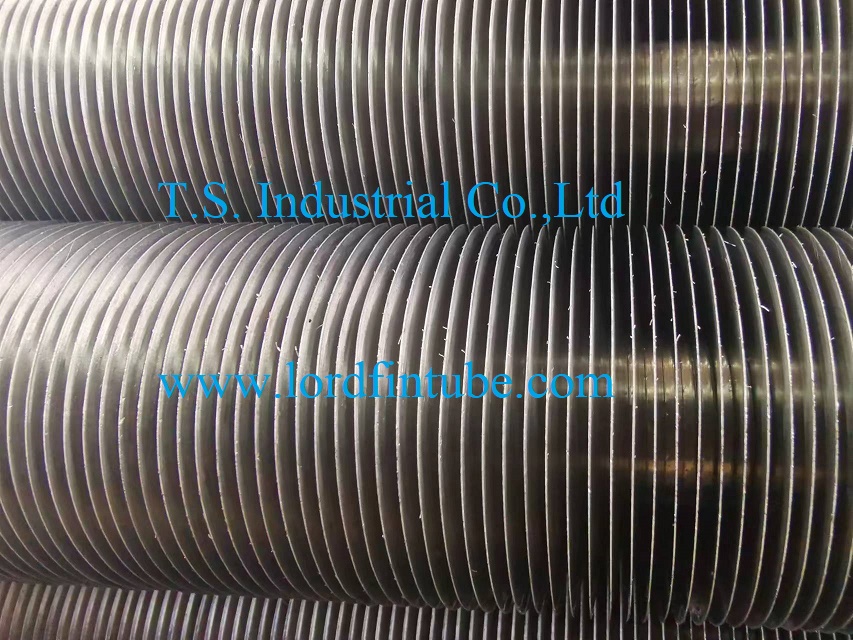
Close-up view of an ASTM A179 L type finned tube showing the L-foot aluminum fins securely attached to the seamless steel base tube. The helical winding pattern and consistent fin spacing are visible.
Beyond the primary industries listed above, ASTM A179 L-foot finned tubes are also used in marine applications (shipboard heat exchangers), in the food and beverage industry (pasteurization and sterilization), and in pharmaceutical manufacturing (clean-in-place heat exchangers). In each case, the tubes combination of thermal performance, material compatibility, and manufacturing flexibility provides a reliable solution that meets the demanding requirements of the application.
For specialized applications — such as those involving high-pressure gases, corrosive fluids, or extreme temperatures — the L-foot finned tube design can be adapted with alternative base tube materials (e.g., ASTM A213 stainless steel or ASTM A179 with internal coatings) or different fin materials (e.g., copper for enhanced thermal conductivity or stainless steel for corrosion resistance). The L-foot attachment method is compatible with a wide range of fin materials, making it a versatile platform for heat exchanger design.
Operational note: Regular cleaning of finned tube surfaces — using low-pressure water washing, steam lancing, or chemical cleaning — is essential to maintain heat transfer performance. Finned tubes in dusty or fouling environments benefit from a scheduled cleaning program to prevent performance degradation.
As a leading manufacturer of heat exchange components, Lord Fin Tube provides high-quality ASTM A179 L type finned tubes tailored to meet specific customer requirements and application challenges. The companys engineering team works closely with clients to optimize fin geometry, tube dimensions, and material selection for each unique project.