


Laser welded finned tube main advantages
Laser Welded Finned Tubes
In industrial thermal systems requiring exceptional durability and heat transfer efficiency, laser welded finned tubes have become essential components. These precision-engineered elements perform reliably in demanding environments characterized by elevated temperatures, high pressures, and corrosive atmospheres.
Laser Welded Finned Tube Applications
The unique construction of laser welded finned tubes makes them suitable for diverse industrial applications where thermal management is critical. Their robust design ensures consistent performance across various operational conditions.
| Industry Sector | Primary Application | Performance Benefit |
|---|---|---|
| Power Generation | Boiler heat exchangers, economizers | Withstands high-temperature flue gases, maintains efficiency under pressure |
| Chemical Processing | Reactors, distillation columns, heaters | Superior corrosion resistance in aggressive chemical environments |
| Oil & Gas | Heat recovery systems, furnaces | Minimizes fouling, handles thermal cycling without degradation |
| Marine & Offshore | Desalination units, engine cooling | Resists saltwater corrosion, compact design for space-constrained installations |
| Waste to Energy | Waste heat recovery, incinerator systems | Tolerates particulate-laden flue gases, maintains heat transfer efficiency |
| HVAC & Refrigeration | Industrial chillers, heat pumps | Enhanced surface area for improved heat exchange in compact designs |
Laser Welded Finned Tube Main Advantages
When selecting heat transfer components for critical applications, procurement specialists evaluate several technical advantages. Laser welded finned tubes provide distinct benefits compared to alternative fin attachment methods.
- Structural Integrity: The laser welding process creates a metallurgical bond between fin and tube, eliminating the risk of contact resistance that plagues mechanically attached fins.
- Thermal Performance: Continuous weld seams ensure optimal heat conduction from base tube to fin, maximizing overall heat transfer coefficients.
- Custom Configuration Flexibility: Manufacturers can produce various configurations including straight, spiral, and U-shaped designs to match specific installation requirements.
- Material Compatibility: Laser welding accommodates diverse material combinations, allowing selection based on corrosion resistance, temperature tolerance, and cost considerations.
- Long-Term Reliability: The solid welded construction withstands thermal expansion cycles without loosening, maintaining performance throughout extended service life.
For procurement teams evaluating heat exchanger components, the selection of Laser welded finned tube designs should consider both immediate thermal requirements and long-term operational stability. The initial investment in laser-welded construction typically yields returns through reduced maintenance, extended equipment life, and consistent thermal performance.
Laser Welded Finned Tube Technical Specifications
Understanding the technical parameters of laser welded finned tubes assists procurement professionals in specifying appropriate components for their applications. The table below outlines typical specifications manufacturers can provide.
| Parameter | Typical Range | Considerations for Specification |
|---|---|---|
| Base Tube Material | Carbon steel, stainless steels (304, 316, 321), duplex, alloy steels | Selected based on corrosion resistance requirements and temperature parameters |
| Fin Material | Carbon steel, stainless steel, aluminum, copper | Often matched to tube material to ensure compatible thermal expansion |
| Tube Outer Diameter | 15 mm to 150 mm (0.6" to 6") | Determined by system pressure requirements and available space |
| Fin Height | 8 mm to 25 mm (0.3" to 1") | Optimized for heat transfer efficiency versus pressure drop considerations |
| Fin Thickness | 0.8 mm to 2.5 mm (0.03" to 0.1") | Thicker fins for abrasive environments, thinner for optimal heat transfer |
| Fin Pitch | 2.5 fins/cm to 8 fins/cm (6 to 20 fins/inch) | Closer pitches increase surface area but may increase fouling potential |
| Maximum Operating Temperature | Up to 650°C (1200°F) depending on materials | Limited by material properties rather than welding method |
| Weld Penetration | Full penetration through fin material | Ensures complete metallurgical bond with no air gaps |
Laser Welded Finned Tube Selection Factors
Procurement decisions for thermal components should balance technical requirements with economic considerations. Key factors influencing the selection of laser welded finned tubes include operating environment, maintenance accessibility, and total cost of ownership.
Operating Environment Assessment: Before specification, evaluate the chemical composition of process fluids, presence of abrasives, temperature ranges, and thermal cycling frequency. Aggressive environments with chlorides, sulfides, or high particulate concentrations particularly benefit from the sealed construction of laser welded designs.
Performance Verification: Reputable manufacturers provide test data including thermal performance curves, pressure ratings, and material certifications. Requesting samples for in-house testing or reviewing case studies from similar applications provides valuable performance insights.
Life Cycle Cost Analysis: While laser welded finned tubes may carry higher initial costs than mechanically attached alternatives, their extended service life and reduced maintenance requirements often result in lower total cost over the equipment lifecycle. This analysis should include potential production losses from unscheduled downtime.
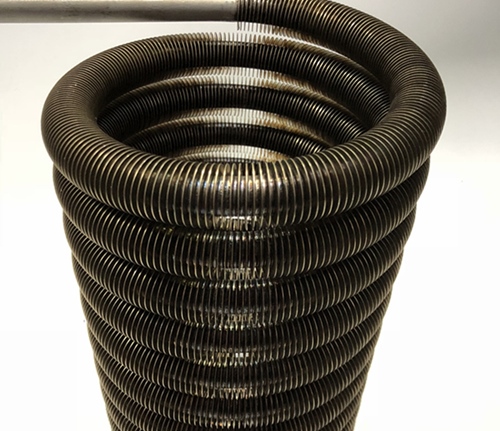
Laser welded finned tube coil demonstrating consistent fin spacing and uniform weld penetration along the entire tube length
Laser Welded Finned Tube Procurement
When sourcing laser welded finned tubes, establishing clear technical requirements ensures received components match application needs. Documentation should include material certifications, non-destructive testing reports, and dimensional verification data.
Supply chain considerations have grown increasingly important for thermal components. Evaluating manufacturer capabilities, lead times, and quality control processes helps ensure reliable component supply. Establishing relationships with manufacturers who maintain raw material inventory and employ advanced welding technology provides procurement advantages.
The integration of laser welded finned tubes into thermal systems represents a strategic investment in operational reliability. Their demonstrated performance in demanding applications continues to drive adoption across industries where thermal efficiency directly impacts production capacity and energy consumption.