


What Stainless Steel Condensers Do in a Thermal Loop
Vapor arrives at the shell nozzle, passes across the outside of a tube bundle, and gives up its latent heat to coolant running inside the tubes. Once the vapor temperature falls below its saturation point, liquid forms on the tube wall, runs down the surface and leaves through the condensate outlet. Nothing in that description involves a moving part — the duty is performed by surface area and temperature difference alone. When the unit is sized correctly, condensation stays steady at a fixed temperature; when it is undersized, vapor slips past the tail of the bundle and the downstream vacuum system has to absorb the extra load.
Stainless steel enters the picture because the coolant side is rarely as clean as the process side. A stainless steel condenser keeps its passivity through wet and dry cycles, chemical cleaning and mildly acidic condensate, which is where carbon steel starts to pit.
Why the chromium oxide film matters more than wall thickness
Grades 304, 316 and 316L all rely on a chromium-rich oxide layer that re-forms within minutes of being scratched, provided oxygen is available. That self-repairing behaviour is why wall thickness can stay modest — 0.7 mm to 1.2 mm on typical tubes — without shortening life. It also explains why a condenser left full of stagnant chlorinated water during a shutdown can fail long before one that was drained and dried.
How Stainless Steel Condensers Split Vapor and Coolant Flow
Shell-and-tube units dominate industrial condensing service because they tolerate high vapor volumes, dirty coolant and thermal cycling at the same time. Vapor enters at the top of the shell and meets a set of baffles that force it sideways across the bundle instead of shooting straight to the outlet. Coolant passes through the tubes, usually making two or four passes so it stays long enough to pick up the heat load.
Counter-current, parallel, and why the layout changes the duty
Counter-current flow — where the hottest vapor meets the warmest coolant — keeps the mean temperature difference high and therefore reduces the surface area required. Parallel flow smooths temperature gradients but wastes driving force. In a condenser the distinction is slightly different from a simple heat exchanger, because most of the heat is removed at a constant saturation temperature; the real design question becomes where the subcooling zone sits and how much non-condensable gas accumulates near the vent.
Which Stainless Steel Condensers Fit a Given Plant Layout
- Shell and tube: the workhorse for chemical, power and pharmaceutical duty. Vapor condenses on the shell side, and the bundle can be pulled for mechanical cleaning when the coolant is fouling.
- Plate: corrugated plates clamped into a frame give a large surface area in a small footprint, which suits clean fluids and duties where the heat load will need adjusting later — plates can be added without replacing the unit.
- Air-cooled: ambient air replaces water, and finned stainless steel tubes carry the duty where cooling water is scarce or discharge permits are tight.
- Spiral and coil designs: compact, self-draining options for viscous condensates and small pilot-scale skids.
Tube sheet detail worth reading twice. The joint between tube and tube sheet is where most condenser leaks begin. Expanded joints are cheaper and can be re-rolled on site; seal-welded joints resist vibration and thermal fatigue but demand qualified welders and post-weld cleaning. The full Stainless Steel Condensers tube sheet geometry, groove pattern and ligament width decide whether that joint survives ten years or two.
Why 304 and 316 Stainless Steel Condensers Behave Differently
The grade decision should follow the cooling water analysis, the vapor chemistry and the cleaning chemicals — not the price list. The table below compares what each material actually delivers in condensing service.
| Material | What it brings to the bundle | Where it holds up | Where it struggles | What to confirm before ordering |
|---|---|---|---|---|
| AISI 304 / 304L | 18% chromium, 8% nickel; strong forming and welding behaviour at the lowest stainless cost | Clean cooling tower water, food-grade steam, neutral condensate, HVAC duty | Chlorides above roughly 200 mg/L, coastal air, chloride-based cleaning agents | Water analysis for chloride and conductivity; whether the bundle will be chemically cleaned |
| AISI 316 / 316L | 2–3% molybdenum that resists pitting and crevice attack; L-grade resists carbide precipitation in weld zones | Chemical processing, pharmaceutical clean steam, dye and pigment plants, brackish cooling water | Concentrated chlorides, hot seawater, strongly reducing acids | Weld procedure and post-weld cleaning; whether the joint is expanded or seal-welded |
| Duplex 2205 | Roughly double the yield strength of austenitic grades plus better chloride stress-corrosion resistance | High-pressure shells, offshore platforms, refinery overhead condensers | Service temperatures above about 300 °C, where embrittlement becomes a risk | Fabricator experience with duplex welding and heat input control |
| Alloy 625 / 904L | Nickel-rich chemistry for aggressive acids, oxidising media and elevated temperature | Concentrated acid condensation, waste heat recovery with acidic flue gas | Cost; long lead times; limited availability of small tube sizes | Whether a lower grade with a corrosion allowance would meet the same service life |
How Fouling Lowers the Heat Transfer of Stainless Steel Condensers
A clean tube wall might offer a resistance of 0.0001 m²·K/W; a scaled one can reach ten times that figure within a single season. Because the overall heat transfer coefficient is built from a chain of resistances, the fouling layer quickly becomes the largest term and the condenser loses vacuum. Stainless steel helps here — its smooth, low-roughness surface resists deposit adhesion better than carbon steel — but it does not remove the need for a fouling allowance in the thermal design.
- Tube-side velocity: keeping coolant above roughly 1 m/s discourages sedimentation; below that, silt settles and starts a corrosion cell under the deposit.
- Cooling water treatment: scale control, biocide dosing and side-stream filtration matter more than the tube material once a unit is in service.
- Cleaning method: chemical descaling with citric or EDTA-based products suits stainless bundles; hydrochloric acid should be avoided because it attacks the passive film.
- Monitoring: tracking approach temperature monthly gives an early warning long before the vacuum system starts complaining.
How Stainless Steel Condensers Are Rated Before Installation
Thermal rating is only one half of the specification. The other half is documentation that proves the unit was built to the rating.
- Material test reports traceable to the heat number for tubes, tube sheet and shell plate.
- Design code stated clearly — ASME Section VIII, TEMA class, PED or an equivalent national standard.
- Heat load, mean temperature difference, overall coefficient and pressure drop on both sides, issued as a calculation sheet rather than a summary line.
- Hydrostatic test pressure and duration, plus any non-destructive examination of welds and tube-to-tube-sheet joints.
- Passivation record and, where specified, a ferroxyl test result confirming no free iron on the wetted surface.
- Nozzle orientation, support saddles and lifting lugs checked against the plant layout drawing before shipment, not after arrival.
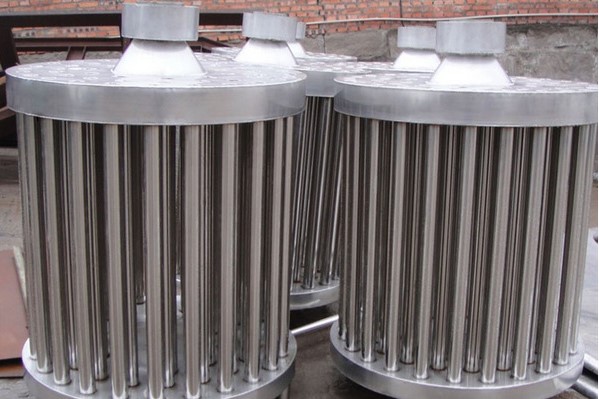
A shell-and-tube stainless steel condenser during assembly.
A Project Record of Stainless Steel Condensers in Solvent Recovery
A specialty chemicals plant recovering acetone from a drying stream replaced a carbon steel condenser that had been retubed twice in four years. The vapor carried trace organic acids and the cooling water ran at roughly 120 mg/L chloride, which produced pitting on the shell-side tube surfaces near the inlet baffle.
The replacement was a horizontal shell-and-tube unit with a 316L bundle, 19.05 mm outside diameter tubes on a 25 mm triangular pitch, a fixed tube sheet with expanded and seal-welded joints, and a removable channel for mechanical cleaning. Duty was set at 1.2 t/h of vapor with 30 °C cooling water entering and 42 °C leaving.
- Approach temperature held within 0.8 °C of the original design through the first fourteen months of operation.
- Bundle inspection at the first shutdown showed light organic film but no measurable pitting or crevice attack at the tube sheet.
- A citric acid circulation clean restored the coefficient to within 2% of the commissioning value.
- Cooling water velocity was raised from 0.7 m/s to 1.1 m/s by changing the tube pass arrangement, which ended the silt settlement that had caused the earlier failures.
The lesson carried over to other units on the site: the material upgrade mattered, but the flow velocity change and the removable channel did just as much to extend service life.
Stainless Steel Condensers: Questions Raised at Specification Stage
How long do stainless steel condensers normally stay in service?
Service life is set by the cooling water chemistry, the vapor composition and the cleaning routine rather than by the calendar. Units on clean cooling tower water with a 316L tube bundle and a regular descaling programme commonly run 15 to 25 years before retubing. Units handling chlorinated solvent vapours or seawater-adjacent cooling loops can lose tubes far sooner, so the water report matters as much as the steel grade.
Is 316L always a better choice than 304 for a condenser bundle?
No. Where the cooling medium is low-chloride and the vapor is neutral, 304 delivers the same thermal duty at a lower material cost. The molybdenum addition in 316L earns its price when chlorides, organic acids or cleaning chemicals are present, or when the tube bundle is welded and cannot be annealed afterwards. Choosing 316L by habit rather than by water analysis raises the price without raising performance.
Does a stainless condenser tube bundle need passivation after fabrication?
It does. Welding, rolling and grinding disturb the chromium oxide layer and can leave free iron on the surface, which becomes the first pitting site. A nitric or citric acid passivation step followed by a ferroxyl test confirms the film has been restored. Skipping this step is one of the most common reasons a new bundle shows pinholes within the first two years.
Horizontal or vertical mounting for stainless steel condensers?
Horizontal shells give a larger tube count in a given footprint and simplify bundle withdrawal for cleaning, which suits most chemical and HVAC duties. Vertical units save floor space and drain condensate by gravity, but tube replacement becomes harder. The deciding factor is usually the maintenance access available in the plant rather than the thermal design itself.
Can the tube bundle of a stainless condenser be replaced on site?
Yes, when the shell is built with a removable channel or a bolted bonnet and the tubes are expanded rather than seal-welded at both ends. A pulled bundle can be retubed in a workshop and returned within a few weeks. Seal-welded bundles are more leak-resistant but generally require the whole tube sheet assembly to be replaced.