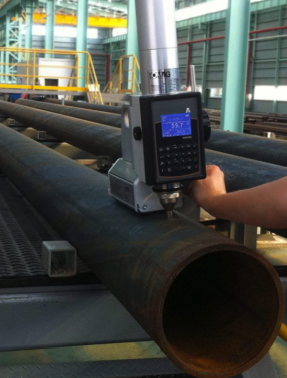

Stainless Steel Pipe Hardness: Testing Methods, Typical Values
Three Hardness Testing Methods and Their Application Scenarios
The Stainless Steel Pipe industry most commonly uses three hardness scales, each with its own applicable boundaries. They must not be mixed or directly converted for acceptance purposes:
| Hardness Scale | Applicable Standard (GB / ISO) | Principle | Application Scenarios |
|---|---|---|---|
| Brinell HBW | GB/T 231.1 / ISO 6506 | Tungsten carbide ball indenter, measure indentation diameter | Coarse-grained materials, thick-wall pipes, forgings, pipe end faces (large indentation, strong representativeness) |
| Rockwell HRB / HRC | GB/T 230.1 / ISO 6508 | Diamond cone / steel ball indenter, measure indentation depth | HRB for soft austenitic steels (≤100 HRB); HRC for cold-worked, martensitic, and other high-hardness materials |
| Vickers HV | GB/T 4340.1 / ISO 6507 | Diamond square-based pyramid indenter, measure diagonal length | Thin-wall pipes, microstructures, weld and heat-affected zone (HAZ) microhardness |
Selection Recommendations
Solution-annealed austenitic stainless steel
(304/316, etc.): HRB is preferred, or HBW for thick-wall items.
Cold-worked or martensitic/precipitation-hardening steels
(high hardness): Use HRC for accurate measurement.
Thin-wall pipes, weld HAZ, coatings/diffusion layers
HV (microhardness) must be used for precise localized readings.
Typical Hardness Values of Stainless Steel Pipes by Steel Type
Stainless steels are classified into four categories by microstructure, with significant hardness variations. The grade alone is insufficient — the delivery condition must also be considered.
Austenitic Stainless Steels (304/316/321/347/310S, etc.)
With a face-centered cubic (FCC) structure, solution-annealed austenitic steels offer relatively low hardness and excellent ductility, making them the mainstream choice for piping.
| Grade | Upper Hardness Limit, Solution-Annealed (Reference Standard) | Typical Production Value |
|---|---|---|
| TP304 / TP304L | ≤90 HRB / ≤192 HBW (ASTM A312/A213, GB/T 14976) | 80–88 HRB, 160–185 HBW |
| TP316 / TP316L | ≤95 HRB / ≤217 HBW | Approx. 79–95 HRB |
| TP321 / TP321H | ≤90 / ≤95 HRB | — |
| TP347 / TP347H | ≤95 HRB | — |
| 310S | ≤95 HRB / ≤217 HBW | — |
ASTM A213 (boiler/heat exchanger tubes) explicitly lists hardness as a mandatory acceptance criterion, and additionally specifies grain size requirements for H-grade materials, in conjunction with high-temperature stress-rupture strength evaluation. ASTM A312 (pressure piping) lists upper hardness limits for each grade in the standard, but typically does not mandate batch-by-batch hardness testing — it must be specified in the procurement specification. GB/T 14976 and GB 13296 likewise specify upper hardness limits for the solution-annealed condition.
Duplex Stainless Steels pipe (2205 / 2507, etc.)
With a dual austenitic-ferritic microstructure, duplex steels offer significantly higher strength and hardness than conventional austenitic steels:
- 2205 (S31803): Solution-annealed, approximately ≤293 HBW (≈ ≤31 HRC)
- 2507 (S32750): Approximately ≤310 HBW (≈ ≤32 HRC)
The high strength resulting from high hardness makes them suitable for high-pressure, highly corrosive service conditions, but it also means they are sensitive to work hardening and more difficult to form and machine.
Martensitic Stainless Steels (410/420/13Cr, etc.)
Can be hardened through quenching and tempering:
- 410/13Cr after quenching and tempering reaches approximately 22–36 HRC
- High-carbon martensitic steels such as 420/440C can reach 45–60 HRC
However, the higher the hardness, the more susceptible the material is to H₂S (SSC), and hardness must be strictly limited in sour service conditions.
Ferritic Stainless Steels (430, etc.)
Hardness is comparable to austenitic steels (approximately 70–90 HRB), with slightly lower strength. They are mostly used in applications with moderate corrosion resistance requirements.
Four Key Factors Affecting Stainless Steel Pipe Hardness
1. Chemical composition
Higher carbon and nitrogen content leads to more pronounced solid-solution strengthening and higher hardness; this is one reason why L-grades (low carbon) are generally slightly softer than standard grades.
2. Heat treatment condition
The solution treatment temperature and cooling rate directly determine the degree of carbide dissolution and grain size. Adequate solution treatment results in stable hardness and optimal corrosion resistance.
3. Degree of cold working
After cold working, the hardness of austenitic stainless steel can increase from approximately 180–200 HV in the solution-annealed condition to over 280 HV in the cold-drawn condition (approximately 28 HRC). At this point, HRC or HV should be used for measurement, as HRB is no longer applicable.
4. Welding and heat-affected zone (HAZ)
Welding thermal cycles can cause local hardening in the HAZ (particularly for martensitic microstructures), which must be controlled through post-weld heat treatment (PWHT) and verified by hardness surveys across the weld cross-section.
The Significance of Hardness in Engineering Acceptance and Failure Prevention
Linked to Corrosion Resistance and Safety (Key Point)
NACE MR0175 / ISO 15156 (sour service with H₂S) specifies an upper hardness limit of 22 HRC (≈248 HV / ≈237 HBW) for carbon and low-alloy steels, applicable simultaneously to the base metal, weld metal, and HAZ.
Austenitic stainless steels are generally acceptable, but heavily cold-worked austenitic steels are susceptible to SSC and must be controlled within the hardness/condition limits of ISO 15156-3.
Martensitic stainless steels are highly susceptible in H₂S environments, and high-hardness conditions are generally not usable — this is the technical basis for the principle that "the higher the hardness, the more dangerous in sour service."
Complementary to Non-Destructive Testing
Hardness testing is a destructive/semi-destructive sampling test, complementary to NDT methods such as UT and ET: NDT checks for "whether defects exist," while hardness checks "whether the material condition is correct." Both are indispensable.