


Nickel Alloy Condenser and Heat-Exchanger Tubes Standard
Nickel alloys behave nothing like carbon steel or ordinary stainless grades once they sit inside a condenser or a shell-and-tube exchanger, and the Nickel Alloy Condenser and Heat-Exchanger Tubes Standards written around them reflect that difference. What follows is the working knowledge applied every day on the mill floor — composition windows, mechanical floors, test frequencies, and the reasoning behind each one.
Nickel Alloy Condenser and Heat-Exchanger Tubes Standards and Service Environments
Why do engineers specify nickel alloys at all, when a 316L tube costs a fraction of the price? Because a condenser tube has to survive three things at the same time: a corrosive medium on one side, a thermal gradient through the wall, and mechanical load from vibration and differential expansion. Carbon steel handles none of the three well. The 300-series stainless grades handle one or two. Nickel alloys are pulled in when all three arrive together.
Power generation, chemical processing, oil and gas, desalination and marine duty are the sectors where these tubes dominate. Each pushes the material in a different direction — chlorides in seawater, high-temperature oxidation in furnace-adjacent exchangers, reducing acids in chemical service, wet CO2 in gas processing. The alloy chosen has to match the failure mode that is most likely to end the tubes life first.
| Alloy Type | Corrosion Resistance | Max Service Temperature (°C) | Applications | Cost Factor |
|---|---|---|---|---|
| Nickel-Copper (UNS N04400) | Excellent in marine environments | 480 | Marine heat exchangers, chemical processing | Medium |
| Nickel-Chromium-Iron (UNS N06600) | Good oxidation resistance | 1095 | High-temperature heat exchangers, furnaces | Medium-High |
| Nickel-Chromium-Molybdenum (UNS N06625) | Exceptional in chloride environments | 980 | Chemical processing, pollution control | High |
| Nickel-Iron-Chromium (UNS N08800) | Good carburization resistance | 815 | Petrochemical, heat treating | Medium |
Nickel Alloy Condenser and Heat-Exchanger Tubes Standards in the ASTM/ASME Series
Where does the "SB" come from, and why does it sit beside a "B" number? The B number is the ASTM material specification. ASME adopts the same text into the Boiler and Pressure Vessel Code with an S in front, so B163 and SB163 describe identical requirements. Which prefix lands on a purchase order usually depends on whether the exchanger is being built to ASME Section VIII. The nine specifications below cover the overwhelming majority of seamless nickel alloy tube ordered for condensers and heat exchangers.
1. ASTM/ASME B/SB163: Seamless Nickel and Nickel Alloy Condenser and Heat-Exchanger Tubes
This is the base specification, and it carries the widest alloy list of any single tube document. It sets out dimensional tolerances, mechanical property floors, heat-treatment rules and the non-destructive examinations that apply to condenser and heat-exchanger tubes made from nickel and nickel alloys. When a project has no unusual requirement, this is the specification that gets cited.
| Alloy UNS | Tensile Strength (min, ksi) | Yield Strength (min, ksi) | Elongation (min, %) | Hardness (max, HB) |
|---|---|---|---|---|
| N02200 | 55 | 15 | 35 | 90 |
| N04400 | 70 | 25 | 35 | 150 |
| N06600 | 80 | 35 | 30 | 195 |
| N06625 | 120 | 60 | 30 | 250 |
2. ASTM/ASME B/SB444: Nickel-Chromium-Molybdenum-Columbium Alloys and Nickel-Chromium-Molybdenum-Silicon Alloy Pipe and Tube
This specification treats the niobium-bearing grades as a family of their own, covering UNS N06625, UNS N06852 and UNS N06219. These alloys hold up where chlorides, oxidizing media and mixed acids would destroy a stainless tube within a single turnaround. The document is also the one to cite when a project needs tighter control over annealing temperature and grain size than the base specification provides. Tubes made to it are frequently ordered as Nickel Heat Exchanger Tubes in U-bend form for chemical and pollution-control service.
| Element | UNS N06625 | UNS N06852 | UNS N06219 |
|---|---|---|---|
| Nickel | ≥58.0 | ≥47.0 | ≥56.0 |
| Chromium | 20.0-23.0 | 20.0-22.0 | 21.0-23.5 |
| Molybdenum | 8.0-10.0 | 12.0-14.0 | 5.5-7.5 |
| Iron | ≤5.0 | ≤3.0 | ≤3.0 |
| Columbium (Nb) | 3.15-4.15 | - | - |
3. ASTM/ASME B/SB165: Nickel-Copper Alloy Seamless Pipe and Tube (UNS N04400)
This standard covers seamless pipe and tube in nickel-copper alloy UNS N04400, known commercially as Monel 400. The alloy resists flowing seawater, hydrofluoric acid and a long list of reducing media, and it holds its strength from cryogenic temperatures up to roughly 480 °C.
Industry Insight: UNS N04400 (Monel 400) demonstrates exceptional performance in marine heat exchanger applications due to its superior resistance to saltwater corrosion, stress-corrosion cracking, and biofouling.
4. ASTM/ASME B/SB407: Nickel-Iron-Chromium Alloy Seamless Pipe and Tube
The specification covers seamless pipe and tube in nickel-iron-chromium alloys, chiefly UNS N08800 (Incoloy 800). The grade keeps useful strength at elevated temperature and resists oxidation and carburization, which is why it turns up in petrochemical furnaces and heat-treating equipment where a stainless tube would scale away.
5. ASTM/ASME B/SB167: Nickel-Chromium-Iron Alloys, Nickel-Chromium-Cobalt-Molybdenum Alloy, and Nickel-Iron-Chromium-Tungsten Alloy Seamless Pipe and Tube
A broad document covering UNS N06600 (Inconel 600), N06601, N06603 and several related grades. What ties them together is a combination of oxidation resistance and creep strength at temperature — the qualities that matter in high-temperature heat exchangers, furnace tubes and nuclear steam generator components.
6. ASTM/ASME B/SB668: UNS N08028 and N08029 Seamless Pipe and Tube
These two alloys were developed with sulfuric acid service in mind. The specification addresses the composition, mechanical properties and corrosion testing needed for tubes that will see aggressive acid environments in fertilizer plants, pickling lines and acid regeneration units.
7. ASTM/ASME B/SB677: UNS N08925, UNS N08354, and UNS N08926 Seamless Pipe and Tube
This one covers high-performance austenitic stainless steels with a substantial nickel content. The molybdenum and nitrogen additions push the pitting resistance equivalent number well above that of 316L, making these grades a middle path where a full nickel alloy would be over-specified but 316L would pit.
8. ASTM/ASME B/SB423: Nickel-Iron-Chromium-Molybdenum-Copper Alloy Seamless Pipe and Tube (UNS N08825, N08221, and N06845)
UNS N08825 (Incoloy 825) is the headline grade here. Its combination of molybdenum and copper gives it resistance to both reducing and oxidizing acids, plus good resistance to stress-corrosion cracking in chloride service. It is a common choice for sulfuric and phosphoric acid exchangers.
9. ASTM/ASME B/SB690: Iron-Nickel-Chromium-Molybdenum Alloys Seamless Pipe and Tube (UNS N08366 and UNS N08367)
Super-austenitic grades UNS N08366 (AL-6XN) and UNS N08367 sit in this specification. The high molybdenum content delivers chloride pitting and crevice corrosion resistance that approaches the nickel alloys at a lower alloy cost, which makes them attractive for seawater-cooled exchangers with moderate temperatures.
Nickel Alloy Condenser and Heat-Exchanger Tubes Standards: Which Alloy Fits Which Duty
Which alloy should be ordered for a given service? That question cannot be answered by price alone, because the cost of a premature tube failure dwarfs the difference in first cost. Five factors drive the decision, and they usually pull against each other:
- Temperature: Nickel alloys retain strength at temperatures where stainless steels creep and oxidize. Above roughly 600 °C, the choice narrows quickly to the nickel-chromium and nickel-chromium-iron families.
- Corrosive medium: Chlorides favour the molybdenum-bearing grades; reducing acids favour the copper-bearing grades; seawater at moderate velocity favours nickel-copper.
- Mechanical loads: Pressure differential, thermal cycling and flow-induced vibration all reduce the allowable wall thickness, and the standards tolerance table has to be read alongside the thermal design.
- Fabrication: Some grades work-harden rapidly and need slower drawing speeds, controlled annealing and dedicated tooling. That affects lead time as much as cost.
- Life cycle: A tube that lasts three turnarounds instead of one changes the economics completely, even at three times the unit price.
| Duty Condition | Typical UNS Number | Governing Specification |
|---|---|---|
| Seawater cooling at moderate velocity | N04400 | ASTM/ASME B/SB165 |
| Chloride-rich chemical process streams | N06625 | ASTM/ASME B/SB444 |
| High-temperature oxidation and furnace duty | N06600, N06601 | ASTM/ASME B/SB167 |
| Sulfuric acid and pickling service | N08028, N08029 | ASTM/ASME B/SB668 |
| Mixed reducing and oxidizing acids | N08825 | ASTM/ASME B/SB423 |
| Seawater with moderate chloride pitting risk | N08367, N08926 | ASTM/ASME B/SB690, B/SB677 |
| Carburizing atmospheres in petrochemical plant | N08800 | ASTM/ASME B/SB407 |
Nickel Alloy Condenser and Heat-Exchanger Tubes Standards: How Tubes Are Tested and Verified
How does a buyer know the tube in the crate actually matches the certificate? The specifications answer that with a defined set of tests, and each one targets a different failure mode. Not every test is mandatory on every order — the purchase order decides which apply, which is why the ordering section of each specification deserves as much attention as the property tables.
| Test | What It Reveals | When It Applies |
|---|---|---|
| Hydrostatic or pneumatic test | Through-wall integrity under pressure | When specified on the order, unless replaced by a non-destructive electric test |
| Eddy-current test | Surface and near-surface discontinuities along the full length | Common on condenser and heat-exchanger tube orders |
| Ultrasonic test | Internal and wall-thickness related flaws | Heavy wall or critical service |
| Tension test | Tensile strength, yield strength, elongation | Per lot, on material from the finished tube |
| Flattening test | Ductility of the tube wall | Per lot |
| Flaring test | Ductility at the tube end, relevant to rolling into a tubesheet | Per lot when specified |
| Hardness test | Consistency of the cold-worked or annealed condition | Per lot |
| Intergranular corrosion test | Sensitization from improper heat treatment | By alloy family and on order |
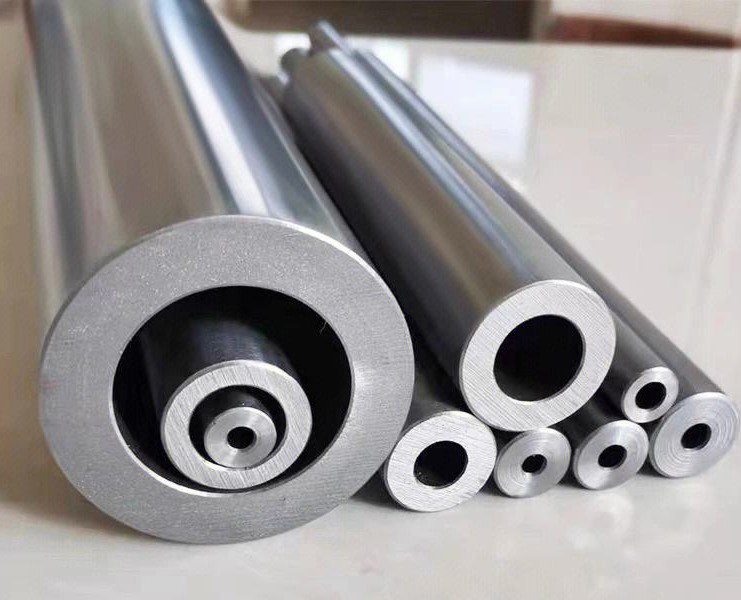
Expert Recommendation: For new installations or replacements, always verify that your nickel alloy condenser and heat-exchanger tubes comply with the latest revisions of ASTM/ASME standards. Third-party certification provides additional assurance of material quality and traceability.
Nickel Alloy Condenser and Heat-Exchanger Tubes Standards: Common Questions
Which standard applies to seamless nickel alloy condenser and heat-exchanger tubes?
ASTM/ASME B/SB163 is the base specification, and it carries the widest alloy list of any single tube document. Companion specifications such as B/SB444, B/SB165, B/SB167 and B/SB423 take over when a specific alloy family needs tighter composition or heat-treatment control.
What does the SB prefix mean next to the B number?
The B number is the ASTM material specification. ASME adopts the same text into the Boiler and Pressure Vessel Code with an S in front, so B163 and SB163 describe identical requirements. Which prefix appears on an order usually depends on whether the exchanger is being built to ASME Section VIII.
Why is UNS N06625 sometimes ordered to SB444 rather than SB163?
Both documents cover the alloy. SB444 treats the niobium-bearing nickel-chromium-molybdenum grades as a dedicated family, so it spells out composition windows, annealing temperatures and grain-size expectations for those grades in more detail. When a project engineer wants the tighter wording for a chloride-heavy duty, SB444 is the document cited.
Why is UNS N04400 still chosen for seawater condensers?
Monel 400 resists flowing seawater, hydrofluoric acid and many reducing media without the pitting that attacks stainless grades, and it resists biofouling because copper ions released at the surface discourage marine growth. Velocity limits in the specification protect the passive film, so tube-side flow rates still need to be checked at the design stage.
How does a buyer verify that delivered tubes meet the ordered standard?
Start with the mill test report. It should list heat number, UNS number, chemical analysis, tensile results, hardness and the specific tests performed, with a signature traceable to the producing mill. An EN 10204 3.1 certificate covers most projects. For critical service, arrange third-party witness of the eddy-current and hydrostatic tests before the tubes are boxed.
What holds this whole framework together is traceability. A tube that can be followed from heat number through drawing, annealing, testing and packing is a tube whose performance in service can be predicted. That is the practical value of the ASTM/ASME specifications — they turn a material choice into a set of verifiable numbers, and they give both the mill and the end user a common language when a question comes up years after the exchanger went into service.