


Finned tubes are essential for improving heat exchange performance by extending the effective surface area. When choosing between Rectangular HH finned tubes and spiral‑wound fin tube, many engineers find it hard to decide based on appearance alone. The real differences lie in construction, fabrication methods, field performance, and the operating conditions they can tolerate. This article compares these two common designs from a practical, hands‑on perspective.
1. Construction Basics – What Sets Them Apart?
Rectangular HH finned tubes (often called H‑type or square finned tubes) get their name from the two flat steel plates that are welded symmetrically on opposite sides of the base tube. When viewed from the end, the cross‑section looks like the letter "H". In the HH version, two base tubes share a single pair of fins, which further increases packing density. The rectangular fins typically have a side length about twice the outer diameter of the bare tube. This design is particularly common in boiler economisers and heavy‑duty heat recovery units, where dust and erosion are constant concerns.
Spiral‑wound fin tubes, on the other hand, are produced by tightly wrapping a continuous metal strip (often aluminium or steel) around the base tube under tension. The winding forms a helical fin with a trapezoidal shape – thicker at the root and tapering toward the tip. The process is straightforward and material‑efficient, but the mechanical contact between fin and tube can introduce some thermal resistance, especially under cyclic thermal loads.
Rectangular HH Finned Tubes – at a glance
- Fin shape: Rectangular / square, symmetrical
- Base tube: Single (H) or double (HH) tubes per fin set
- Fin attachment: High‑frequency resistance welding (metallurgical bond)
Spiral‑Wound Finned Tubes – key features
- Fin shape: Helical, trapezoidal profile
- Base tube: Single tube only
- Fin attachment: Mechanical tension winding (no fusion)
2. Manufacturing Processes – Welding vs. Winding
Rectangular HH finned tubes are made using high‑frequency resistance welding. The high‑frequency current generates heat at the contact points between the fin strip and the tube, melting the surfaces almost instantly. Forging pressure then fuses them into a strong metallurgical joint, with a weld fusion rate above 97 %. This results in very low contact thermal resistance and excellent resistance to fin loosening, even after years of thermal cycling. However, the equipment and quality control are more demanding, which drives up the initial cost.
Spiral‑wound fin tubes rely on a simpler mechanical winding process: one end of the metal strip is locked onto the tube, and the tube rotates to pull the strip tightly around its circumference. No heating or fusion takes place – the fin stays in place purely by tension and the friction of overlapping layers. This keeps production fast and inexpensive, but the interface between fin and tube is not a continuous metallurgical bond. In practice, aluminium fins on steel tubes can loosen over time due to different expansion rates, which may reduce heat transfer efficiency in high‑temperature services.
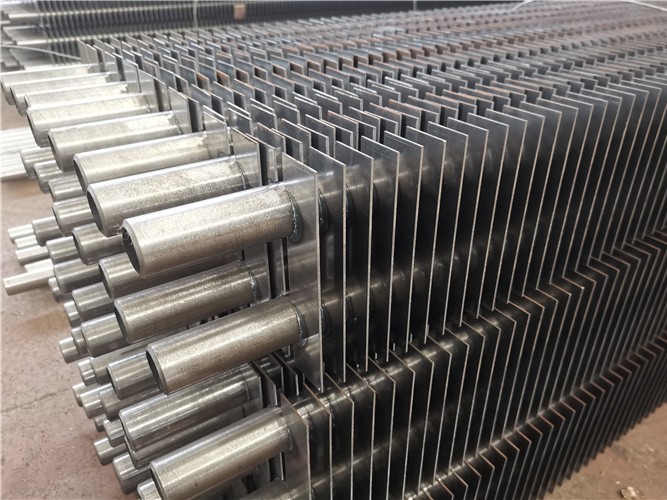
Rectangular HH finned tube
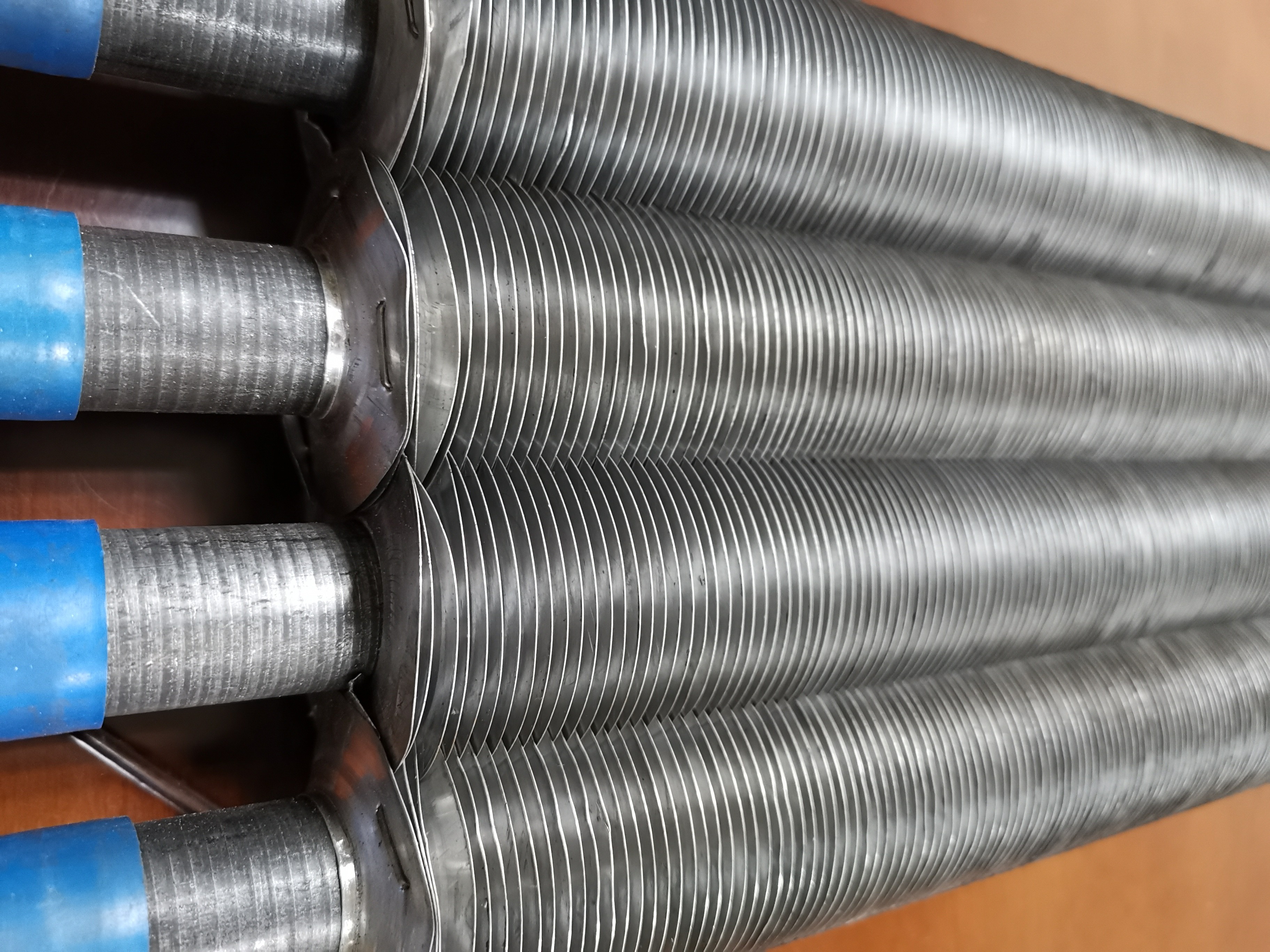
Spiral‑wound fin tube
3. Performance Comparison – Where Each Design Excels
3.1 Heat Transfer Efficiency
Under typical industrial flue‑gas conditions, rectangular HH finned tubes can deliver 6 to 9 times the heat transfer area of a plain bare tube of the same diameter. Per unit length, the effective area is roughly 3 to 5 times higher. Field data from Air cooler finned‑tube designs have shown that rectangular‑fin configurations often achieve overall heat transfer coefficients roughly twice those of comparable units using spiral‑wound round fins. The reason is the lower contact resistance and the straight‑fin geometry that promotes better airflow distribution. Spiral‑wound fins, while still effective, suffer from a small but meaningful thermal barrier at the fin‑tube interface. In applications with frequent start‑up and shutdown, this can become a noticeable drawback.
3.2 Anti‑Fouling and Self‑Cleaning
One of the strongest advantages of rectangular HH finned tubes is their resistance to dust accumulation. The H‑shaped fin arrangement divides the flue‑gas path into several parallel, straight channels. This not only equalises the flow but also helps the gas carry away loose particles. During routine soot‑blowing cycles, the straight passages allow cleaning media to reach all surfaces, and the fins themselves vibrate slightly under pulsed flow, shedding ash more readily. In contrast, spiral‑wound fins create helical dead zones where dust tends to lodge, making them more prone to fouling in high‑particulate streams.
3.3 Wear Resistance
In abrasive environments – such as coal‑fired boilers or cement kilns – rectangular HH finned tubes last significantly longer. Because the fins are arranged in straight rows, they break up the strong vortex that normally forms behind tubes in cross‑flow, reducing the erosive impact of high‑velocity ash particles. Plant operators have reported that under identical conditions, HH finned tubes exhibit a wear life 3 to 4 times that of bare tubes, and outperforms spiral‑wound alternatives. This makes them a preferred choice for retrofit projects where erosion is a primary concern.
3.4 Space Efficiency
For a given heat duty, the compact layout of H‑type finned tubes can save about 40 – 50 % of the volume compared to conventional designs. In practice, this often means a boiler economiser can be shortened by more than 40 % while maintaining the same thermal output. Spiral‑wound fin tubes also offer good compactness thanks to their uniform pitch, but they may need more frequent cleaning intervals in dusty services, which can offset the space advantage.
| Feature | Rectangular HH Finned Tube | Spiral‑Wound Finned Tube |
|---|---|---|
| Fin geometry | Flat rectangular plates, symmetrical; H‑type for single tube, HH for twin‑tube | Helical strip with trapezoidal cross‑section |
| Bonding method | High‑frequency resistance welding – metallurgical bond, very low contact resistance | Mechanical winding – no fusion, relies on tension |
| Heat transfer coefficient | Typically twice that of wound‑fin designs in air‑cooler applications | Good but lower; contact resistance and possible loosening reduce performance |
| Fouling tendency | Straight channels minimise dead zones; easy to clean with soot‑blowers | Helical crevices trap dust; cleaning cycles need to be more frequent |
| Erosion life | 3‑4 times longer than bare tubes in high‑dust flue gas | Moderate – better than bare tubes but less than HH type |
| Footprint | Compact; can cut economiser height by over 40 % | Compact as well, but fouling may require extra maintenance space |
| Initial cost | Higher due to welding equipment and tighter process control | Lower – simpler production, faster turnaround |
4. Where You’ll Find Them – Typical Applications
Rectangular HH Finned Tubes are often used in:
- High‑ and low‑temperature Economizers in coal‑fired, gas‑fired, and biomass power boilers
- Waste heat recovery units behind incinerators and cement kilns
- Retrofit projects where erosion and fouling are major issues
- Chemical and petrochemical plants with dusty process gases
Spiral‑Wound Finned Tubes are typically selected for:
- HVAC and clean‑air cooling systems
- Air heaters in drying processes
- Low‑pressure, ambient‑temperature heat exchangers
- Applications where budget constraints are tight and media are clean
5. Cost Considerations and Selection Guidance
Cost is often a deciding factor. Rectangular HH finned tubes command a premium because the high‑frequency welding process requires specialised equipment, skilled operation, and strict quality assurance. The rectangular fins also need to be stamped separately before welding. In contrast, spiral‑wound fin tubes are less expensive to produce – the winding machinery is simpler, and the raw strip can be fed continuously. That makes them attractive for projects with tight budgets and clean operating conditions.
However, choosing solely on price can be short‑sighted. Here is a practical guideline:
Choose rectangular HH finned tubes if:
- Your flue gas carries heavy dust or abrasive particles (e.g., coal, biomass, waste‑to‑energy).
- You expect high thermal cycling that might loosen mechanically attached fins.
- You want to reduce soot‑blowing frequency and maintenance downtime.
- You need maximum heat transfer per unit volume.
Opt for spiral‑wound fin tubes when:
- The medium is clean – air, light gases, or low‑dust streams.
- Operating temperature and pressure stay moderate.
- Your primary concern is lower upfront capital expenditure.
- You have easy access for cleaning and maintenance.
Remember, the total cost of ownership often includes cleaning, replacement, and downtime. In dirty environments, the higher initial investment of HH finned tubes can pay back quickly through extended service life and reduced maintenance.
6. Practical Takeaways – Beyond the Spec Sheet
When comparing these two finned‑tube types, do not just look at numbers on a data sheet. Consider your actual operating profile: how often does the unit start and stop? What is the ash loading and particle size? Are you able to perform routine soot‑blowing, and how effective is it? For example, in a real‑world boiler retrofit, one plant switched from spiral‑wound to rectangular HH tubes and cut their annual cleaning shutdowns by half, despite the higher purchase cost. That kind of operational insight is often more valuable than theoretical comparisons.
Also, think about your maintenance crew’s experience. Welded fins are more robust and less prone to accidental damage during cleaning. If your facility already uses water‑lance or steam soot‑blowing, the straight‑fin design will tolerate those forces better than the more fragile helical fins. Ultimately, the best choice balances technical performance, budget, and long‑term reliability.