


What is single metal finned tube?
Single Metal Finned Tubes for Industrial Heat Exchange
Single metal finned tubes represent a specialized category within heat exchanger components, designed for efficient thermal transfer in demanding industrial environments. Unlike bimetallic or welded-fin alternatives, these tubes are fabricated from a single, continuous metal material through precise manufacturing processes.
Core Principle: The fundamental advantage of single metal finned tubes lies in their homogeneous construction. The fins and tube body share identical material composition, eliminating potential weak points from dissimilar metal interfaces. This uniformity ensures consistent thermal expansion, corrosion resistance, and structural integrity across the entire component.
Single Metal Finned Tube Fundamentals
A single metal finned tube is an integrated heat transfer component where extended surfaces (fins) are formed from the same metal stock as the base tube. This monolithic construction is achieved through deformation processes like extrusion or rolling, which reshape the tube wall to create permanent, high-contact-fin surfaces without joints or bonds.
Common manufacturing methods for these tubes include:
This approach is distinct from attaching separate fins via welding or tension-wrapping. The single metal finned tube offers superior reliability in applications where thermal cycling, vibration, or corrosive atmospheres might compromise mechanical joints. For specialized profiles, T-shaped finned tubes represent another variation within this manufacturing family.
Comparison of Single Metal Fin Types
The following table outlines key distinctions between two primary single metal finned tube categories, helping procurement specialists select appropriate configurations for specific project requirements.
| Feature | Basic Single Metal Finned Tube | Extruded (Rolled) Single Metal Finned Tube |
|---|---|---|
| Formation Process | Fins created through deformation of tube wall material via rolling or machining techniques. | Continuous extrusion process integrates fin and tube into single monolithic structure. |
| Fin-Tube Interface | Fins and tube share same material with no seam; formed from single metal piece. | Fin emerges seamlessly from tube wall; strongest possible metallurgical bond. |
| Thermal Performance | Enhanced surface area improves heat transfer versus smooth tubes; suitable for moderate duty. | Exceptional heat transfer efficiency due to uninterrupted thermal path and optimized fin geometry. |
| Fouling Resistance | Improved over smooth tubes; fin arrangement disrupts boundary layers. | Excellent; smooth fin base and profile minimizes deposit accumulation in harsh service. |
| Typical Materials | Aluminum, copper, carbon steel, stainless steel (single alloy throughout). | Aluminum, copper, stainless steel, specialized alloys; chosen for extrudability. |
| Industrial Applications | Air-cooled exchangers, ventilation systems, process heaters. | High-pressure boilers, condensers, petrochemical processing, power generation. |
Material Selection for Single Metal Tubes
Choosing the appropriate metal alloy is critical for performance and longevity. The single-material constraint requires balancing thermal conductivity, corrosion resistance, formability, and cost. Aluminum provides excellent conductivity and lightweight properties for ambient-temperature applications. Copper offers superior thermal performance but at higher material cost. Stainless steel grades deliver corrosion resistance for chemical processing, while carbon steel serves cost-effective applications in non-corrosive environments.
Material selection directly impacts manufacturability. Softer metals like aluminum and copper extrude more readily into high-fin configurations, while harder alloys may require specialized rolling equipment. The homogeneous nature of these tubes ensures uniform corrosion behavior, eliminating galvanic corrosion concerns present in multi-material assemblies.
Industrial Applications
Power Generation
Used in air-cooled condensers and feedwater heaters where reliability under thermal stress is paramount. Single metal construction withstands pressure cycling without joint fatigue.
HVAC & Refrigeration
Employed in large-scale chillers and heat recovery systems. Aluminum tubes provide efficient heat transfer for evaporators and condensers in commercial systems.
Process Industries
Critical in chemical, petrochemical, and pharmaceutical heat exchangers where material purity and corrosion resistance are essential for process integrity.
Procurement Considerations
When specifying single metal finned tubes, engineers should evaluate several technical parameters. Fin density (fins per inch) balances surface area against airflow resistance. Fin height influences heat transfer enhancement and structural stability. Tube wall thickness must accommodate internal pressure while allowing proper fin formation during manufacturing.
Quality verification should include dimensional inspection, metallurgical consistency checks, and pressure testing. The absence of joints eliminates leak testing at fin interfaces but requires verification of the overall tube integrity. Procurement specialists should request material certifications confirming alloy composition and mechanical properties throughout the component.
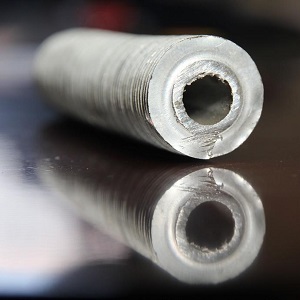
High-density single metal finned tubes designed for maximum heat transfer efficiency in compact exchanger designs.
The manufacturing process achieves fin formation through controlled deformation of the tube wall. This ensures optimal thermal contact between fin and tube, eliminating thermal resistance present in attached-fin designs. The resulting components offer predictable performance throughout their service life, with maintenance limited primarily to external cleaning rather than joint repairs.
For industrial procurement teams, single metal finned tubes provide a reliable solution for heat exchanger applications requiring durability, consistent performance, and material uniformity. Their monolithic construction eliminates failure modes associated with fin attachment methods, offering long-term operational stability in demanding thermal environments.
Technical Advantage: The integral fin-tube interface in single metal finned tubes achieves near-perfect thermal continuity. Heat flows directly from tube wall to fin without interfacial resistance, providing approximately 15-25% greater efficiency than mechanically attached fins in equivalent applications.