


If youve ever worked on a floating head or hairpin heat exchanger, youve probably seen a split ring. Its that small, C‑shaped metal ring with a gap. Doesnt look like much, but without it, pulling the tube bundle becomes a major headache.
At Lord Fin Tube, we specialize in high‑quality finned tubes and heat exchanger components. Understanding how a split ring works — and where it fits in your heat exchanger — can help you make better maintenance decisions and improve equipment uptime.
This article covers:
- What a split ring is and why it is called that.
- Its exact location inside a heat exchanger.
- How it benefits floating head and hairpin (U‑bend) heat exchangers.
- Why choosing the right split ring matters for finned tube bundles.
What is a split ring, really?
A split ring is just a retaining ring with an intentional cut through its circumference. That cut – the "split" – lets you compress it slightly so it fits into a groove. Once inside, it springs back and locks into place.
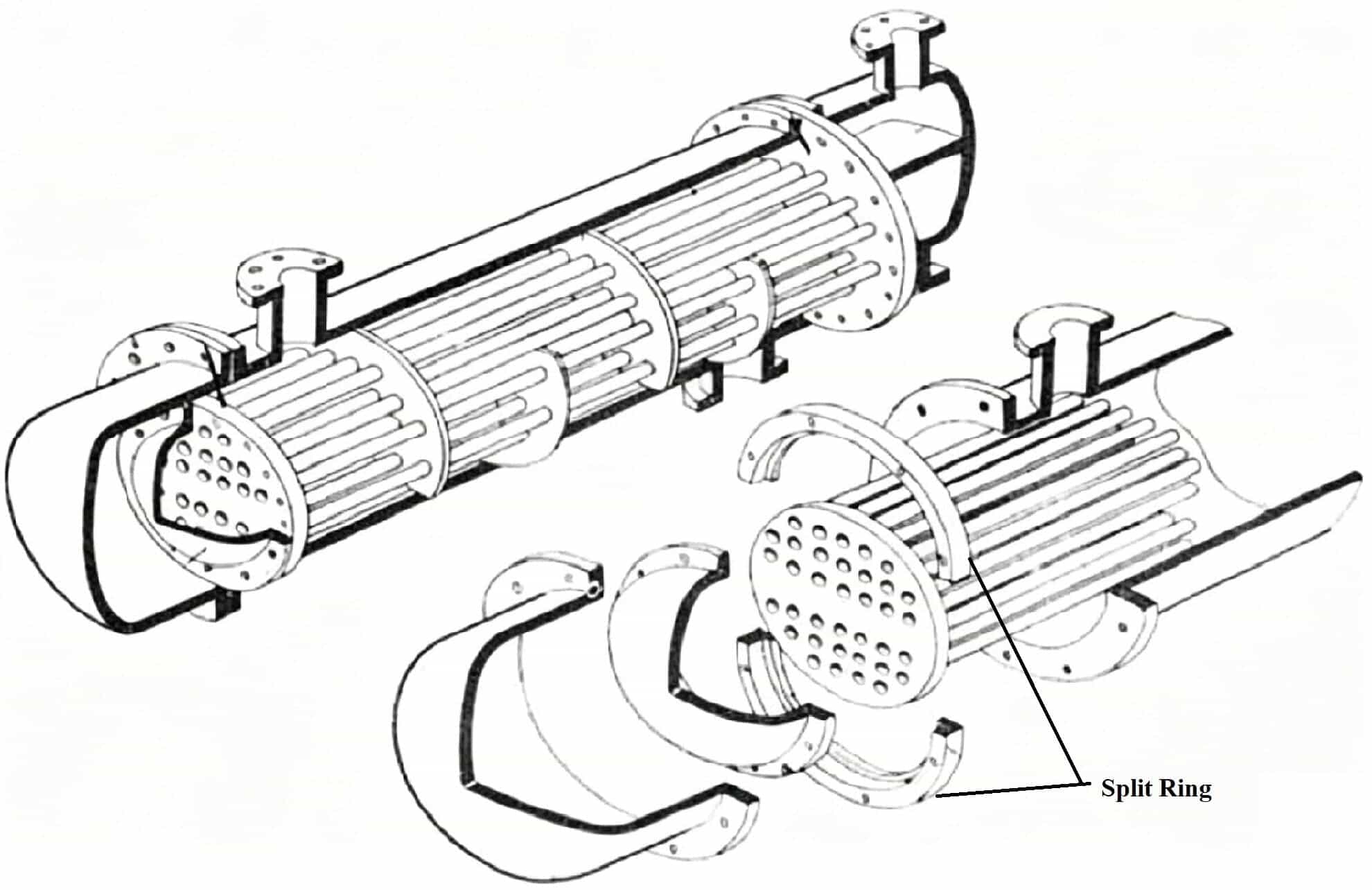
Why "split ring"? Because its a ring thats split. No hidden meaning. Same idea as a key ring, except made from heat‑treated alloy steel and designed to take axial loads.
Where does it go in a heat exchanger?
You wont find split rings everywhere. Theyre used in two specific locations.
1. Floating head end (TEMA S or T types)
In a floating head exchanger, one end of the tube bundle is fixed. The other end – the floating head – needs to move with thermal expansion. The split ring locks the floating head cover onto the head itself.
Heres how it works:
- A groove is machined on the floating heads outer diameter.
- The split ring sits in that groove.
- The cover slides over the ring. When it reaches the right position, the ring expands into a matching internal groove, locking the cover.
To remove the cover, you compress the ring – either with special pliers or by squeezing it through access holes. No unbolting of heavy flanges. Thats the whole point.
2. Hairpin (U‑tube) exchanger – stationary end
In a hairpin (U‑tube) heat exchanger, the split ring is often found between the tubesheet and the shell flange. It holds a backing device or an internal seal. Again, the advantage is quick disassembly.
Why use a split ring instead of a bolted flange?
| Feature | Split ring | Bolted flange |
|---|---|---|
| Assembly time | Minutes | Hours |
| Disassembly | Pliers or simple tool | Torque wrench + multiple passes |
| Space needed | Compact | Wide flange projection |
| Effect of thermal cycles | Maintains preload | Bolts can relax |
For finned tube bundles that need frequent cleaning — because fins foul faster than bare tubes — the split ring design can save days of downtime per year.
What does this have to do with finned tubes?
At Lord Fin Tube, we make finned tubes for shell‑and‑tube exchangers, air coolers, and waste heat units. When a customer uses our finned tubes in a split‑ring floating head exchanger, maintenance gets noticeably easier.
✔ Pulling the bundle
Remove the split ring cover in minutes, then slide the whole finned bundle out.
✔ Less fin damage
No prying or hammering against the fins.
✔ Cleaning happens more often
Because its easy to do. That means fins stay clean, and heat transfer stays high.
If youre ordering a replacement finned tube bundle for a split‑ring exchanger, double‑check the groove dimensions and split ring size. A 0.1 mm mismatch can cause seal leakage.
Materials & practical tips
Split rings are typically made from:
- Carbon steel – low cost, moderate service.
- Stainless steel 304/316 – corrosive or clean service.
- Alloy steel (4140, 17‑4 PH) – high pressure / high temperature.
What to look for in a good split ring:
- Shot‑peened surface – better fatigue life.
- Ground working faces – even load distribution.
- Some form of coating or passivation – prevents rust if the exchanger sits idle.
Common problems
Even a good split ring fails if misused. Typical issues:
- Plastic deformation – over‑compressed during installation. Solution: use the correct groove depth.
- Stress corrosion cracking – stainless steel in chlorides. Switch to super duplex or Inconel.
- Wear from repeated assembly – replace the ring when the free gap increases more than 5% from new.
Worn split rings can let the floating head cover shift, creating a leak path that bypasses the tube bundle. That directly kills heat transfer.