


What Is a Surface Condenser?
Surface Condenser: Principle, Structure, Operation and Industrial Application
1. Introduction
A surface condenser is a specialized shell-and-tube surface condenser used in thermal power and industrial steam systems. It separates cooling water and exhaust steam for indirect heat exchange, serving as the core cold-end equipment of steam turbines.
It condenses low-pressure turbine exhaust steam into pure condensate under vacuum, creating stable negative pressure to boost cycle efficiency, while recycling condensate as boiler feedwater for closed energy circulation.
2. Core Structural Composition
This robust shell-and-tube unit consists of four core modules customized for vacuum and anti-corrosion service:
2.1 Shell Body
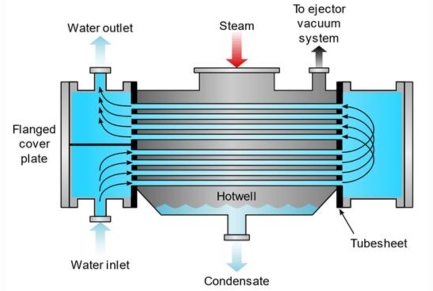
Pressure-resistant cylinder holding exhaust steam, equipped with steam inlet, air extraction ports and manholes. A bottom hotwell collects condensed water.
2.2 Tube Bundle
Heat transfer core made of thin-walled tubes. Cooling water runs inside tubes while steam condenses outside. Titanium, Cu-Ni alloy or stainless steel resist seawater corrosion and scaling.
2.3 Tube Sheet & Sealing System
Seals and fixes tubes to isolate cooling water and steam sides. Gaskets and expansion joints eliminate thermal stress leakage.
2.4 Auxiliary Components
Includes cooling water pumps, air extractors, condensate pumps and vacuum systems to remove non-condensable gas and circulate condensate.
3. Working Principle
Its operation relies on indirect heat transfer and steam volume shrinkage under vacuum, divided into three stages:
3.1 Steam Condensation & Heat Exchange
Low-pressure exhaust steam contacts cold tube walls, releases latent heat and condenses into droplets that flow down to the hotwell.
3.2 Vacuum Formation & Maintenance
Steam condenses into liquid with massive volume reduction to form vacuum. Air extractors continuously discharges trapped non-condensable gas to avoid vacuum drop, ensuring the turbine exhaust end maintains a high-vacuum working state.
3.3 Condensate Recycling
Condensate is pumped to boiler feedwater treatment and recycled into steam circulation for zero extra water waste.
4. Key Advantages of Surface Condensers
4.1 High-purity Condensate
Complete media separation prevents sediment and salt contamination, reducing boiler scaling and maintenance work.
4.2 Stable Vacuum & High Efficiency
Stable high vacuum improves Rankine cycle efficiency, cutting fuel consumption and raising power output.
4.3 Wide Application & Strong Adaptability
Exchangeable tube materials fit fresh water, seawater and industrial water. Matches steam turbine surface condenser units of all capacities.
4.4 Low Operation Cost & Long Lifespan
Low flow resistance saves pump power; anti-corrosion tubes extend service life and reduce makeup water consumption.
5. Key Performance Parameters
| Parameter Item | Spec & Function |
|---|---|
| Operating Vacuum | 0.003~0.005 MPa absolute; higher vacuum delivers better efficiency |
| Heat Transfer Efficiency | Depends on tube material, layout and water flow |
| Condensate Subcooling | Excessive subcooling increases heat loss |
| Non-condensable Air Content | High air level raises thermal resistance and damages vacuum |
| Cooling Water Temperature Rise | Direct indicator of real-time heat exchange load |
6. Common Operation Problems and Maintenance
6.1 Vacuum Degradation
Caused by air leakage, scaling or insufficient cooling water. Fix via tightness test, tube cleaning and air pump inspection.
6.2 Over Subcooling
Resulting from uneven steam flow or high hotwell liquid level. Optimize baffles and stabilize water level.
6.3 Tube Scaling & Corrosion
Clean tubes with chemical or high-pressure water; enhance anti-corrosion protection for seawater cooling.
7. Industrial Applications
thermal power condenser serves as standard equipment for medium & large turbine units. Widely used in thermal & nuclear power plants, chemical, metallurgy, paper waste heat recovery and distributed energy stations to recycle waste heat and cut energy consumption.
8. Conclusion
Surface condensers deliver irreplaceable performance in steam power cycles with separated media, stable vacuum and efficient heat recovery. Modern units develop toward high efficiency, corrosion resistance and intelligent operation. Proper design, operation and maintenance improve thermal cycle economy and guarantee safe equipment running.