


A compact heat exchanger is a heat transfer device that fits a large heat transfer surface into a small physical envelope. Instead of relying on long tubes, it uses dense fins, small channels, or corrugated plates to multiply the surface area available for heat exchange. That single design idea—high surface area per unit volume—is what separates a compact heat exchanger from a conventional shell and tube unit.
This article explains what compact heat exchangers are, how their key parameters are defined and calculated, which types are used in industry, and how engineers select and balance them for real projects.
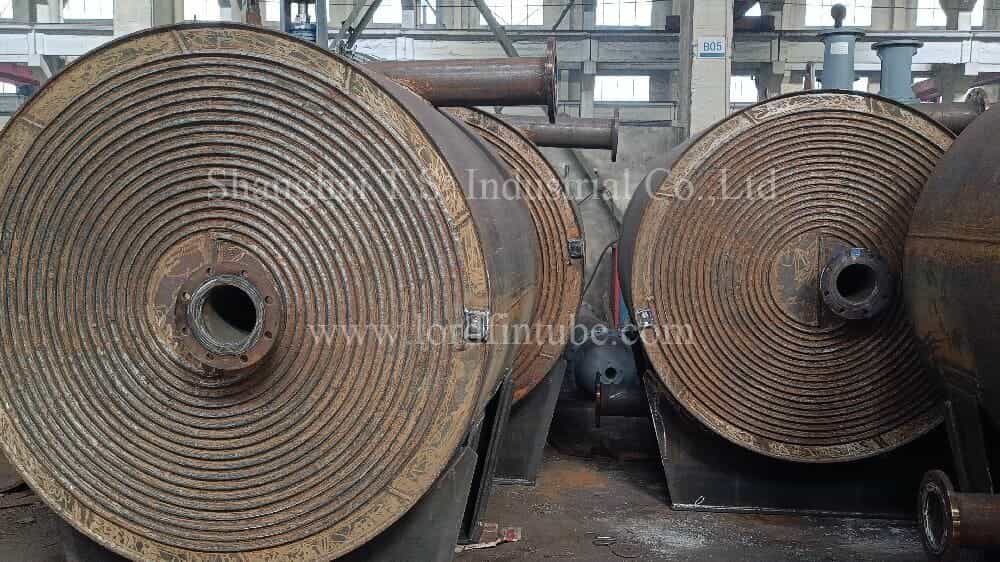
What Is a Compact Heat Exchanger?
A compact heat exchanger is a heat exchanger with a high area density, typically defined as 700 m²/m³ or more. Area density is the total heat transfer area divided by the exchanger volume. Designs above roughly 3,000 m²/m³ are often called ultra-compact heat exchangers.
For comparison, a conventional shell and tube heat exchanger usually falls in the range of 100 to 300 m²/m³. That gap explains why compact units are smaller, lighter, and often lower in material cost for the same duty.
Definition and Working Principle
A compact heat exchanger is an indirect (recuperative) heat exchanger. Two fluids are separated by a solid wall, and heat passes from the hot fluid, through the wall, into the cold fluid. What makes the design compact is the geometry of the wall:
- Fins bonded to a separating plate increase secondary surface area.
- Small hydraulic diameter channels raise the surface-to-volume ratio.
- Stacked plates multiply parallel flow passages inside one housing.
- Etched or formed microchannels pack hundreds of paths into a single block.
The result is more heat transfer area per cubic meter, and often a higher heat transfer coefficient, because small channels promote turbulent flow at lower Reynolds numbers.
Key Parameters and Units
Four parameters dominate the design and evaluation of a compact heat exchanger.
Area Density (β)
Area density is the total heat transfer area divided by exchanger volume, expressed in m²/m³. It is the primary indicator of compactness. Higher area density means more surface in less space, but also narrower flow passages.
Overall Heat Transfer Coefficient (U)
The overall heat transfer coefficient describes how effectively heat moves from one fluid to the other, expressed in W/(m²·K). Compact geometries usually produce higher U values than bare tube surfaces because the fins and small channels reduce the thermal resistance on the gas or liquid side.
Pressure Drop (ΔP)
Pressure drop is the loss of fluid pressure across the exchanger, expressed in kPa or bar. It rises sharply as channels shrink and surface density increases. Pressure drop directly affects pumping power and operating cost.
Effectiveness (ε) and Thermal Duty (Q)
Effectiveness is the ratio of actual heat transfer to the thermodynamic maximum, dimensionless. Thermal duty Q is the total heat transferred, expressed in kW or W. These two values define what the exchanger must achieve.
How the Parameters Interact
These parameters are not independent. Increasing area density usually increases U but also increases ΔP. Raising U allows a smaller exchanger for the same Q, which reduces cost and footprint. However, that gain can be cancelled by higher fan or pump power. Designers therefore balance U, ΔP, β, and Q together, not one at a time.
Area Density Formula and Calculation
Area density is calculated with a simple relationship:
β = A / V
- β = area density, m²/m³
- A = total heat transfer area, including primary and secondary surface, m²
- V = external volume of the heat exchanger core, m³
Example: if a plate-fin core has 42 m² of total heat transfer area and an external volume of 0.05 m³, then β = 42 / 0.05 = 840 m²/m³. That result places the unit in the compact range.
Different manufacturers and standards may define volume differently—some use core volume, others use envelope volume including headers. Always confirm the definition before comparing values. Final calculations should be verified against project specification and manufacturer data.
Types of Compact Heat Exchangers
- Plate-fin heat exchanger: fins brazed between flat plates; widely used in air separation, aerospace, and cryogenic service.
- Brazed plate heat exchanger: corrugated plates vacuum-brazed into a single block; common in refrigeration and hydraulic cooling.
- Gasketed plate heat exchanger: plates sealed with gaskets and clamped in a frame; easy to open and clean.
- Printed circuit heat exchanger (PCHE): microchannels chemically etched and diffusion-bonded; suited to high pressure and high temperature duties.
- Microchannel heat exchanger: parallel small channels, often aluminum; used in air conditioning and electronics cooling.
- Finned tube heat exchanger: fins mechanically bonded to tubes; standard for air-cooled radiators and coils.
Compact vs Shell and Tube: Comparison
| Dimension | Compact Heat Exchanger | Shell and Tube Heat Exchanger |
|---|---|---|
| Area density | 700 m²/m³ and above (typical range) | 100–300 m²/m³ (typical range) |
| Footprint and weight | Small and light | Large and heavy |
| Pressure drop | Higher for the same flow | Lower, more forgiving |
| Fouling tolerance | Lower; narrow passages foul faster | Higher; tubes are easier to clean |
| Cleaning | Chemical or backflush for brazed/welded types | Mechanical cleaning possible |
| Pressure and temperature limits | Depends on design and material; confirm per project | Broad range, well established |
| Typical duty | Gas, two-phase, cryogenic, high-effectiveness duties | General liquid, steam, and process duties |
Design Trade-offs and Selection Trade-offs
Compact heat exchangers involve several deliberate trade-offs. Understanding them prevents oversized, over-priced, or under-performing selections.
- Heat transfer vs pressure drop: smaller channels raise U but increase ΔP. Pumping power can offset thermal gains.
- Compactness vs fouling: dense surfaces foul faster. Dirty fluids may require wider channels or pretreatment.
- Weight vs durability: lighter materials such as aluminum save mass but may limit temperature or corrosion resistance.
- Cost vs performance: brazed and diffusion-bonded cores cost more to manufacture but deliver higher effectiveness.
- Efficiency vs serviceability: welded and brazed cores are leak-tight but cannot be opened for mechanical cleaning.
- Effectiveness vs approach temperature: high effectiveness requires more surface, which increases size, cost, and ΔP.
Technical Specifications
| Parameter | Typical Range | Unit |
|---|---|---|
| Area density (β) | 700–3,000 and above | m²/m³ |
| Overall heat transfer coefficient (U) | Varies widely by fluid pair and geometry | W/(m²·K) |
| Pressure drop (ΔP) | Set by project allowance | kPa or bar |
| Thermal duty (Q) | Set by process requirement | kW |
| Design pressure | To be confirmed per project | bar or MPa |
| Design temperature | To be confirmed per project | °C |
Materials and Standards
Material selection follows fluid compatibility, operating temperature, and corrosion risk. Common materials include:
- Stainless steel 304 and 316L
- Aluminum alloys
- Copper and copper alloys
- Titanium
- Nickel-based alloys
Brazing filler metals such as copper or nickel-based alloys are common in plate-fin and brazed plate construction. Standards are applied according to project specification; the applicable standard should be confirmed before design and fabrication begin.
Applications by Industry
- HVAC and refrigeration: condensers, evaporators, and chillers.
- Automotive: radiators, charge air coolers, oil coolers, and battery thermal management.
- Aerospace: environmental control and fuel-oil cooling.
- Chemical and petrochemical: process gas cooling and heat recovery.
- Power generation: supercritical CO₂ cycles and waste heat recovery.
- Electronics: cold plates and liquid cooling modules.
- LNG and cryogenics: main cryogenic heat exchangers and liquefaction trains.
Selection Guide
Use the following steps when specifying a compact heat exchanger:
- Define thermal duty Q and the required outlet temperatures.
- Identify both fluids, their flow rates, and their fouling tendency.
- Set an allowable pressure drop for each side.
- Determine design pressure and design temperature.
- Confirm available space, weight limits, and connection sizes.
- Select a type: plate-fin, brazed plate, gasketed plate, PCHE, or microchannel.
- Choose materials for corrosion and temperature compatibility.
- Check serviceability requirements against cleaning method.
- Verify area density and effectiveness against the duty.
- Confirm final selection with the manufacturer and project engineer.
Quality Control and Testing
Typical inspection and test items for compact heat exchangers include:
- Dimensional and visual inspection
- Material certification review
- Hydrostatic pressure test
- Pneumatic or leak test
- Helium leak detection for high-integrity cores
- Dye penetrant or other non-destructive examination where specified
- Flow and thermal performance verification where required
Test scope is defined by project specification and the applicable standard. Final test requirements should be confirmed with the manufacturer before order release.
Packaging and Shipping
Compact heat exchangers are often thin-walled and sensitive to impact. Typical packing and shipping practice includes:
- Clean, dry internal surfaces with sealed ports
- Moisture barrier and desiccant for long transit or humid destinations
- Foam or wooden blocking to prevent movement
- Rugged wooden cases for export shipment
- Clear handling marks and orientation labels
- Documentation including packing list and test reports
FAQ
What is a compact heat exchanger?
A compact heat exchanger is a heat transfer device with a high area density, generally 700 m²/m³ or more. It uses small channels, fins, or corrugated plates to pack a large heat transfer surface into a small volume.
How is area density calculated?
Area density is calculated as β = A / V, where A is the total heat transfer area in m² and V is the exchanger volume in m³. The result is expressed in m²/m³.
What is the difference between a compact heat exchanger and a shell and tube heat exchanger?
A shell and tube heat exchanger typically offers 100–300 m²/m³, while a compact heat exchanger reaches 700 m²/m³ or more. Compact units are smaller and lighter but usually have higher pressure drop and are harder to clean.
What are the main types of compact heat exchangers?
Common types include plate-fin, brazed plate, gasketed plate, printed circuit, microchannel, and finned tube heat exchangers.
What causes pressure drop in a compact heat exchanger?
Small hydraulic diameters, long flow paths, and dense fin or channel geometry increase friction and pressure drop. Designers balance heat transfer gain against pumping power.
What materials are used in compact heat exchangers?
Typical materials include stainless steel 304/316L, aluminum, copper, titanium, and nickel alloys. Brazing filler metals such as copper or nickel-based alloys are also common.
Can compact heat exchangers be cleaned?
Some designs, such as gasketed plate units, can be opened and cleaned mechanically. Brazed, welded, and printed circuit designs are usually cleaned chemically or by backflushing. The final cleaning method depends on the fluid and project specification.
Need a compact heat exchanger sized for your duty? Share your flow rates, temperatures, and allowable pressure drop with our engineering team.