


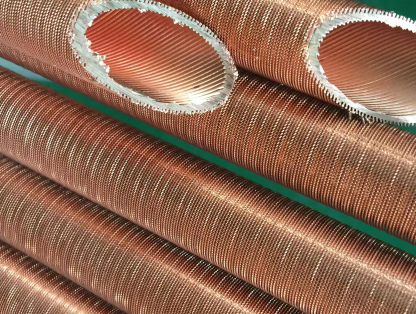
Trufin type tube, also widely known as integral low finned tube, is a high-performance heat transfer component manufactured by cold plastic deformation from seamless or welded base tubes. Unlike conventional wrapped or welded finned tubes, the fins are rolled directly out of the parent tube wall as a single monolithic metal structure, with no bonding interface between fins and tube body. This fin configuration delivers stable thermal conductivity and outstanding mechanical integrity, making it a preferred choice for condensers, evaporators and process heat exchangers across global industries.
Manufacturing & Structure
Trufin tubes are produced by precision rolling tooling that extrudes spiral low fins on the outer tube surface without material removal. The tube base retains its original metallurgical continuity, while plain bare tube ends are reserved for tube sheet expansion or welding during heat exchanger assembly.
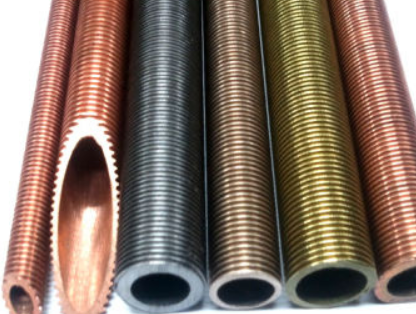
Common Trufin variants include Type S and Type T. Standard S/T Trufin integral low fin tubes have fin densities of 30, 32, 36, 43 FPI (fins per inch). An enhanced version named Turbo-Chil tube is available with additional internal spiral ribs, realizing double-sided heat transfer reinforcement on both inner and outer surfaces.
Material options: Copper alloys, carbon steel, stainless steel, titanium (ASME SB-338 Gr.2) and copper-nickel alloys such as C70600, to match different corrosion and temperature service requirements.
Key Parameters & Specifications
The table below lists typical specification range for Trufin type tube. All figures are typical range; final values shall be confirmed by project specification, engineering review and manufacturer data.
| Parameter Item | Typical Value & Unit |
|---|---|
| Fin Density | 30, 32, 36, 43 FPI (fins per inch) |
| Fin Pitch (center to center) | 0.71 ~ 0.85 mm (typical range) |
| Tube Structure Variant | Type S, Type T, Turbo-Chil |
| Processing Method | Cold rolling plastic forming, no material removal |
Formula or Calculation
Not applicable to this product type. The fin geometry of Trufin type tube is defined by rolling tooling, and heat transfer calculation must be performed by heat exchanger thermal design software according to working conditions.
Core Advantages
- Zero thermal contact resistance: Fins and base tube are one-piece metal. There is no risk of fin loosening, delamination or thermal contact degradation under thermal cycling, vibration or corrosive environments.
- Compact footprint & high heat transfer efficiency: Extended outer surface greatly boosts heat exchange capacity, reducing heat exchanger shell size, weight and material cost.
- Good bendability and processability: The low-profile fin geometry maintains good ductility. Trufin tubes can be bent into coils while keeping fin integrity.
- Reliable corrosion resistance: No crevice gap at fin root to trap corrosive media. Proper material selection supports seawater, brine, light chemical and oil cooling services.
Materials & Applicable Standards
Typical material options: Copper alloys, carbon steel, stainless steel, titanium (ASME SB-338 Gr.2), C70600 copper-nickel alloy. Final material selection depends on medium, temperature and corrosion conditions.
Applicable standards: to be confirmed, subject to project specification and client requirements.
Typical Applications
- Refrigeration & HVAC: shell-and-tube condensers and evaporators
- Petrochemical & refinery: process cooling, oil coolers, phase-change heat transfer
- Power generation: auxiliary heat exchangers, waste heat recovery
- Desalination: seawater condenser with titanium or Cu-Ni Trufin tubes
- Food & pharmaceutical process heating and cooling
Comparison with Other Finned Tubes
| Item | Trufin Integral Low Fin Tube | Wrapped / Welded High Fin Tube |
|---|---|---|
| Fin connection | Monolithic, rolled from tube wall | Mechanical wrap or welding |
| Thermal resistance | Very low | Contact resistance exists |
| Anti-loosening performance | Excellent under thermal fatigue | Risk of fin detachment |
| Fin height | Low | High |
| Best application scenario | Condensation, evaporation, liquid-liquid heat transfer | Gas side heat transfer |
Design & Selection Trade-offs
When selecting Trufin type tube for heat exchanger design, engineers need to balance multiple factors:
- Type S vs Type T selection: Trufin Type S integral low finned tube for condensation with rounded fin tips. Trufin Type T integral low finned tube for boiling, with truncated flat fin tips.
- FPI selection: Higher FPI brings larger heat transfer area, but increases pressure drop and fouling risk. Lower FPI reduces fouling tendency with less heat transfer enhancement.
- Turbo-Chil upgrade option: Turbo-Chil tube adds internal spiral ribs to boost tube-side heat transfer, but will raise tube-side pressure drop and manufacturing cost.
- Material trade-off: Copper alloy offers superior thermal conductivity; stainless steel, titanium or Cu-Ni alloys are selected for harsh corrosive media at higher material cost.
Selection Guidelines
- Confirm heat transfer mechanism: condensation, boiling or liquid convection, to decide Type S or Type T.
- Define working medium, temperature and corrosion environment for material selection.
- Balance heat transfer requirement against allowable pressure drop to select proper FPI.
- Evaluate whether tube-side heat transfer enhancement is required to select standard S/T Trufin or Turbo-Chil tube.
- Check bending requirement: Trufin tube can be coiled, but fin protection must be considered during bending.
Quality Inspection & Testing
Typical quality tests for Trufin type tube (final inspection items subject to order requirements):
- Dimensional inspection: OD, wall thickness, fin height, FPI check
- Visual inspection for surface defects
- Hydrostatic test or air leak test
- PMI material composition verification
- Mechanical test (tensile, hardness) upon request
- Nondestructive testing: UT, ET as specified in project IT
Packing & Shipping Requirements
Typical packing: Bundled with protective wrapping, plastic end caps for tube ends, wooden pallet or wooden case for long-distance sea or land transport. Special packaging for long length or bent coil products. Final packing plan to be confirmed by order.
Frequently Asked Questions
1. What is Trufin type tube?
Trufin type tube, also called integral low finned tube, is cold rolled monolithic finned tube. Fins are extruded directly from the base tube wall without welding or wrapping, with continuous metallurgical metal structure.
2. What is the difference between Type S Trufin and Type T Trufin?
Type S Trufin has rounded convex fin tips optimized for vapor condensation. Type T Trufin has flat truncated fin tips, designed for liquid boiling and convective heat transfer.
3. What does FPI mean for integral low finned tube?
FPI means fins per inch. Standard S/T Trufin integral low finned tube has standard fin densities of 30, 32, 36, 43 FPI.
4. What is Trufin Turbo-Chil tube?
Trufin Turbo-Chil tube is an enhanced variant with external S or T low fins plus integral internal spiral ribs, achieving double-sided heat transfer reinforcement.
5. Is Trufin tube metal continuous between fin and base tube?
Yes. Trufin tube is formed by cold rolling extrusion without material removal. Fins and base tube maintain full metallurgical continuity. Jagged edges on cross-section photos are cutting burrs, not separation of metal.
6. Can Trufin integral low finned tube be bent into coils?
Yes. The low fin profile retains good ductility, and Trufin tube can be coiled while fin integrity can be maintained with proper processing.
Summary
Trufin type tube represents a mature enhanced heat transfer technology. Its integral fin construction balances thermal performance, mechanical strength and long-term reliability. For heat exchanger design where high heat flux, compact layout and low maintenance are required, Trufin tube remains a proven and cost-effective surface enhancement solution.
Need technical data or quotation for Trufin type tube?
Request a Quote