


Convection Studded Tubes for High-Temp Services
What are Convection Studded Tubes?
In many fired heaters and waste heat recovery systems, the real bottleneck sits on the gas side. Flue gases carry plenty of thermal energy, but they move slowly and have poor thermal conductivity. The classic fix—increasing tube surface area—often brings new problems: thin fins erode in dusty streams, collect ash deposits, or simply cant survive sustained temperatures above 500°C. That is where convection studded tubes step in.
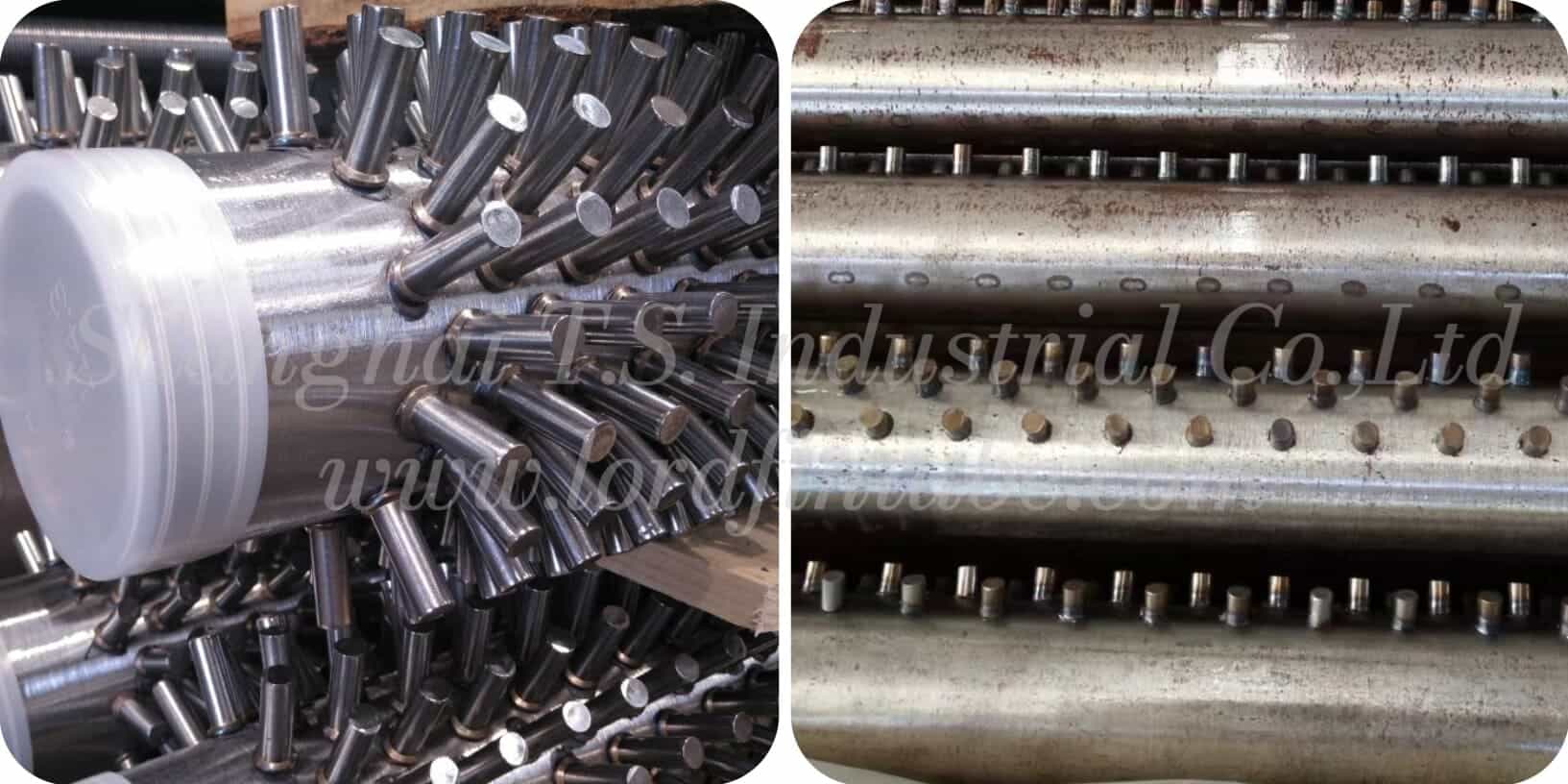
These are essentially pressure-rated steel pipes with rows of short, thick metal pins welded onto the outside. The pins do two jobs at once: they break up the sluggish gas film clinging to the tube wall, and they add extra surface for heat to escape into the tube wall. The result is a heat exchanger component that can outlast most finned alternatives in dirty, hot, or abrasive environments.
What makes them different from a plain pipe?
A bare tube exposed to hot gas quickly develops a stagnant boundary layer—a thin cushion of gas that acts like thermal insulation. The studs destroy that layer by forcing local turbulence. Every time gas flows past a stud, it creates a small wake, mixing cooler incoming gas against the tube surface. That mixing effect alone can roughly double the convection coefficient compared to a smooth tube.
On top of that, the studs add 200–300% more external area (sometimes up to 400% with dense patterns). The combined gain means a studded tube exchanger often delivers over 80% higher overall heat transfer coefficient than a bare‑tube design under identical flow conditions – a figure supported by multiple CFD studies in the literature.
The base pipe is always seamless (welded pipes are not used in high‑integrity applications for this purpose), typically in carbon steel, Cr‑Mo alloys (P5, P9, P11, P22, P91), or austenitic stainless grades like 304/316L. Stud diameters usually fall between 6 and 12.7 mm, with heights from 10 to 35 mm. The layout is staggered—each row offset from the next—which gives better coverage and more uniform turbulence than any straight grid pattern.
Studded vs. spiral‑finned
This is the most common engineering dilemma. spiral finned tubes (helical wound strip) offer much larger area multipliers—up to 9× bare tube—and they are cheaper to produce. So why would anyone choose studded tubes?
The answer lies in the operating envelope. Spiral fins are thin, often only 1–2 mm at the tip. In a clean gas stream at moderate temperatures (say, under 400°C), they work beautifully. But introduce fly ash, catalyst dust, or high‑velocity particles, and those delicate fins erode quickly—sometimes losing 50% of their thickness within a few years. Worse, the narrow gaps between fins trap soot and scale, degrading performance steadily until the exchanger is taken offline for manual cleaning, which often damages the fins further.
Studs, by contrast, are thick (6–12.7 mm diameter) and welded individually. They have no narrow crevices. Soot and ash cannot bridge between studs as easily, and when they do accumulate, the open spacing allows steam lances or mechanical scrapers to clean effectively without breaking anything. In high‑temperature zones (above 500°C and up to 650°C with alloy grades), spiral fins often suffer from oxidation at the weld root or loosening due to differential thermal expansion; studs maintain their bond because each weld is a discrete, strong forge joint.
- Clean gas, moderate temperature
- Maximum surface density in a limited footprint
- Gas carries particulates
- Fouling is inevitable
- Temperature exceeds 450°C
- Avoid frequent shutdowns for cleaning
| Feature | Studded Tube | Spiral Finned Tube |
|---|---|---|
| Area increase | 2–3× bare | 4–9× bare |
| Max. temperature (alloy) | ~650°C | Often ≤400°C |
| Abrasion resistance | Excellent | Poor |
| Fouling resistance | Excellent | Moderate–poor |
| Cleaning ease | Easy (steam/mechanical) | Difficult |
| Best application | Dirty, high‑temp gases | Clean, moderate gases |
Material selection – not just about strength
Choosing the right material pair (tube + stud) is often underappreciated. The tube must withstand internal pressure and the external metal temperature, but the studs face a different environment—they are directly exposed to flame radiation (in some zones) and flue gas corrosives. For general duties up to 450°C, plain carbon steel (ASTM A106 Gr.B) with carbon steel studs is sufficient. Above that, Cr‑Mo alloys (P11, P22) become necessary, and for severe oxidation or sulphuric acid dew‑point corrosion, stainless steels (316L/317L) or even high‑chromium alloys are specified.
A common mistake is using the same material for studs as the tube without considering that studs run hotter because they protrude into the gas stream. Some designers prefer studs made of a slightly more oxidation‑resistant grade (e.g., 410 stainless) even when the tube is low‑alloy steel. The extra cost is marginal compared to the replacement cost of an entire tube bundle.
Where do they actually get used?
You will find studded tubes predominantly in:
Practical advantages that dont always make it into spec sheets
A final word on design and procurement
When specifying studded tubes (only linked once below), do not just copy old datasheets. Define the stud density (pitch and arrangement) based on the actual gas velocity and particle loading—too many studs increase pressure drop unnecessarily; too few reduce heat transfer. Work with a manufacturer that uses automated resistance welding with consistent energy control, because manual welding can cause local hardening or burn‑through. Also, request a sample weld cross‑section for metallographic inspection before full production.
convection studded tubes are not a novelty—they are a mature, battle‑tested solution for the most punishing heat recovery services. Their initial cost is higher than plain fins, but their lifecycle cost, when maintenance, downtime, and replacement are factored in, almost always favours the studded design in challenging conditions.
If your application involves clean, dry gas at moderate temperatures, save money and go with spiral finned tubes. But if you are fighting erosion, fouling, or high heat flux, studded tubes will give you peace of mind—and that is worth more than a few extra percent of area on paper.