

The convection section of coal-fired, biomass and waste heat recovery boilers comprises superheater, reheater and economizer tube banks. High-velocity flue gas carrying fly ash and solid particles continuously scours the windward side of tubes, causing wall thinning, tube leakage and unplanned shutdowns. Erosion failure remains one of the top root causes for boiler pressure part outages. This article analyses the erosion mechanism of convection section pipelines, introduces a full set of protection solutions covering flow field optimization, sacrificial hardware, surface cladding & coating, material upgrading and inspection & maintenance strategy, and provides practical guidance for new boiler design and in-service retrofit.
1. Introduction
The boiler convection pass is the core heat transfer zone where flue gas releases residual heat to pressure tubes. In actual operation, non-uniform flue gas distribution, local high gas speed, high ash concentration and soot blower jet impact lead to severe particle erosion on the leading edge of tube rows. Erosion rate is exponentially proportional to particle velocity, so even minor flow deviation can create localized wear hotspots.
Convection tube erosion does not only increase maintenance cost. Progressive wall thinning may trigger sudden tube rupture, unit trip and safety hazards. Traditional solutions such as periodic tube replacement are costly and only mitigate symptoms rather than root causes. A reliable erosion protection system shall combine flow field correction, passive sacrificial protection, surface hardening and regular condition monitoring.
2. Erosion Mechanism & Typical Vulnerable Zones
2.1 Erosion Mechanism
Fly ash particles entrained in flue gas strike tube outer surfaces at certain impact angles, removing metal material by micro-cutting and plastic deformation. It is a typical solid particle erosion, often coupled with high-temperature corrosion, forming erosion-corrosion synergistic damage. Key influencing factors:
- Flue gas local velocity (dominant factor)
- Ash particle hardness, size and mass concentration
- Particle impact angle
- Tube base material performance and surface oxide integrity
- Soot blower steam jet impact and thermal cycling
2.2 Typical Erosion-Prone Locations
- Windward leading tubes of superheater / reheater / economizer tube banks
- Areas directly in soot blower sweeping lanes
- Flue gas turning zones, vortex regions and duct contraction sections
- Tube bends, penetrations and flow disturbance positions
- Zones with flue gas bypass and local high-speed channeling
3. Integrated Erosion Protection Solutions
3.1 Flow Field Optimization (Fundamental Solution)
Most convection tube erosion originates from uneven flue gas distribution. Flow correction eliminates high-speed channels and reduces particle impingement intensity from the source.
- Install flow equalizing baffles, diffusion screens and ash guiding plates at convection pass inlet; perform cold air velocity test (CAVT) to map velocity distribution and validate retrofit effect.
- Optimize duct geometry to eliminate sharp corners, recirculation zones and flue gas bypass.
- Adjust combustion system to control excess air and reduce fly ash carryover; optimize fuel particle size.
- Revise soot blowing logic: reduce blowing frequency, adjust steam pressure and nozzle distance to avoid direct jet impact on tube surfaces.
3.2 Sacrificial Tube Shields & Ferrules (Most Widely Adopted Passive Protection)
Tube shields are semi-circular, saddle or wrap-around sacrificial metal covers fitted on the flue-gas-facing side of convection tubes. The shield bears fly ash abrasion and soot blower impact, protecting the base pressure tube. When the shield wears to the limit, only the shield needs replacement without cutting the main tube.
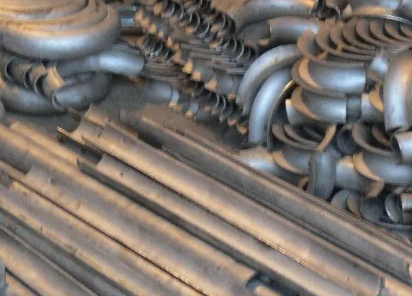
- Material options: AISI 309, 310, 1Cr18Ni9Ti or other high-temperature wear-resistant alloys according to operating temperature.
- Mounting types: Welded, clamped or crimped fixation. Welded shields are preferred for soot blower lanes to prevent loosening under steam impulse and vibration.
- Application: Leading tube rows, soot blower impact zones, bend sections.
- Caution: Proper clearance and drainage design are required to avoid under-shield deposit and galvanic corrosion between shield and substrate tube.
Read more about sacrificial tube shield for boiler heating surface erosion protection.
3.3 Surface Hardening Technology
For high-severity erosion zones where shields are difficult to install, surface hardening improves tube substrate wear resistance.
- Laser Cladding: Deposit high-hardness alloy layer (NiCr, Cr₃C₂ composite) on tube windward surface. Features low dilution, metallurgical bonding, controllable layer thickness and high erosion resistance; widely used for economizer and superheater retrofit during shutdown.
- HVOF Thermal Spray: High-velocity oxy-fuel spraying of cermet coatings for medium-temperature erosion zones. Good for uniform thin-layer protection; attention must be paid to coating porosity and bonding quality.
- Weld Overlay: Manual / automatic hardfacing on localized heavy wear areas, suitable for partial repair of existing tubes.
3.4 Base Material Upgrade
For new boiler design or full-scale tube replacement, substrate material upgrade is available. SA213 T11 / T22 can be adopted for conventional medium-high temperature superheater / reheater zones. TP304H or TP347H is recommended for regions under combined medium-high temperature erosion and corrosion. For extreme temperature and severe sulfidation corrosion service, either solid TP310S tube or alloy overlay cladding tube can be selected.
Note: Austenitic stainless steel mainly improves high-temperature corrosion and oxidation resistance. For pure fly ash particle erosion, material upgrade alone brings limited wear improvement; tube shields or laser cladding are still recommended as supplementary protection.
3.5 Inspection, Monitoring & Predictive Maintenance
Protection hardware performance degrades over time; a complete maintenance system is necessary to avoid unexpected failure.
- Periodic ultrasonic thickness measurement (UT) on vulnerable tubes, record wall thickness trend and map erosion rate.
- PMI inspection for cladding and shield material verification after installation.
- Visual and borescope inspection during boiler shutdown, check shield loosening, coating peeling and under-shield corrosion.
- Establish erosion asset database: mark hotspots, track wear rate and plan replacement window.
- Online flue gas velocity and ash concentration monitoring for early warning of abnormal flow deviation.
4. Material Selection Comparison Table
| Material Grade | Applicable Zone | Key Advantage | Erosion Remarks |
|---|---|---|---|
| SA213 T11 / T22 | Conventional superheater / reheater medium-high temperature area | High temperature creep resistance | Moderate abrasion resistance; not suitable for heavy fly ash scouring without protection |
| TP304H / TP347H | Medium-high temperature erosion + corrosion coupled area | High-temperature sulfidation & oxidation resistance | Better corrosion performance; limited improvement for pure solid particle erosion |
| TP310S | Extreme temperature + severe sulfidation corrosion | Excellent high-temperature oxidation resistance | High cost; no major gain for simple fly ash particle erosion |
5. Solution Selection Principle
Select protection measures by erosion severity, operating temperature, boiler structure and maintenance accessibility:
- Mild erosion: Optimize soot blowing + regular UT monitoring
- Moderate localized erosion: Install tube shields / ferrules (cost-effective first choice)
- Severe erosion, limited space for shields: Laser cladding or HVOF coating
- Wide-spread high-speed flow channeling: Flow equalization baffle retrofit (root-cause solution)
- Extreme erosion-corrosion environment: Alloy cladding tube replacement
Combination schemes are commonly applied in real projects: flow field adjustment + tube shields on leading tubes + laser cladding for residual hotspots.
6. Design & Selection Tradeoffs
When designing boiler convection section erosion protection, engineers must balance capital investment, downtime cost, maintenance accessibility and service life:
- Sacrificial tube shields feature low upfront cost, but periodic replacement work is required during boiler outages.
- Laser cladding has higher initial cost, longer service life, but cannot be applied if tube geometry or site access is restricted.
- Full material upgrade delivers long-term corrosion performance, but the high material cost may not be economical if only local erosion hotspots exist.
- Flow field optimization reduces overall erosion risk, but duct modification may require large-scale boiler outage and structural rework.
7. Quality Inspection & Testing
Typical quality tests for boiler convection tube and anti-erosion components (final test scope subject to project specification):
- Ultrasonic thickness measurement (UT) for remaining wall thickness
- PMI positive material identification for tube, shield and cladding layers
- Visual inspection + borescope inspection
- Hardness test for laser cladding or weld overlay surface
- Non-destructive test for weld joints
8. Packaging & Shipping
Boiler tubes and tube shields are packed in steel frame or wooden case with anti-rust coating, end caps and moisture-proof packing. Marking includes material grade, heat number and project mark. Shipping method can be sea freight or air freight, subject to project schedule and cargo dimension.
9. Formula & Calculation
Not applicable to this product type. Solid particle erosion rate is affected by multiple site-specific parameters including flue gas velocity, ash property and impact angle. Erosion prediction calculation must be completed by boiler thermal engineer according to actual operating parameters.
10. Application Industries
- Coal-fired power plants
- Biomass boiler stations
- Waste heat recovery boilers for chemical and metallurgical plants
- Waste-to-energy boiler systems
- Industrial steam boiler facilities
FAQ
A1: Boiler convection tube erosion is mainly caused by high-speed flue gas carrying fly ash particles. Soot blower jet impact and uneven flue gas flow also accelerate tube wall thinning.
A2: SA213 T11/T22, TP304H/TP347H and TP310S are typical options. Even these grades have limited inherent erosion resistance. Tube shields or laser cladding shall be considered for high ash or high local gas velocity zones.
A3: Integrated solutions include flow field optimization, sacrificial tube shields, laser cladding, material upgrading and regular UT thickness inspection. Tube shields are the most cost-effective option for moderate localized erosion.
A4: Yes. Laser cladding provides metallurgically bonded wear-resistant alloy layer, suitable for severe erosion zones where tube shields cannot be installed.
A5: No. Austenitic stainless steel mainly improves high-temperature corrosion and oxidation resistance. Material upgrade brings limited improvement for pure fly ash particle erosion, supplementary protection such as tube shields is still required.
A6: CAVT maps flue gas velocity distribution inside the boiler convection pass. It identifies high-speed flow channels and verifies the effect of flow equalization baffle retrofits to reduce particle erosion.
Need technical proposal or quotation for boiler convection section erosion protection components?