


Lord Fin Tube-Finned Tube For Furnaces & Heaters
Finned Tube For Furnaces & Heaters – Core Thermal Components
In high-temperature industrial environments, the Finned Tube For Furnaces & Heaters plays a decisive role in heat transfer efficiency and operational reliability. Unlike bare tubes, finned tubes increase the effective surface area without proportionally increasing the overall footprint, which directly translates into better thermal performance and lower energy consumption. This page provides a detailed technical overview of Finned Tube For Furnaces & Heaters, covering material selection, manufacturing standards, application scenarios, and real-world project specifications.
Why this matters to procurement engineers: Selecting the right Finned Tube For Furnaces & Heaters involves balancing thermal conductivity, corrosion resistance, mechanical strength, and cost. The data below is drawn from actual project orders and reflects the diversity of requirements across the petrochemical, refining, and power generation sectors.
What Defines A Finned Tube For Furnaces & Heaters
A Finned Tube For Furnaces & Heaters is a tubular heat exchanger component with extended surface elements — fins — that are metallurgically bonded to the base pipe. The fins increase the heat transfer area per unit length, allowing more heat to be exchanged between the fluid inside the tube and the surrounding environment. Common fin types include solid, serrated, helical, longitudinal, and extruded configurations. The choice of fin geometry directly affects the thermal performance, pressure drop, and fouling characteristics of the heating equipment.
Which type of fin is best for a given furnace depends on the operating temperature, flue gas composition, and required heat flux. For example, Finned Tube For Furnaces & Heaters operating in convection sections of ethylene crackers typically use high-alloy materials such as Incoloy 800H or 304H stainless steel to withstand both high temperatures and corrosive atmospheres.
Which Materials Are Used For Finned Tube For Furnaces & Heaters
Material selection is one of the most critical decisions when specifying a Finned Tube For Furnaces & Heaters. The base tube and the fin material must be compatible in terms of thermal expansion, weldability, and corrosion resistance. Below is a summary of commonly used materials drawn from actual project data.
| Base Tube Material | Grade | Fin Material | Typical Application | Max Service Temp (°C) |
|---|---|---|---|---|
| ASTM SA312 TP316L | TP316L | Aluminium | Lube oil coolers, Plan 52 fin coolers | ~550 |
| 11Cr / ASTM A335 P22 | P22 | 11Cr or Carbon Steel | Reactor field heaters, convection coils | ~580 |
| ASTM A312 TP304H | 304H | AISI 304 / 430 | Furnace convection sections, pyrolysis furnaces | ~800 |
| CS API 5L Grade B | Grade B | Carbon Steel | General industrial finned tubes | ~450 |
| Incoloy 800H / 800HT | 800H / 800HT | SS430 / Incoloy | EDC pyrolysis furnaces, high-temp convection | ~980 |
| ASTM A335 P11 | P11 | — | HTC-I convection coils | ~570 |
How Finned Tube For Furnaces & Heaters Enhance Thermal Efficiency
The fundamental principle behind the Finned Tube For Furnaces & Heaters is the extension of the heat transfer surface. By adding fins, the external surface area can be increased by a factor of 5 to 15 compared to a bare tube of the same diameter. This significantly improves the heat transfer rate on the gas side, where heat transfer coefficients are typically much lower than on the liquid or steam side.
How does fin geometry affect performance? Fin height, thickness, spacing, and shape all influence the thermal performance and pressure drop. For instance, a Finned Tube For Furnaces & Heaters with 6 fins per inch (as seen in some project data) provides a surface area of approximately 2.78 m² per meter of tube length, which is substantially higher than a plain tube. Serrated fins offer even better heat transfer by promoting turbulence and reducing the thermal boundary layer.
Why Finned Tube For Furnaces & Heaters Are Critical In Petrochemical Plants
In petrochemical facilities, furnaces and heaters are the backbone of the production process. The Finned Tube For Furnaces & Heaters is used extensively in convection sections to recover waste heat, preheat feed streams, and generate steam. The reliability of these tubes directly impacts plant uptime, maintenance costs, and safety.
Why are finned tubes preferred over bare tubes in these applications? First, they allow for a more compact furnace design, reducing the overall footprint. Second, they improve the thermal efficiency of the furnace, which lowers fuel consumption and reduces emissions. Third, the extended surface helps to maintain a more uniform temperature profile across the tube bundle, minimizing thermal stress and extending equipment life. Real-world projects from major EPC contractors — including Abb Lummus, Babcock-Hitachi, Selas Fluid Processing, and Heurtey Petrochem — consistently specify Finned Tube For Furnaces & Heaters for critical service.
Finned Tube For Furnaces & Heaters – Technical Specifications From Actual Projects
The following table compiles detailed specifications from multiple project orders. Each row represents a specific Finned Tube For Furnaces & Heaters configuration, with variations in size, material, schedule, finning data, and application. This data is particularly useful for procurement professionals who need to compare options or validate their own specifications against industry practice.
| Size | Material / Grade | Schedule / Wall | Length (mm) | Finning & Application | Manufacturer / Drawing |
|---|---|---|---|---|---|
| 3/4 In | ASTM SA312 TP316L | Sch 80 | 925 | Plan 52 Fin Cooler – Lube Oil; Aluminium fins | Protec / P 02486 Rev 0 |
| 4 In | 11Cr / P22 | Sch 40 | 4492 | Reactor Field Heater (Revamp) – LH 1026A | Babcock-Hitachi / LH1026A-E4 |
| 6 In | 11Cr / P22 | Sch 40 | 4318 | Reactor Field Heater (Revamp) – B/M 3 | Babcock-Hitachi / LH1026A-E4 |
| 6 In | 304H | 7.1 mm | 4318 | Reactor Field Heater – PMI & marking required | Babcock-Hitachi / LH1026A-E4 |
| 2 In | CS API 5L Grade B | Sch 80 | — | 6 fins/in; CS fins; 2.78 m²/m surface area | Con-Rad Corp |
| 6 In | ASTM A335 P22 | Sch 40 (7.11mm) | 8010 | Convection Coil HTC-I; ITP & TPI required | Yansab / 11-Q-1718 |
| 4 In | CS ASTM SA106 Gr B | Sch 40 (6.02mm) | 9838 | Convection Coil FPH; Technip spec; finning material spec in PO | Yansab / 11-Q-1720 |
| OD 168.3 mm | ASTM A335 P11 | — | 13.06 m | HTC-I Convection Coil | KTI Corp / 165sp |
| Dia 2 In | ASTM A335 P22 | 11.07 mm | 9310 | Solid fin 11% Cr; HFW helical; 98.4 fins/m | Tex-Fin / 1861-F53-30 |
| OD 168.3×7.1 | ASTM A312 TP304H | — | 13908 | Furnace convection; Ends BW | Abb Lummus / SE6-6896-BA130 |
| OD 114.3 | ASTM A335 P22 | 8.56 mm | 14136 | Super heated steam; CS fins; 177 fins/m | Abb Lummus / SE6-6896-BA130 |
| OD 4.5 In | Incoloy 800HT | 0.337 In | 14.17 m | Pyrolysis furnace TH-1301C | Heurtey Petrochem / 1301FD-402 |
| OD 114 mm | Incoloy 800H | — | 13.519 m | EDC pyrolysis; SS430 fins; 25mm height | Selas Fluid / LH1046-B1 |
| OD 114.3 | ASTM A312 TP304H | 6.02 mm | 12554 | KOP furnace; AISI 304 fins; 155 fins/m | Abb Lummus / SA6-1400-130 |
| 4 In | Incoloy 800H | Sch 80 | 13316 | EDC pyrolysis convection; 1 In Incoloy fins | Selas Fluid / LH1046-E16 |
| OD 114 | Incoloy 800H | — | 12573 | EDC pyrolysis; SS430 fins; 1/2 In height | Selas Fluid / LH1046-B1 |
| 4 In | Incoloy 800H | Sch 80 | 13316 | EDC pyrolysis convection coil; SS430 fins | Selas Fluid / LH1046-E16 |
| 4 In | Incoloy 800H | Sch 80 | 12573 | EDC pyrolysis convection coil (bared) | Selas Fluid / — |
Finned Tube For Furnaces & Heaters – Project Application Examples
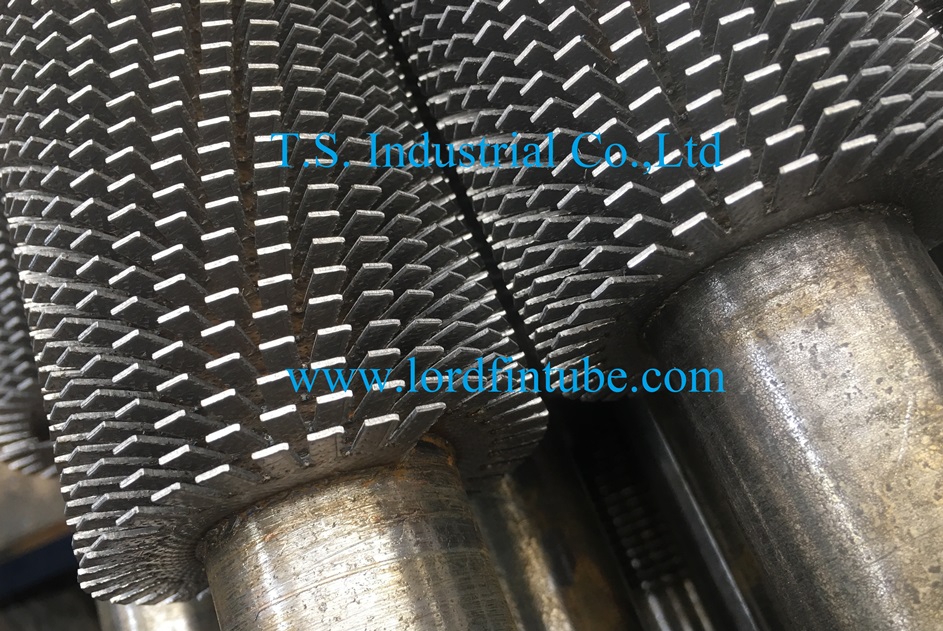
Project: Abb Lummus Convection Coil
A Finned Tube For Furnaces & Heaters supplied to Abb Lummus for a superheated steam application. The tube is made of ASTM A335 Gr P22 ferritic steel, with an OD of 114.3 mm and a total length of 14,136 mm. The finning consists of carbon steel fins measuring 152.5 mm × 1.5 mm thick, with 177 fins per meter. Unfinned lengths of 333 mm and 105 mm are provided at the ends to facilitate welding. This tube is part of a convection coil for the AH-0107/0108 equipment, with inspection and material test certificates required.
Project: Selas Fluid Processing – EDC Pyrolysis Furnace
Multiple Finned Tube For Furnaces & Heaters were supplied for the TH-1301 EDC pyrolysis furnace. These tubes are made of Incoloy 800H, with a nominal size of 4 inches and Schedule 80 wall thickness. The finning material is SS430, with fin heights of 1 inch or 1/2 inch depending on the specific bundle. Each tube is supplied with a material test certificate as required by the project specification.
Project: Babcock-Hitachi – Reactor Field Heater Revamp
For the LH 1026A reactor field heater, a series of Finned Tube For Furnaces & Heaters were manufactured using 11Cr material (Grade P22) with Schedule 40 wall thickness. Sizes ranged from 4 inches to 6 inches, with lengths up to 4,492 mm. The finned tubes were used in the convection section, with specific PMI and marking requirements for Sabic warehouse receiving.
Inspection & Certification Requirements For Finned Tube For Furnaces & Heaters
Quality assurance is paramount when procuring a Finned Tube For Furnaces & Heaters. Based on the project data, the following inspection and certification requirements are commonly specified:
- Hydrostatic testing to verify pressure integrity
- Material test certificates (MTC) in both hard and soft copy
- Positive material identification (PMI) testing
- Third-party inspection (TPI) involvement during manufacturing
- ITP (Inspection and Test Plan) and WPS/PQR submission prior to fabrication
- Mill test certificates for traceability
Which certification is required for a specific Finned Tube For Furnaces & Heaters depends on the end-users specifications and the criticality of the service. For high-temperature and high-pressure applications, full traceability and third-party verification are standard practice.